Artificial Intelligence is becoming part of almost every enterprise conversation.
Organizations want AI to predict failures, optimize energy, improve quality, monitor risks, automate reports, support field teams, and make operations more efficient.
The expectation is high.
AI should help teams move faster.
AI should reduce uncertainty.
AI should identify risks earlier.
AI should recommend better actions.
AI should support operational decisions.
But there is a critical point that often gets missed.
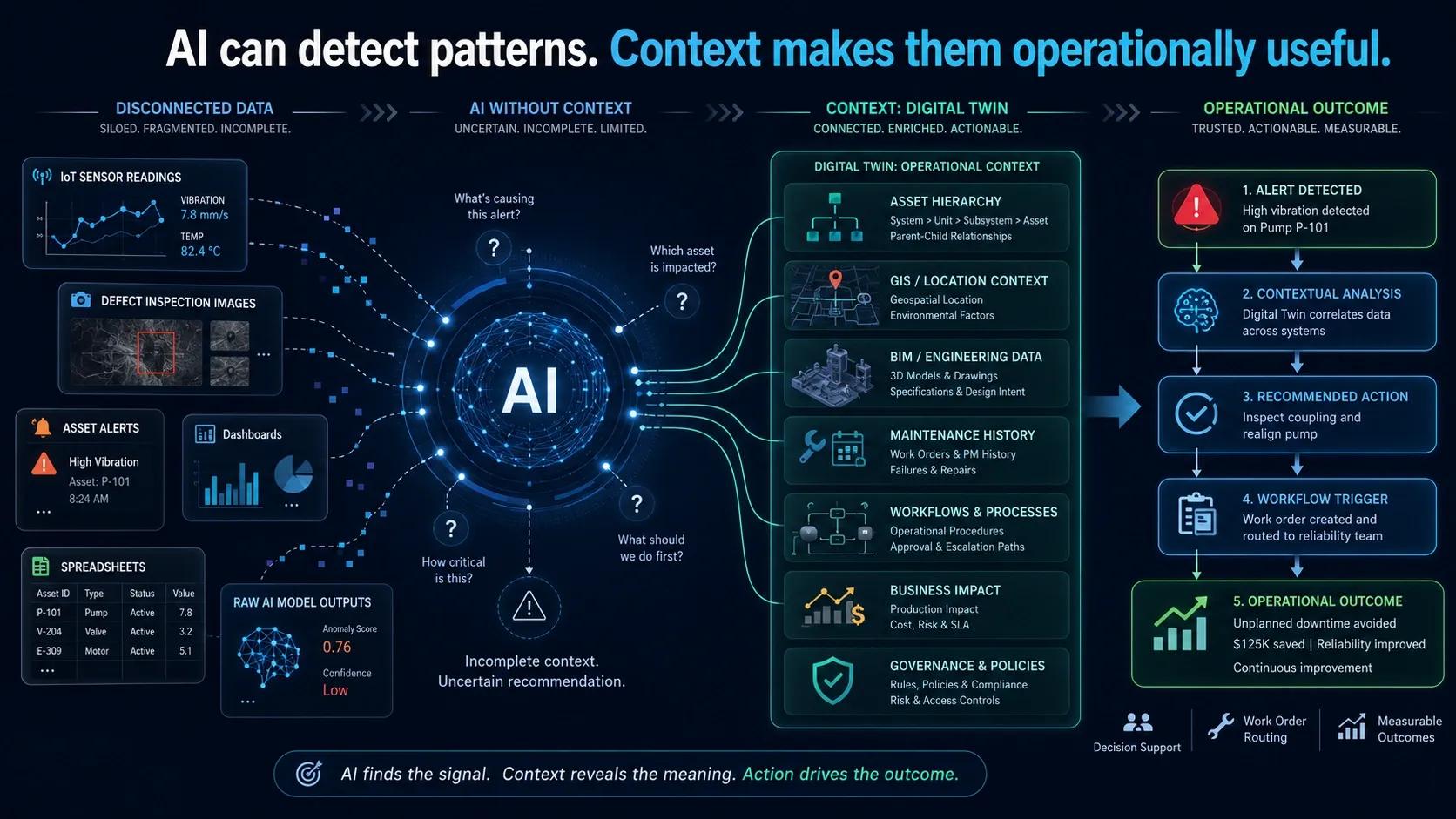
AI cannot support operations effectively without context.
Data alone is not enough.
Algorithms alone are not enough.
Dashboards alone are not enough.
For AI to become useful in real operations, it must understand the environment in which the decision is being made.
That environment includes assets, locations, engineering relationships, workflows, operating conditions, risks, people, business impact, and governance.
Without context, AI may produce outputs.
With context, AI can support decisions.
AI Can Detect Patterns, But Operations Need Meaning
AI is very good at identifying patterns.
It can detect anomalies in sensor data.
It can classify defects in images.
It can summarize maintenance records.
It can forecast energy consumption.
It can identify trends in operational performance.
It can generate alerts and recommendations.
But detecting a pattern is not the same as understanding its meaning.
For example, AI may identify that a motor is showing abnormal vibration.
That is useful.
But the operations team needs to know more.
Which motor is affected?
Where is it located?
How critical is it?
What process does it support?
What happens if it fails?
Has this happened before?
Is there an open work order?
Are spare parts available?
Who should respond?
What is the cost of downtime?
Should action be immediate or scheduled?
The AI output is only the beginning.
The decision depends on context.
Why Context Matters in Operations
Operations are not abstract.
They happen in real environments.
A factory has machines, production lines, energy systems, safety zones, quality processes, and maintenance teams.
A building has rooms, floors, HVAC systems, electrical networks, occupants, comfort requirements, and energy targets.
A utility network has assets, feeders, valves, pipelines, substations, service areas, customers, field crews, and regulatory obligations.
A construction project has drawings, BIM models, schedules, procurement data, site progress, safety observations, change orders, and cost controls.
A city has roads, drains, traffic, public assets, emergency teams, environmental conditions, and citizen impact.
In each case, AI must understand the operating reality.
The same signal can mean different things depending on where it occurs, which asset is involved, how critical the asset is, and what business process it affects.
A temperature rise in one system may be normal.
In another system, it may indicate serious risk.
A delay in one activity may be manageable.
In another activity, it may affect the entire project schedule.
A defect in one road segment may be low priority.
In another location, it may create a safety risk.
Context helps AI understand the difference.
The Risk of Context-Free AI
Without context, AI can become misleading.
It may generate too many alerts.
It may recommend actions that are not practical.
It may miss operational dependencies.
It may ignore location-based risks.
It may overlook engineering constraints.
It may fail to understand business priorities.
It may create outputs that teams do not trust.
This is especially risky in asset-heavy and mission-critical environments.
In industrial plants, a wrong recommendation can affect safety and production.
In utilities, it can affect service reliability.
In buildings, it can affect comfort, energy, and maintenance.
In infrastructure, it can affect public safety and asset performance.
In smart cities, it can affect emergency response and citizen services.
AI should not be treated as a standalone layer placed on top of raw data.
It must be grounded in operational context.
The Five Contexts AI Needs
For AI to support operations, it needs several types of context.
1. Asset Context
AI must know which asset it is analyzing.
This includes asset ID, asset type, hierarchy, age, condition, specifications, ownership, criticality, and maintenance history.
Without asset context, AI may detect a signal but not know what it belongs to or how important it is.
For example, a vibration alert on a non-critical backup pump is different from a vibration alert on a primary production pump.
The data pattern may look similar.
The operational priority is different.
2. Spatial Context
AI must know where the issue is happening.
Location changes meaning.
In infrastructure, utilities, logistics, smart cities, ports, campuses, mining, agriculture, and real estate, spatial context is essential.
AI should understand proximity, accessibility, service areas, routes, terrain, zones, network relationships, and exposure to risk.
For example, a road defect near a school or accident-prone junction may need higher priority than the same defect in a low-traffic area.
A utility fault in a dense service area may require faster response than one in a low-impact zone.
Geospatial intelligence helps AI understand where action matters most.
3. Engineering Context
AI must understand how systems are designed and how they are expected to behave.
Engineering context includes design intent, operating limits, dependencies, capacity, tolerances, safety constraints, process logic, and technical documentation.
Without engineering context, AI recommendations may be technically weak.
For example, AI may suggest optimizing energy use in a building, but the recommendation must respect HVAC design constraints, indoor comfort requirements, control logic, and equipment limitations.
AI should not only be statistically correct.
It should also be operationally and technically valid.
4. Workflow Context
AI must understand what happens after an insight is generated.
Who receives the alert?
Who validates it?
Who approves the action?
Which system creates the work order?
Which team responds?
How is the action tracked?
How is the outcome measured?
Without workflow context, AI creates recommendations that may not lead to action.
This is one reason many AI pilots fail to scale.
They generate insights, but those insights are not embedded into real workflows.
Operations need action, not just analysis.
5. Business Context
AI must understand the business impact of its recommendations.
Not every issue has the same financial, operational, safety, or compliance impact.
Business context includes cost of downtime, service impact, customer impact, safety exposure, compliance risk, productivity loss, energy cost, and ROI potential.
For example, two assets may show similar risk scores.
But if one asset supports a critical production line and the other supports a low-priority process, the business decision will be different.
AI becomes useful when it can help prioritize based on value, risk, and impact.
Context Turns Alerts into Decisions
Many organizations begin AI adoption with alerts.
This is natural.
AI detects an anomaly.
AI predicts a failure.
AI flags a risk.
AI highlights inefficiency.
AI identifies a trend.
But alerts are not enough.
Too many alerts can overwhelm teams.
An alert becomes valuable only when it is connected to context and action.
A better AI-supported workflow should answer:
What happened?
Where did it happen?
Why does it matter?
What is likely to happen next?
What action is recommended?
Who should act?
What is the expected impact?
How will the result be measured?
This is the difference between AI alerts and AI-assisted operations.
Why Digital Twins Help Provide Context
Digital Twins are becoming important because they help organize operational context.
A Digital Twin can connect:
physical assets,
BIM and engineering models,
GIS and spatial layers,
IoT sensor data,
asset registers,
maintenance records,
ERP and cost data,
SCADA and control data,
inspection reports,
workflows,
AI models,
dashboards,
simulation logic.
This connected environment helps AI understand not only the data point, but the asset, location, relationship, process, risk, and action behind the data point.
That is why Digital Twins are often described as operating layers for AI.
They help AI move from isolated prediction to contextual decision support.
Why Geospatial Context Is Especially Important
Many operational decisions are spatial by nature.
Where is the asset?
Which area is affected?
Which route is available?
Which network segment is at risk?
Which customer group will be impacted?
Which site should be prioritized?
Which location has the highest risk exposure?
AI without geospatial context may identify a pattern but miss the practical meaning of location.
For example:
In flood management, AI may predict a high-risk area. But geospatial context is needed to understand terrain, drainage, road access, vulnerable communities, and response routes.
In utilities, AI may identify network risk. But spatial context is needed to understand service areas, nearby assets, field access, and customer impact.
In logistics, AI may optimize movement. But geospatial context is needed to understand distance, traffic, delivery zones, restrictions, and route feasibility.
Geospatial intelligence gives AI a sense of place.
Without that sense of place, operational recommendations may remain incomplete.
Context Improves Trust
Trust is one of the biggest challenges in enterprise AI adoption.
People may not act on AI recommendations if they do not understand them.
A context-rich AI system can explain why a recommendation was made.
Instead of saying:
“Asset risk is high.”
It can show:
The asset is critical.
Its vibration has increased over the last 10 days.
Similar patterns previously led to failure.
There is no recent maintenance record.
The asset supports a high-value process.
Downtime cost is significant.
A work order should be raised within 48 hours.
This explanation builds confidence.
It allows human experts to review, validate, challenge, or approve the recommendation.
In operations, explainability is not a nice-to-have.
It is essential for adoption.
Context Supports Human Oversight
AI should not replace operational responsibility.
It should support it.
Human experts understand exceptions, field realities, organizational constraints, safety concerns, and stakeholder priorities.
AI can process data quickly.
Digital Twins can organize context.
Analytics can predict risk.
But humans must remain responsible for critical decisions.
Context helps humans and AI work together.
It gives decision-makers enough information to understand the recommendation and decide whether to act.
This is the foundation of responsible operational AI.
Context Enables Measurable Value
AI projects should not be measured only by model accuracy.
They should be measured by operational impact.
Did the AI reduce downtime?
Did it improve response time?
Did it reduce energy consumption?
Did it improve asset utilization?
Did it reduce rework?
Did it improve safety?
Did it help teams make faster decisions?
Did it reduce manual coordination?
Did it improve compliance?
Context is what connects AI output to business value.
Without context, AI may produce technical results.
With context, AI can create operational outcomes.
What Enterprises Should Do Before Deploying AI
Before deploying AI into operations, enterprises should ask:
What operational decision are we trying to improve?
Which assets, systems, or locations are involved?
Is the required data available and reliable?
Are asset IDs consistent across systems?
Is spatial context available?
Is engineering information connected?
Is maintenance and operational history accessible?
Are workflows clearly defined?
Who validates AI outputs?
How will recommended actions be tracked?
How will business value be measured?
What governance is needed?
These questions help organizations avoid context-free AI.
They shift the conversation from “Which AI tool should we use?” to “Which operational decision are we ready to support?”
Sector Examples
In manufacturing, AI needs production schedules, machine hierarchy, quality records, energy use, downtime cost, maintenance history, and process dependencies to support operational decisions.
In buildings, AI needs floor plans, occupancy patterns, HVAC systems, comfort requirements, energy baselines, maintenance records, and control logic to optimize performance.
In infrastructure, AI needs asset condition, location, inspection history, usage intensity, safety exposure, maintenance budgets, and service priorities.
In utilities, AI needs network topology, service areas, asset condition, outage history, crew availability, customer impact, and regulatory priorities.
In construction, AI needs BIM models, schedules, procurement data, site progress, safety records, change orders, and field constraints.
In smart cities, AI needs mobility data, drainage networks, public assets, environmental conditions, vulnerable zones, emergency workflows, and citizen impact.
Across all sectors, the principle is the same.
AI needs context before it can support operations.
Closing Thought
AI has enormous potential in enterprise operations.
But potential is not the same as readiness.
AI does not become operationally useful simply because a model is deployed.
It becomes useful when it is connected to assets, locations, engineering logic, workflows, business priorities, and human accountability.
The future of operational AI will not be defined only by better algorithms.
It will be defined by better context.
Because in real operations, intelligence is not just about detecting patterns.
It is about understanding what those patterns mean, what action should follow, and what value that action will create.
That is why AI needs context before it can support operations.