Opening Reflection
What if your sensors didn’t just send data, but understood what they were measuring, why it mattered, and how it connected to everything else?
Context: From Connected Systems to Intelligent Systems
Over the past decade, industries have invested heavily in IoT and Digital Twins. Sensors are everywhere, on infrastructure, in cities, across supply chains. Data is flowing continuously.
Yet, despite this abundance, a critical gap remains.
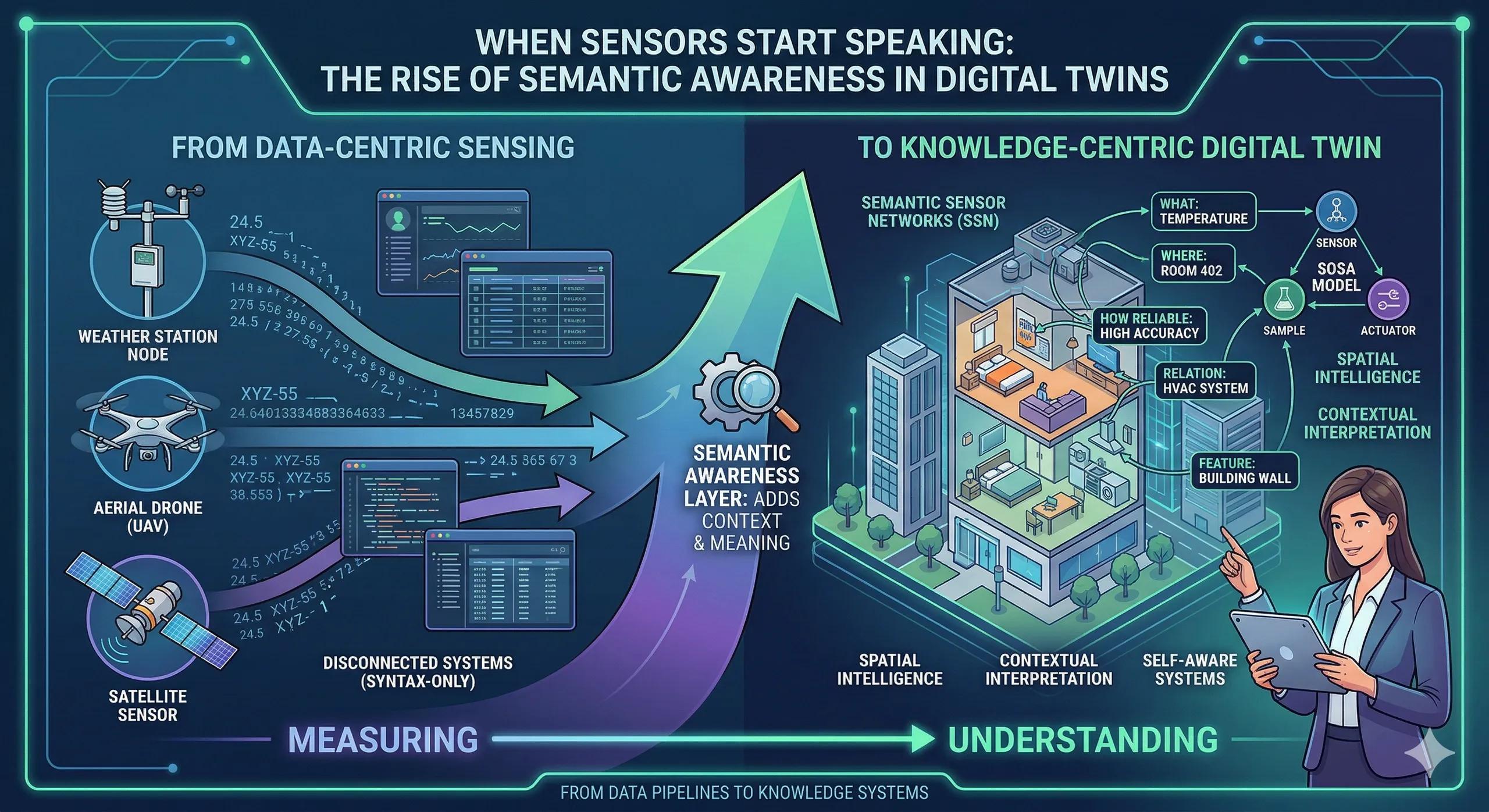
Most systems today are connected , but not intelligent . They transmit data, but they don’t interpret it in context. They operate on syntax, not meaning.
This is where a new layer is emerging, quietly but powerfully, reshaping how digital systems function: Semantic Sensor Networks (SSN) .
The Deeper Question
If systems can measure everything, why do they still struggle to understand anything?
The limitation is not in sensing, it is in meaning.
A temperature reading of “24.5” is just a number unless the system knows:
What is being measured
Where it is measured
How reliable that measurement is
What it relates to in the physical world
Without this, even the most advanced Digital Twin remains reactive, not intelligent.
Spatial Intelligence Perspective: From Data Streams to Knowledge Graphs
Semantic Sensor Networks introduce a shift, from data pipelines to knowledge systems .
At its core, SSN defines:
Phenomenon → What is being observed
Sensor capability → How it is measured
Feature of interest → Where it belongs in the real world
This transforms isolated data streams into a connected understanding of reality.
Why this matters in a geospatial context
Consider a Digital Twin of a smart city:
A UAV captures thermal data
Ground IoT stations record temperature
Satellite imagery provides macro-level heat patterns
Traditionally, these are three separate datasets.
With semantic context, the system understands:
All are measuring temperature
All relate to the same spatial feature
Each has different accuracy, resolution, and constraints
This is not integration. This is interpretation .
The Technical Shift: From Sensors to Meaningful Observations
At the operational level, SSN is built on a lightweight model called SOSA (Sensor, Observation, Sample, Actuator) .
This introduces a structured way to define:
Sensor → The device (e.g., LiDAR, thermal camera)
Observation → The act of measurement
Result → The data generated
Actuator → The system response
This structure allows systems to query data not just by value, but by meaning .
Crossing the BIM–IoT Divide
One of the long-standing challenges in Digital Twin implementations is the disconnect between:
BIM models (structured spatial context)
IoT data (real-time sensor streams)
Semantic frameworks bridge this gap.
For example, a system can now ask:
“Which sensors inside Room 402 are reporting abnormal vibration in the last 10 minutes?”
This is not a database query.
It is a contextual question grounded in space, time, and meaning .
Real-World Implication: The Emergence of Self-Aware Systems
Once meaning is embedded, systems begin to behave differently.
Scenario: Sensor Trust and Decision-Making
A satellite image is obstructed by clouds
A UAV provides clearer data
Ground sensors show local variations
A traditional system would treat all inputs equally or require manual validation.
A semantic system:
Understands sensor limitations
Evaluates context
Prioritizes the most reliable source
This leads to what can be described as a “self-healing Digital Twin” , a system that adapts its understanding without human intervention.
Insight: From Digital Twin to Knowledge-Centric Twin
This shift changes the positioning of Digital Twins entirely.
We move from:
Visualization platforms → showing data to
Knowledge systems → interpreting reality
This has three direct implications:
1. Decision Confidence
When systems understand data lineage and context, decisions become defensible.
2. Interoperability at Scale
Different systems, sensors, and platforms can communicate meaning, not just data.
3. Compliance and Governance
In frameworks like India’s Digital Personal Data Protection (DPDP) ecosystem, semantic models can trace:
Source of data
Sensor calibration
Time and context of capture
This creates audit-ready Digital Twins .
The Deeper Shift: Machines That Understand Context
The real transformation is philosophical.
We are moving from:
Machines that record events to
Systems that understand relationships
This aligns closely with the evolution toward:
Knowledge graphs
Event-driven intelligence
Autonomous decision systems
In this world, spatial intelligence becomes the foundation, not an add-on.
Closing Reflection
The future of Digital Twins is not about more sensors.
It is about smarter interpretation .
Because in the end, the value of a system is not defined by how much it measures—but by how well it understands what it measures.