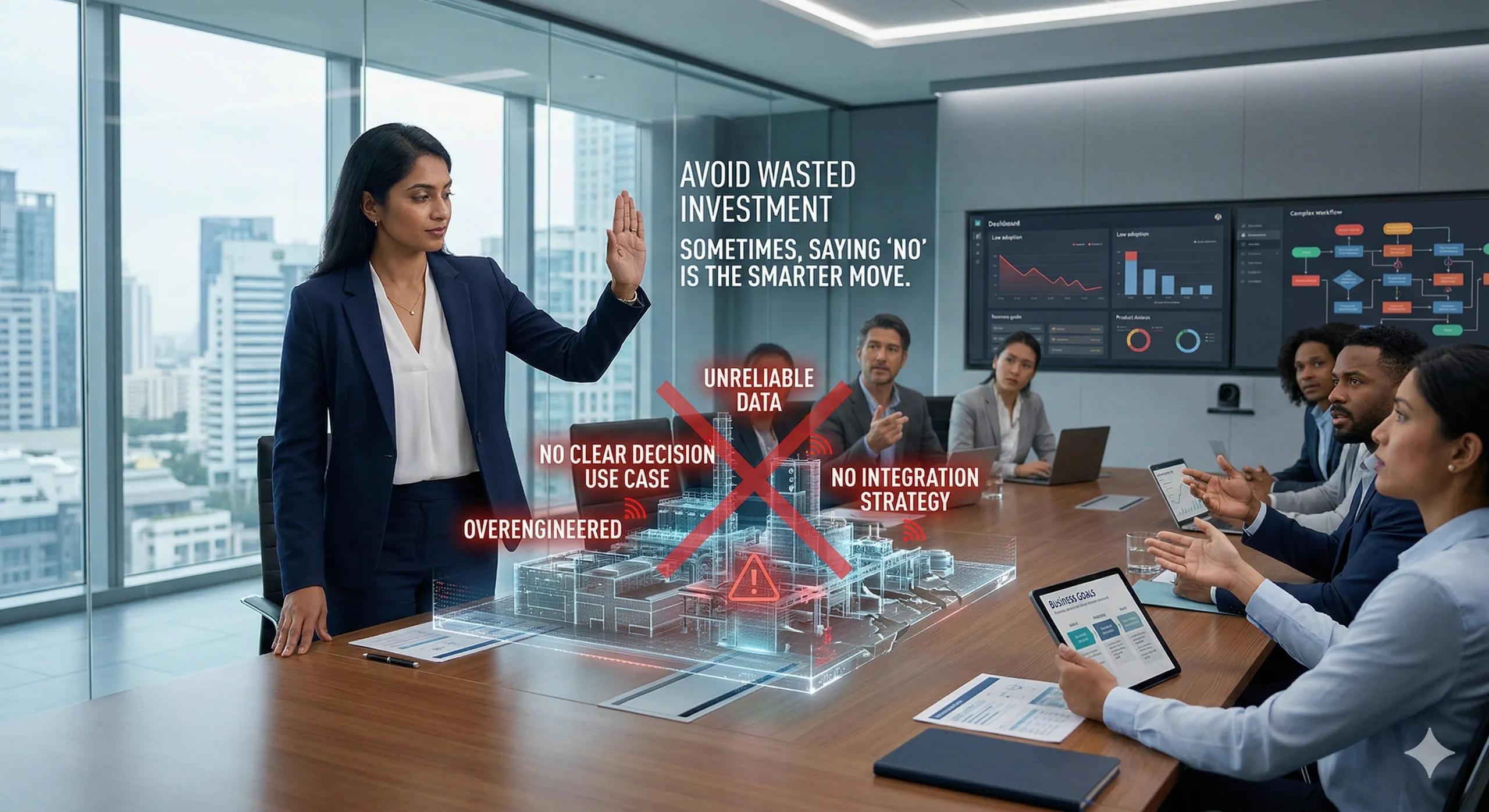
Not every problem needs a Digital Twin.
In many cases, building one is the wrong decision.
Introduction
Digital Twins are often positioned as a universal solution.
But in practice:
👉 forcing a Digital Twin where it’s not needed leads to wasted investment, low adoption, and failed initiatives.
Knowing when NOT to build one is just as important as knowing when to build one.
The Core Issue: Solution Before Problem
Many organizations start with:
👉 “We need a Digital Twin”
Instead of asking:
👉 “What decision are we trying to improve?”
This reversal creates systems:
with no clear purpose
with unclear ROI
that quickly lose relevance
When You Should NOT Build a Digital Twin
1. No Clear Decision Use Case
If you cannot answer:
👉 “What will change because of this system?”
Then a Digital Twin is not justified.
Without a defined decision:
Data has no direction
Insights have no impact
2. Poor or Incomplete Data
If your data is:
inconsistent
outdated
not connected
Then the Digital Twin will:
👉 amplify confusion, not clarity
3. No Integration Strategy
If systems are not designed to work together:
BIM, GIS, IoT remain isolated
Then the result is:
👉 a fragmented model, not a true Digital Twin
4. Low Operational Readiness
If teams:
are not trained
do not trust data
rely on manual processes
Then adoption will fail.
Even the best system:
👉 fails without user trust
5. Expectation of Immediate ROI
Digital Twins require:
phased implementation
gradual maturity
If the expectation is:
👉 instant results
The initiative will likely be abandoned early
6. Overengineering from Day One
Trying to build:
full-scale models
real-time everywhere
all integrations at once
👉 leads to high cost and complexity
Practical Example
Scenario: Facility Management
Wrong Approach:
Build a full Digital Twin
Integrate all systems
No defined use case
👉 Result: Low usage, unclear value
Right Approach:
Start with energy optimization
Integrate relevant systems only
Expand based on results
👉 Result: Measurable ROI and adoption
The Better Approach
Before building a Digital Twin, ensure:
A clear decision problem exists
Data is reliable and accessible
Systems can be integrated
Teams are ready to use it
Outcomes are measurable
Ask Yourself
Do we actually need a Digital Twin or do we need better decisions using existing systems?
Indian Context
In India, many organizations:
invest in technology for visibility
but struggle with operational adoption
A focused approach:
avoids unnecessary investment
delivers faster value
Benefits of Saying “No” at the Right Time
Avoids wasted investment
Builds stronger foundations
Improves future success rate
Aligns technology with business goals
Conclusion
A Digital Twin is powerful but only when it is necessary, justified, and well-structured .
Sometimes, the smartest move is not to build one.