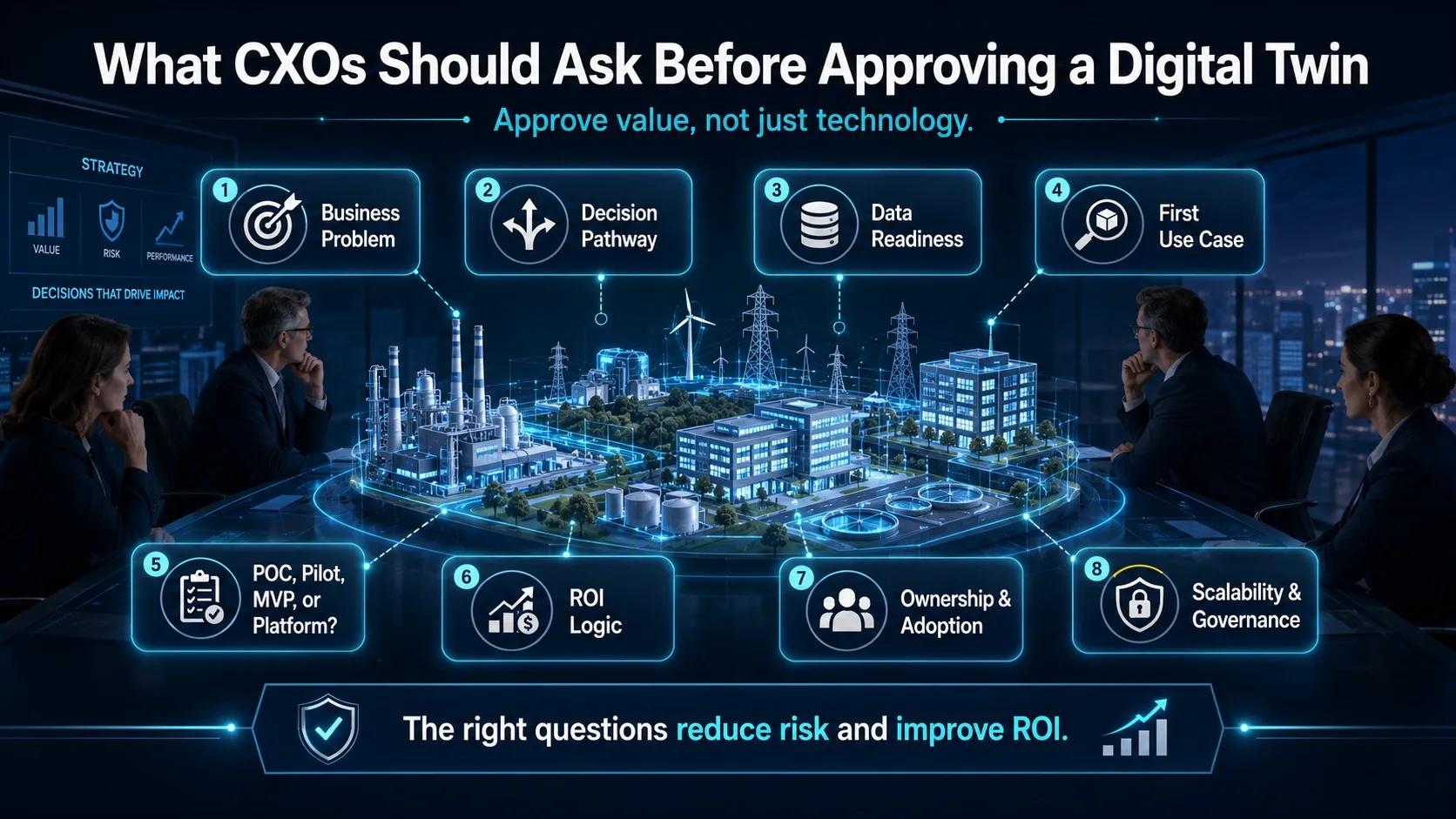
Digital Twins are gaining attention across infrastructure, manufacturing, utilities, ports, campuses, smart cities, and asset-heavy industries.
The promise is attractive.
Real-time visibility.
Better asset intelligence.
Predictive maintenance.
Improved planning.
Lower downtime.
Energy optimization.
Operational efficiency.
AI-ready decision-making.
But for CXOs, the question is not whether Digital Twin technology is interesting.
The real question is:
Should we approve this investment now and are we ready to extract value from it?
This is where leadership judgment becomes critical.
A Digital Twin should not be approved only because the demo looks impressive, the technology is trending, or competitors are exploring it. It should be approved because there is a clear business problem, reliable data foundation, measurable value pathway, and operational ownership model.
Before approving a Digital Twin, CXOs should ask the right questions.
1. What Business Problem Are We Solving?
The first question should not be:
Which platform are we buying?
It should be:
Which business problem are we solving?
This may sound simple, but many Digital Twin initiatives begin with broad ambition and unclear outcomes.
Statements like “we want a Digital Twin for our factory,” “we want a smart building platform,” or “we want a city Digital Twin” are not enough.
CXOs should ask:
What specific operational issue are we addressing?
Is this problem linked to cost, risk, downtime, safety, compliance, sustainability, or customer service?
How serious is the problem today?
What happens if we do nothing?
Who is affected by this problem?
How will the Digital Twin improve the situation?
A Digital Twin must be connected to business pain.
Without that connection, it can become a technology showcase rather than a value-generating system.
2. Which Decision Will This Digital Twin Improve?
A Digital Twin should ultimately improve decisions.
That decision may be related to asset maintenance, energy use, production quality, safety response, inspection planning, road repair prioritization, equipment utilization, cargo movement, or emergency response.
CXOs should ask:
What decision is currently slow, manual, reactive, or unreliable?
Who makes this decision today?
What data do they use?
What information is missing?
How will the Digital Twin change the decision process?
What action will follow from the insight?
This is important because visibility alone is not enough.
A dashboard may show what is happening.
A Digital Twin should help teams decide what to do next.
If the decision pathway is unclear, the Digital Twin may remain underused even if the technology works.
3. Do We Have the Right Data Foundation?
No Digital Twin can perform better than the data behind it.
CXOs do not need to review every dataset in detail, but they should understand the current data maturity.
They should ask:
Do we have a reliable asset register?
Are assets uniquely identified?
Are BIM models, GIS layers, drawings, or engineering records updated?
Is operational data available?
Are sensor feeds reliable and accessible?
Is historical maintenance or performance data usable?
Are data sources connected or scattered?
Who owns the data?
Do teams trust the data?
The issue is not always lack of data.
Many organizations already have large volumes of data. The problem is that it may be fragmented, outdated, inaccessible, or not structured for decision-making.
A CXO should be cautious if the Digital Twin proposal assumes that all data will automatically become useful once a platform is implemented.
Data readiness must be part of the approval discussion.
4. Is the First Use Case Focused Enough?
Many Digital Twin projects struggle because the first scope is too large.
CXOs may be presented with ambitious plans covering entire plants, campuses, cities, networks, or enterprise-wide operations.
Ambition is useful, but the first implementation must be focused.
CXOs should ask:
What is the first use case?
Why has this use case been selected?
Is it valuable enough to matter?
Is it focused enough to implement?
Is data available for this use case?
Are users identified?
Can we measure value within a controlled scope?
Can this use case scale later?
The first use case should not be selected because it looks impressive.
It should be selected because it is valuable, feasible, measurable, and scalable.
A focused pilot can create more confidence than a broad implementation with unclear outcomes.
5. Is This a POC, Pilot, MVP, or Full Platform?
CXOs should be clear about what they are approving.
A POC, pilot, MVP, and full platform are not the same.
A POC proves technical possibility.
A pilot proves operational value.
An MVP proves usability.
A platform enables scale.
If the proposal is called a “POC” but expects ROI, the expectations may be mismatched.
If the proposal is called a “platform” but readiness is weak, the investment may become risky.
CXOs should ask:
Are we approving a POC, pilot, MVP, or platform?
What is the purpose of this stage?
What will success look like?
What will not be included?
What decision will we make after this stage?
What is the next investment gate?
This creates clarity.
It prevents early-stage experiments from being judged like mature platforms and prevents large platforms from being approved without readiness.
6. What Is the ROI Pathway?
Digital Twins should be linked to measurable value.
That value may come from:
reduced downtime,
lower maintenance cost,
faster inspections,
improved asset utilization,
reduced energy consumption,
better safety response,
lower rework,
improved compliance,
reduced site visits,
better planning,
faster reporting,
improved service reliability.
CXOs should ask:
What value are we expecting?
How will it be measured?
What is the current baseline?
What improvement target is realistic?
How long will it take to see measurable impact?
Who will track benefits?
What assumptions are being made?
What happens if the benefits are not achieved?
ROI does not need to be perfect on day one.
But the value pathway must be visible.
If ROI is not defined early, the Digital Twin may be appreciated as innovation but questioned as investment.
7. What Are the Real Costs Beyond the Platform?
A Digital Twin is not only a software cost.
The total cost may include:
discovery and assessment,
data preparation,
BIM, GIS, or model development,
sensors and edge devices,
cloud infrastructure,
platform license,
custom development,
system integration,
dashboards,
AI and analytics,
cybersecurity,
training,
support,
data updates,
maintenance,
governance,
scale-up.
CXOs should ask:
What is the upfront cost?
What is the recurring cost?
What is CapEx?
What is OpEx?
What costs are included?
What costs may appear later?
What will scaling cost?
What internal effort is required?
What happens after the pilot?
A low initial cost can be misleading if integration, data preparation, support, or recurring costs are not included.
The budget should reflect the full journey, not only the first demo.
8. Who Will Own the Digital Twin After Deployment?
Ownership is one of the biggest success factors.
A Digital Twin is a living system. It requires updates, governance, user adoption, and continuous improvement.
CXOs should ask:
Who is the business owner?
Who is the technical owner?
Who owns the data?
Who owns the workflows?
Who validates insights?
Who responds to alerts?
Who updates asset information?
Who measures ROI?
Who decides future enhancements?
If ownership is unclear, the Digital Twin may lose relevance after deployment.
Technology can be implemented by a vendor or project team, but value must be owned by the organization.
9. Are Users Ready to Adopt It?
A Digital Twin can only create value if people use it.
CXOs should ask:
Who are the primary users?
What problem will it solve for them?
Will it reduce their workload or add another system?
Are current workflows being changed?
Is training planned?
Are SOPs being updated?
Is feedback being collected?
Are users involved before deployment?
User adoption is not automatic.
If the Digital Twin is not aligned with daily workflows, teams may continue using spreadsheets, phone calls, manual reports, or legacy systems.
A Digital Twin should make work easier, clearer, faster, or more reliable.
10. What Systems Must Be Integrated?
A Digital Twin becomes valuable when it connects systems.
These may include BIM, GIS, IoT, ERP, CMMS, SCADA, energy management, document management, mobile applications, analytics platforms, and other operational systems.
CXOs should ask:
Which systems need to be connected?
Are APIs available?
Is integration technically feasible?
Are there cybersecurity concerns?
Is data exchange real-time or periodic?
Is there a common asset ID structure?
Are integrations reusable for scale?
What happens if one system changes?
Without integration, the Digital Twin can become another isolated platform.
Integration is where operational value begins.
11. What Governance and Security Controls Are Required?
Digital Twins may connect sensitive asset, operational, spatial, engineering, and business data.
CXOs should ask:
Who can access what?
How is data protected?
What cybersecurity controls are required?
How are changes approved?
How is data lineage maintained?
How are model versions controlled?
How are compliance requirements handled?
What are the risks of wrong or outdated data?
What is the escalation process for critical alerts?
Governance is not bureaucracy.
It is what makes the Digital Twin trusted.
Without governance, different teams may continue working with different versions of truth.
12. Can This Scale Beyond the First Phase?
A pilot should be focused, but it should not be a dead end.
CXOs should ask:
Can the architecture scale?
Can the data model support more assets?
Can dashboards be reused?
Can integrations be extended?
Can the operating model support more users?
Can governance scale?
Can the solution expand to other sites, zones, or processes?
What is the roadmap after the first phase?
A Digital Twin pilot should be designed as a learning system.
It should prove value and create a foundation for scale.
If the first phase cannot scale, it may become another isolated innovation project.
The CXO Approval Checklist
Before approving a Digital Twin, leadership should be able to answer:
What business problem are we solving?
Which decision will this improve?
Is the data foundation ready?
Why is this the right first use case?
Are we approving a POC, pilot, MVP, or full platform?
What is the ROI pathway?
What are the real CapEx and OpEx implications?
Who will own the twin after deployment?
Are users ready to adopt it?
Which systems must be integrated?
What governance and security controls are needed?
Can this scale beyond the first phase?
If these questions cannot be answered clearly, the organization may not be ready for full approval.
It may first need a readiness assessment, use case workshop, data audit, or focused pilot definition.
Closing Thought
CXOs do not need to become Digital Twin technologists.
But they do need to ask better questions before approving Digital Twin investments.
The right questions protect the organization from expensive demos, disconnected platforms, unclear ownership, weak adoption, and poor ROI.
A Digital Twin should not be approved because it looks advanced.
It should be approved because it has a clear business purpose, trusted data foundation, defined ownership, measurable value pathway, and practical route to scale.
The best Digital Twin projects are not those that start with the most impressive technology.
They are the ones that start with the right leadership questions.