What if you could test a major infrastructure decision before spending a single rupee on the ground?
Not in a simulation lab. Not in a theoretical model.
But in a system that mirrors your real-world asset, continuously, accurately, and in real time.
That is the promise of a Digital Twin.
But in practice, most organizations are still unclear about what it truly means.
Introduction
The term “Digital Twin” is everywhere, across construction, smart cities, manufacturing, and infrastructure. Yet, in many cases, it is misunderstood, overhyped, or reduced to just a 3D model.
In reality, a Digital Twin is not about visualization.
It is about decision-making powered by continuously updated data .
Understanding this difference is where real value begins.
The Core Problem: Misinterpreting Digital Twins
Most organizations fall into one of these traps:
Treating Digital Twins as advanced 3D models
Assuming it is just BIM taken to the next level
Believing it is only about visual dashboards
Starting implementation without data readiness
The result?
High investment
Low adoption
Minimal ROI
The issue is not the technology, it is the understanding of what the system is supposed to do .
What a Digital Twin Actually Is
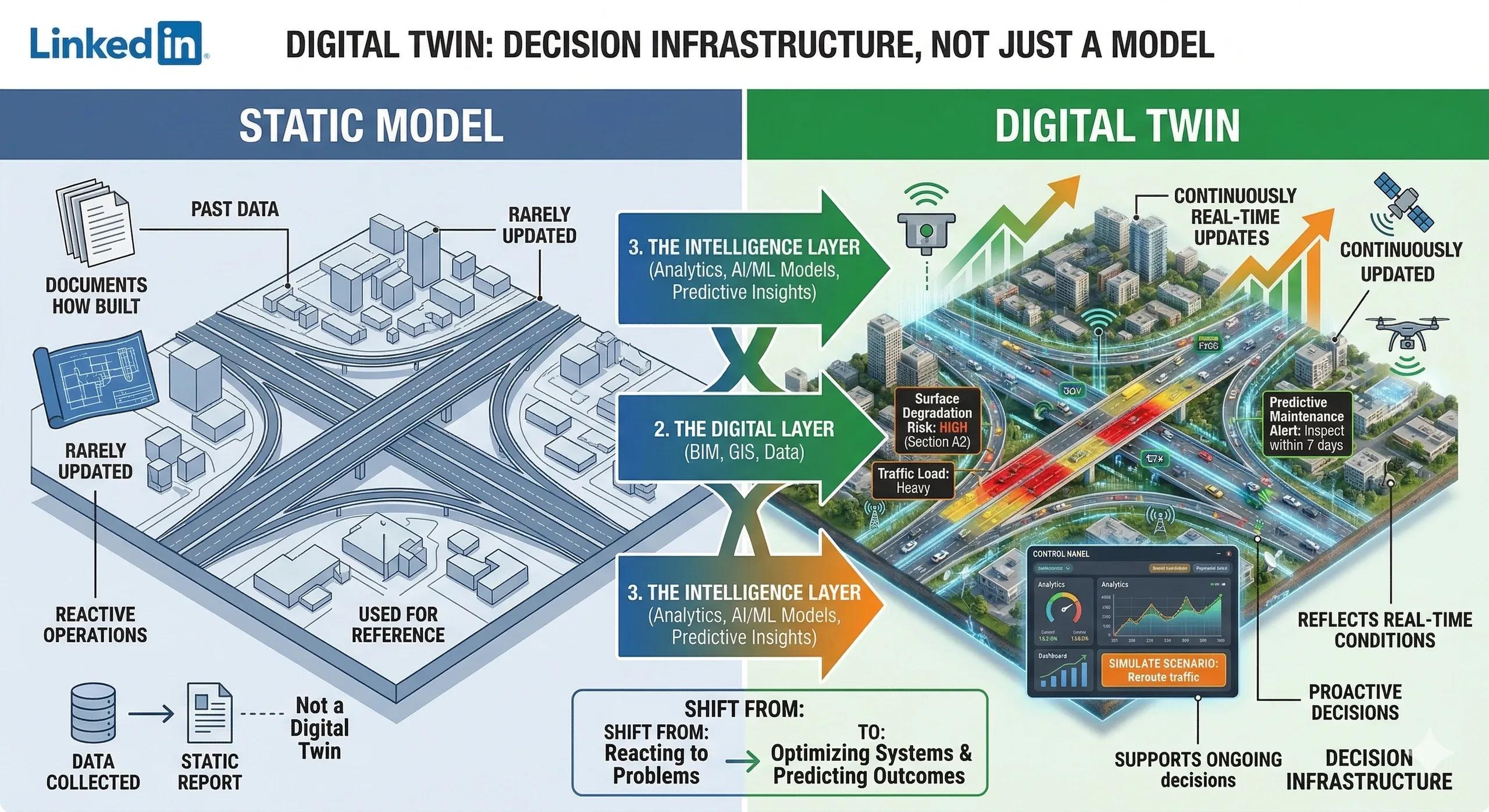
A Digital Twin is a living digital system that reflects the current state of a physical asset and enables decision-making.
At its core, it connects three layers:
1. The Physical Layer
Assets: roads, buildings, machines, pipelines
Sensors: IoT devices, UAV surveys, LiDAR scans
Real-world events: usage, wear, environmental changes
2. The Digital Layer
BIM models (design and structure)
GIS data (location and context)
Historical and real-time datasets
3. The Intelligence Layer
Analytics and rules
AI/ML models
Predictive and prescriptive insights
👉 The value emerges when these layers are continuously connected , not isolated.
Static Models vs Living Systems
This is the most critical distinction.
Static Model
Created once (design or survey stage)
Rarely updated
Used for reference
Digital Twin
Continuously updated
Reflects real-time conditions
Supports ongoing decisions
Example:
A highway BIM model shows how the road was built.
A Digital Twin shows:
Current traffic load
Surface degradation
Risk zones for maintenance
One is documentation .
The other is decision infrastructure .
How It Works in Practice
Let’s take a simple infrastructure example:
Scenario: Urban Road Network
A Digital Twin system integrates:
Traffic sensors → vehicle count and speed
Satellite/UAV data → road condition
Weather data → impact on road wear
GIS layers → surrounding land use
Now, instead of reacting to problems:
The system predicts congestion hotspots
Flags maintenance needs before failure
Suggests alternate traffic routing
👉 The shift is from reactive operations to proactive decision-making
Where Most Projects Go Wrong
Even well-funded initiatives fail because:
1. No Clear Use Case
Starting with technology instead of a problem.
2. Data Silos
BIM, GIS, and IoT systems exist but don’t talk to each other.
3. Lack of Real-Time Integration
Data is collected but not used dynamically.
4. Ignoring End Users
If engineers, operators, or managers don’t use it daily, it fails.
A Better Way to Think About Digital Twins
Instead of asking:
❌ “Do we need a Digital Twin?”
Ask:
✅ “Where are we making decisions with incomplete or delayed data?”
That’s where a Digital Twin delivers value.
Ask Yourself
Are you comfortable continuing operations with incomplete or delayed data, (or) is it time to move toward real-time, decision-driven systems?
Real-World Direction
In India, sectors like:
Highways (NHAI projects)
Smart Cities
Urban utilities
are already generating massive amounts of data.
The opportunity is not in collecting more data but in connecting and using it effectively .
Organizations that move early will:
Reduce lifecycle costs
Improve asset performance
Make faster, data-backed decisions
Benefits & ROI
A well-implemented Digital Twin can:
Reduce maintenance costs through predictive insights
Improve asset lifespan with proactive interventions
Enhance operational efficiency
Enable scenario simulation before execution
Support better planning and investment decisions
Conclusion
A Digital Twin is not a model.
It is not a dashboard.
It is not a one-time project.
It is a decision system .
The organizations that understand this early will move from:
Managing assets → to optimizing systems
Reacting to problems → to predicting outcomes
And that shift is where the real ROI lies.