This summary distills last week’s global tech developments across geospatial, BIM/digital twins, XR, AI at the edge, and smartphones. It focuses on what changed, why it matters, and the immediate actions leaders can take to stay ahead, without the hype.
1) Breakthroughs in Geospatial, BIM → Digital Twins, and XR
Geospatial: Vendors highlighted end-to-end drone-to-cloud workflows that automate upload, generate dense point clouds, and run AI feature extraction and anomaly detection. Practical impact: faster surveys, fewer site revisits, and collaborative sharing of high-fidelity models in near-real time.
BIM → Digital Twins: Costs are dropping and edge devices are getting smarter. Static BIM is turning into “always-on” twins for live monitoring, predictive maintenance, and ESG tracking. Buildings move from one-time “snapshots” to “living assets” with continuous updates and automated O&M checks. Expect lower operating costs, better uptime, and audit-ready data trails.
XR (AR/MR/VR): Lightweight AR/MR glasses and enterprise-ready headsets dominated headlines. Use cases are shifting from demos to operations: safety training, remote diagnostics, and high-fidelity simulations in defense and aerospace. The market is recalibrating in 2025, with a steeper adoption curve expected from 2026 onward.
“If you had to pick one pilot this quarter, XR training, geospatial automation, or a building twin, what would create visible value in 90 days?”
2) Big Tech Moves That Matter
Meta: Expanded AI/XR hiring to accelerate agentic experiences and generative content for future AR/VR devices. Signal: aggressive investment in spatial computing.
Google: Launched the Pixel 10 lineup, including a second-gen foldable and a new Pixel Watch, ecosystem play ahead of the holidays.
Xiaomi: Led smartphone shipments in Southeast Asia, ranked #2 in Europe, and pushed 81k EV deliveries in Q2 while chasing profitability. Diversification beyond phones is real.
Samsung: Teased next-gen XR hardware with Google and Qualcomm. Expect renewed platform competition in 2026.
3) Emerging Trends: Trajectory, Not Just Headlines
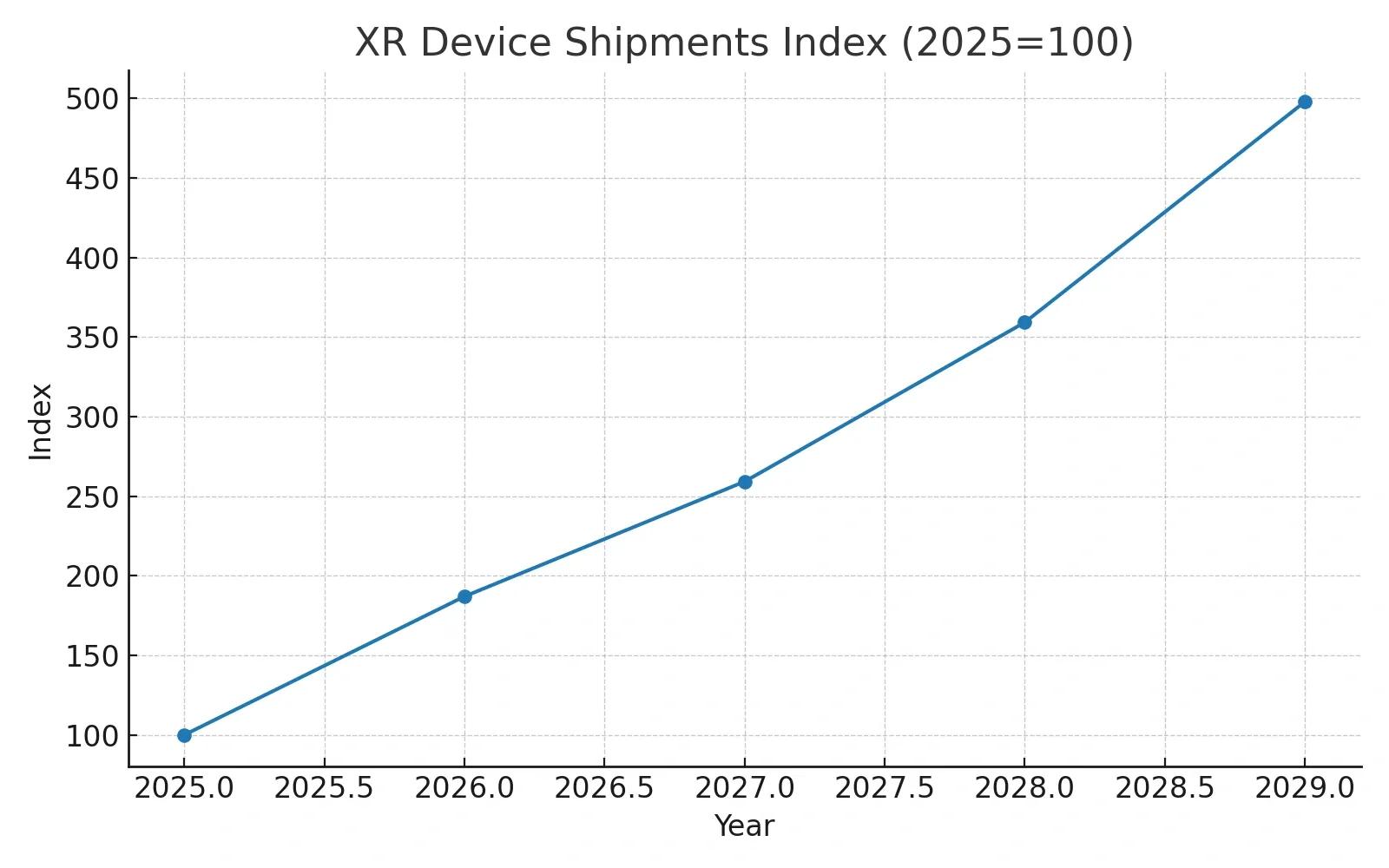
XR Shipments: 2026 could see ~87% growth, with ~38.6% CAGR through 2029. This is the strongest forward signal that enterprise XR will scale from pilots to programs. (See chart below.)
Real-time Edge + AI: On-device analytics reduce latency and bandwidth while enabling immediate responses to operational events, think computer vision at the perimeter, vibration-based asset health, and agentic process orchestration.
Foldables: Still <2% of shipments, but steady improvements in durability and satellite connectivity keep premium users engaged.
BIM → Digital Twins: Autonomous updates, predictive ops, and policy/ESG alignment are making twins a default for large assets.
4) Use Case Snapshot
Scenario: Utility + Campus Operations: A state utility deploys XR for lock-out/tag-out training and field procedures; the campus facility team runs a building twin that ingests BMS, occupancy, and energy data for predictive O&M and ESG reporting; the geospatial team publishes drone-derived models to the cloud for progress tracking and claims. In 12 weeks, they see fewer safety incidents, lower time-to-competency, and reduced unplanned downtime.
5) Benefits & ROI (What Leaders Can Expect)
Productivity: Faster field capture, automated processing, and fewer repeat site visits.
Safety & Quality: XR-based training reduces error rates; twins detect anomalies early.
Cost: Lower rework, optimized maintenance windows, and better asset life-cycle planning.
Compliance: Continuous evidence for ESG and safety audits.
Scalability: Open standards (e.g., OpenXR) and cloud-native pipelines reduce lock-in.
6) Risks to Watch
Technology Fragmentation: Rapid shifts in XR devices and twin platforms can create integration debt; standardize early.
Privacy & Security: Spatial data in public/sensitive spaces raises compliance stakes; apply least-privilege and data minimization.
Market Timing: Over-committing to unproven stacks can dilute ROI; stage investments via targeted pilots.
Conclusion
Last week’s developments point to a practical convergence: geospatial automation for speed, twins for operational intelligence, and XR for safer, faster human performance. The near-term advantage goes to teams that pilot now, standardize on open platforms, and build measurable capability ahead of the expected 2026 inflection.