Most construction delays are explained after they happen.
By then, the reasons sound familiar:
Weather
Late drawings
Material delays
Trade conflicts
What’s missing is not explanation, it’s foresight .
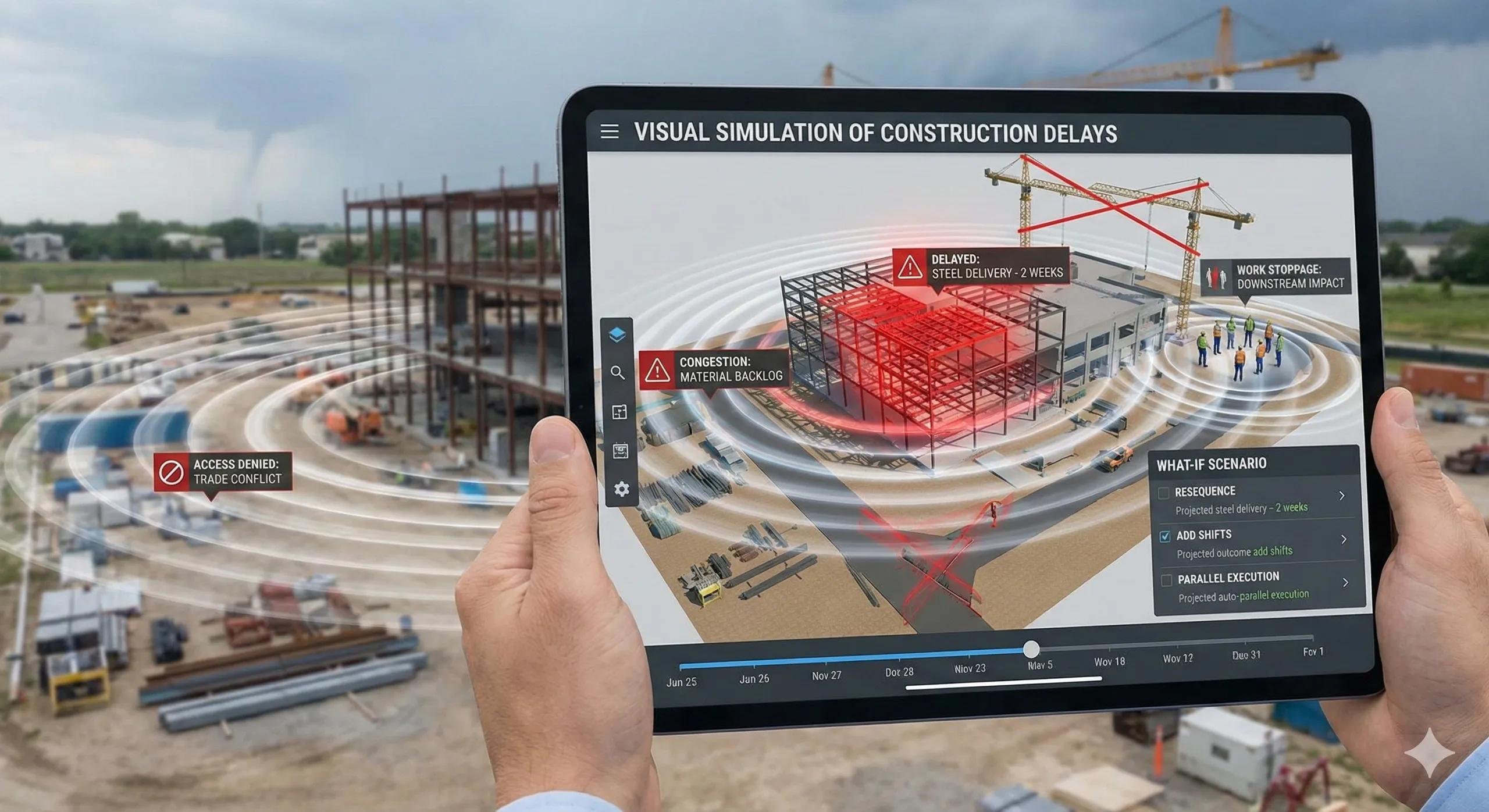
Visual simulation of delays uses 4D BIM to show how , where , and when delays propagate through space and time, before they hit the site.
1. Why Delays Are Hard to Understand in Gantt Charts
Traditional schedules show:
Dates shifting
Activities extending
Critical paths moving
What they don’t show:
Which work fronts are blocked
Which trades are forced to stack
Where access collapses
How one delay triggers another spatially
Time without space hides consequences.
2. What Visual Delay Simulation Actually Does
Visual simulation overlays:
Construction sequence (4D)
Site access and logistics
Temporary works
Resource movement
When a delay is introduced, teams can see :
Idle zones forming
Congestion increasing
Unsafe overlaps emerging
Downstream activities losing space
This turns delay analysis from narrative into evidence.
3. Primary Types of Delays That Benefit from Simulation
Visual simulation is especially powerful for:
Delayed handover of floors or zones
Late material delivery affecting access
Weather-induced stoppages
Equipment unavailability
Redesign or rework loops
Not all delays are equal. Some break flow more than others.
4. Delay Propagation Is a Spatial Problem
A one-week delay rarely stays one week.
It spreads through:
Shared access routes
Crane and lift schedules
Laydown areas
Trade sequencing
4D simulation reveals where delays amplify, and where they can be absorbed.
5. Using Simulation to Test “What If” Scenarios
Before committing to recovery plans, teams can test:
Resequencing options
Parallel execution risks
Additional crews or shifts
Temporary access changes
Simulation allows comparison, not guesswork.
6. Visualizing Delay Impact on Safety and Logistics
Delays often force:
Trade stacking
Overtime congestion
Improvised access paths
Simulation helps identify when recovery plans increase risk , even if they save time.
7. India Context: Why Visual Delay Analysis Matters
In Indian projects:
Schedules are aggressive
Space is limited
Parallel work is common
Monsoon disruptions are frequent
Visual delay simulation:
Improves coordination discussions
Reduces blame-based planning
Helps site teams understand consequences quickly
8. From Claim Support to Prevention
Delay simulations are often used only for:
Claims
Disputes
Post-mortems
Their real value is prevention :
Identifying fragile sequences
Strengthening buffers
Designing realistic recovery paths
9. Common Mistakes to Avoid
Simulation fails when:
Models are not construction-ready
Schedules are unrealistic
Updates are not maintained
Outputs are treated as presentations
Accuracy matters more than animation quality.
10. A Simple Delay Rule
If you can’t show how a delay affects space, you don’t fully understand its impact.
Conclusion
Delays are inevitable.
Surprises are not.
Visual simulation allows teams to:
Anticipate ripple effects
Choose safer recovery strategies
Communicate clearly across disciplines
Move from reaction to foresight
When delays become visible early, decisions improve, and projects regain control.