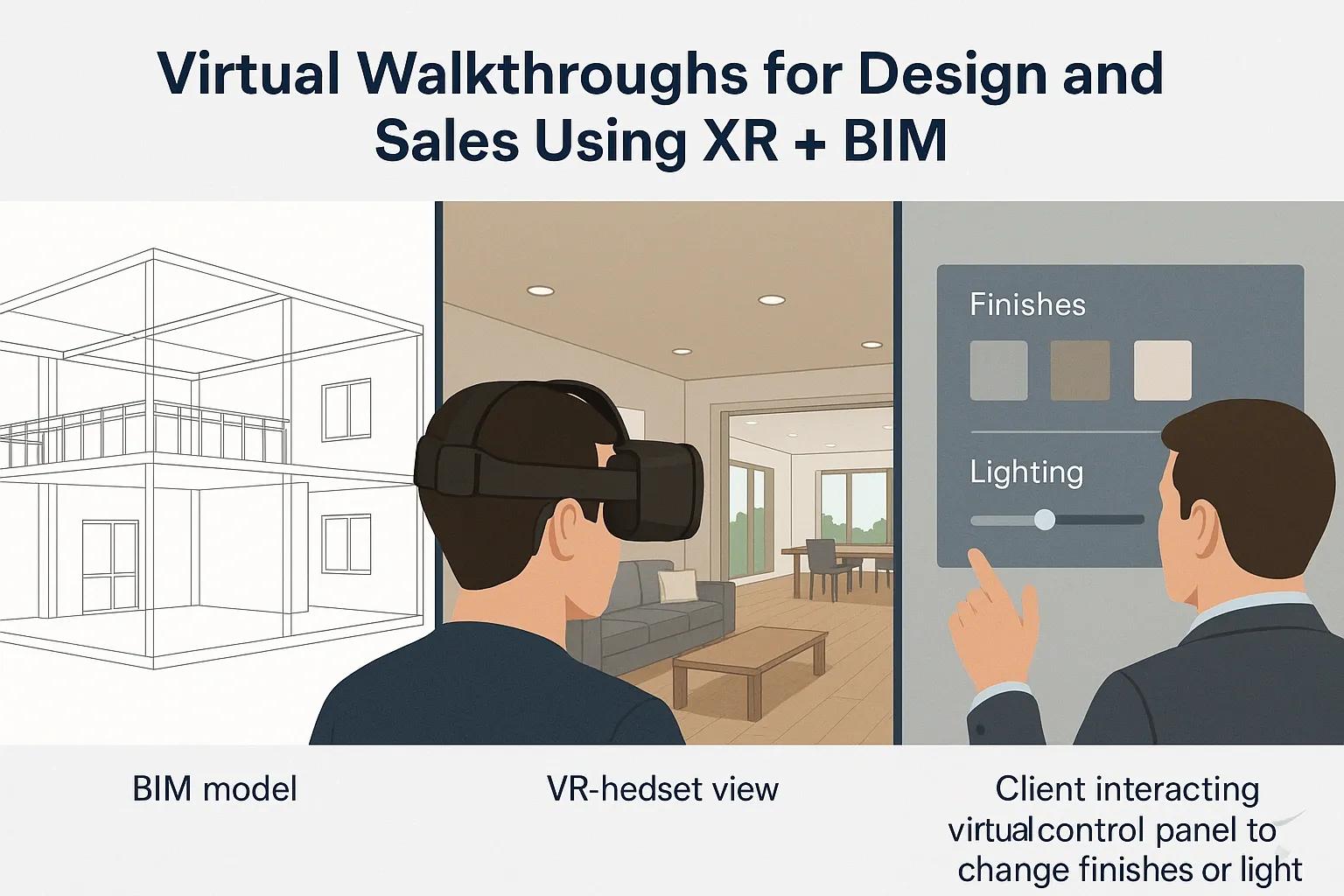
The convergence of Extended Reality (XR) and Building Information Modeling (BIM) is transforming how architecture, engineering, and construction (AEC) firms communicate design intent and drive sales. By merging immersive technologies with intelligent digital models, virtual walkthroughs are enabling clients, investors, and stakeholders to experience, interact with, and understand a space before a single brick is laid .
This approach not only enhances visualization but also reduces design errors, shortens decision cycles, and improves buyer confidence. As real estate development, manufacturing facilities, and infrastructure projects become more complex, XR + BIM walkthroughs are fast becoming a standard part of the digital toolkit.
Understanding the Technology Stack
What is BIM?
Building Information Modeling is a digital representation of the physical and functional characteristics of a space. Unlike static CAD drawings, BIM encompasses geometry, spatial relationships, geographic information, and even time and cost (4D and 5D).
What is XR?
Extended Reality is an umbrella term that includes:
Virtual Reality (VR) : Fully immersive environments.
Augmented Reality (AR) : Digital overlays on real-world environments.
Mixed Reality (MR) : Real-time interaction between physical and virtual elements.
When XR is powered by BIM models, it enables dynamic, data-rich visualizations that go far beyond traditional 3D renders.
The Business Need: Why Virtual Walkthroughs Matter
Traditional blueprints and 2D designs have long posed a challenge to non-technical stakeholders. Clients often struggle to visualize final outcomes, leading to misaligned expectations and costly revisions.
Virtual walkthroughs bridge this gap by offering:
Pre-construction visualization of spaces at human scale.
Interactive design reviews with real-time modifications.
Remote collaboration for global teams and buyers.
Enhanced marketing through immersive sales tools.
In today’s market, especially in high-stakes sectors like luxury real estate, healthcare, and manufacturing, the ability to experience a space virtually is a decisive advantage.
How Virtual Walkthroughs Work
Here’s how XR + BIM-enabled walkthroughs come to life:
Step 1: BIM Model Creation
AEC teams design the structure using BIM tools like Revit, ArchiCAD, or Tekla. These models contain all geometry and metadata, materials, MEP systems, and timelines.
Step 2: Optimization for XR
The BIM model is then converted into lightweight formats compatible with game engines such as Unity or Unreal Engine. This stage may involve polygon reduction and scripting for interactivity.
Step 3: XR Integration
Depending on the application:
VR walkthroughs allow full-scale exploration using headsets like Oculus or HTC Vive.
AR applications let users overlay interior designs on real rooms via tablets or smartphones.
MR solutions enable real-time interaction with dynamic elements like lighting or HVAC systems.
Step 4: Deployment and Use
These immersive experiences can be:
Hosted on cloud for global access.
Installed at Experience Centers for client demos.
Integrated into sales pitches, online configurators, or marketing apps.
Use Cases Across Industries
Real Estate Sales and Marketing
Property developers use XR walkthroughs to show off-plan apartments or villas. Clients can explore layouts, switch finishes, and visualize lighting at different times of day. This boosts buyer confidence and accelerates bookings, even for under-construction properties.
Industrial Plant Design
Manufacturing companies can pre-visualize shop floor layouts, assess machinery placements, and simulate worker movement. This improves ergonomics, safety, and efficiency before physical implementation.
Healthcare Infrastructure
Hospitals and clinics require high customization. XR walkthroughs allow doctors, nurses, and administrators to virtually tour operating rooms or ICUs to optimize layout, accessibility, and compliance, before approving the build.
Educational Campuses and Smart Cities
Universities and smart city developers use virtual walkthroughs to engage communities, gather feedback, and validate design decisions at the urban planning stage.
Business Impact
1. Better Design Decisions
By engaging end-users early, design feedback becomes more precise. Modifications made during walkthroughs reduce rework during construction, improving design quality and coordination.
2. Accelerated Sales
Virtual walkthroughs act as a compelling sales tool. Clients can visualize how a space aligns with their expectations, leading to faster closure rates and fewer drop-offs.
3. Cost Savings
Avoiding late-stage changes and miscommunication results in significant cost reductions, especially in large-scale commercial or industrial projects.
4. Global Access
Remote clients can experience walkthroughs without travel, especially critical in post-COVID digital-first engagement strategies.
Future Directions and Trends
AI-Powered Customization
Generative design tools are enabling real-time layout changes based on client preferences during the walkthrough. For instance, choosing between different furniture layouts or adjusting materials with AI-generated alternatives.
Integration with Digital Twins
Walkthroughs are evolving into operational tools. By linking BIM data with real-time sensor feeds, virtual models can serve as Digital Twins, allowing users to not just explore but monitor and control the built environment post-construction.
Web-Based XR
With advancements in WebXR and 5G, immersive walkthroughs are becoming more accessible via browser, eliminating the need for high-end devices.
Challenges to Consider
While the benefits are significant, organizations must be aware of:
Hardware and rendering limitations, especially for large-scale models.
Data fidelity when translating BIM models to XR platforms.
User onboarding and accessibility, particularly for non-technical stakeholders.
Licensing and intellectual property risks when sharing detailed models.
Conclusion
Virtual walkthroughs using XR + BIM are more than just visualization tools, they are strategic enablers of better design, faster sales, and greater stakeholder alignment. As technology matures and adoption grows, we can expect these walkthroughs to become a default expectation in client engagements.
Whether it’s real estate developers pitching premium properties or plant designers validating factory layouts, the message is clear: seeing is believing , and immersive visualization is the key to driving trust, clarity, and outcomes in a digital-first world.