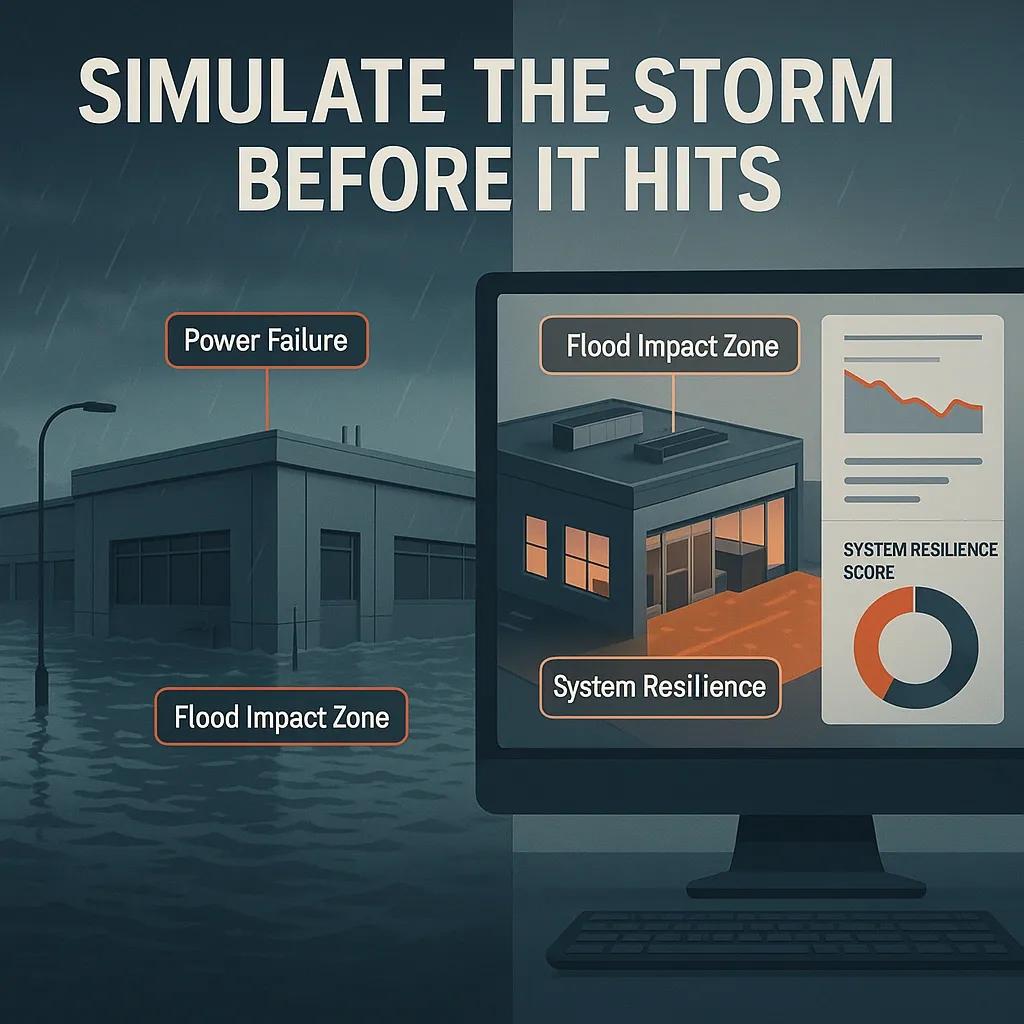
Business Continuity Planning (BCP) is critical for organizational resilience. It ensures that operations can continue during and after unexpected disruptions, be it natural disasters, cyberattacks, or infrastructure failures. However, most BCPs are static documents that are rarely stress-tested under real-world scenarios. This is where digital twin technology comes in, offering a dynamic, data-driven environment to model, simulate, and validate the effectiveness of continuity strategies.
A digital twin is a virtual replica of a physical system, integrated with real-time data streams, sensor feedback, and environmental variables. When applied to business operations, it enables simulation of “what-if” scenarios, such as floods, power outages, or supply chain disruptions, and helps identify weaknesses before actual crises occur.
This article explores how digital twins can enhance BCP by enabling detailed simulation, stress testing, and optimization of recovery protocols.
1. Understanding the Role of Digital Twins in BCP
Digital twins serve as a bridge between operational systems and risk assessment. By replicating critical infrastructure, such as IT systems, physical assets, energy supplies, and logistics networks, digital twins allow decision-makers to test various disruption scenarios without any real-world impact.
Key features that support BCP validation:
Real-time Monitoring: Integration with sensors and IoT systems to mirror current operating conditions.
Scenario Simulation: Ability to model events like fire, flood, cyberattack, or equipment failure.
Impact Analysis: Forecasting consequences across departments, supply chains, or geographies.
Feedback Loops: Continuously improving models based on past disruptions and responses.
2. Core Components of a Digital Twin for BCP
A business continuity digital twin generally comprises the following components:
Component - Role in BCP Simulation
Data Layer - Collects historical and live operational data
Modeling Engine - Simulates the behavior of physical systems under varied conditions
AI/ML Algorithms - Predict outcomes, failure patterns, and dependencies
Visualization - Provides dashboards to explore the state of the virtual system
Scenario Modules - Configures “what-if” events (e.g., outage, flood, attack)
Control Interface - Tests mitigation steps such as rerouting, backup deployment
By integrating these components, organizations gain a full-spectrum view of operational vulnerabilities and mitigation readiness.
3. Simulating Disruptions: Floods, Power Outages, and More
A. Power Outages
Power outages can cripple manufacturing lines, data centers, and logistics hubs. A digital twin can simulate:
Which systems are affected when electricity fails.
How long Uninterruptible Power Supply (UPS) or generators can support critical loads.
The downstream effects on customer deliveries or service levels.
Whether failover systems automatically activate as expected.
By running simulations, IT teams can evaluate the Mean Time to Recovery (MTTR) and adjust backup strategies or load prioritization accordingly.
B. Floods and Natural Disasters
In industries like retail, manufacturing, or utilities, flooding of facilities can cause:
Damage to assets and infrastructure.
Loss of critical data or disruption to communications.
Inability to access the site for days or weeks.
A facility-level digital twin can simulate water ingress patterns based on elevation models and weather forecast data. This can validate:
Whether flood barriers or sump systems are adequate.
How quickly operations can switch to alternate sites.
Inventory loss estimates and insurance exposure.
Using GIS-integrated digital twins, enterprises can also model regional effects, identifying if multiple branches are vulnerable simultaneously.
4. Validating Backup Systems and Redundancy Plans
Many BCPs include fallback strategies like:
Cloud-based data backups.
Redundant suppliers.
Alternate office or manufacturing locations.
Secondary communication networks.
However, unless these systems are tested, failure is often discovered too late. With digital twins, organizations can:
Test if backup systems trigger automatically.
Simulate the actual time it takes for data switchover.
Measure bandwidth sufficiency for remote operations.
Evaluate vendor response times under simulated global disruption.
These insights help fine-tune resource allocation and improve contractual service-level agreements (SLAs).
5. Cross-Domain Simulation for Interconnected Operations
In complex enterprises, one failure can ripple across functions. For example:
A flooded warehouse delays last-mile delivery.
Delayed deliveries trigger refund requests or stockouts.
CRM systems overloaded with complaints affect reputation.
A digital twin doesn’t just simulate these in silos. It shows:
Which functions are most sensitive to upstream delays.
How cascading failures can be controlled with early intervention.
Dependencies between physical, IT, and human resources.
By seeing the full impact chain, business leaders can define clearer priorities for protection, restoration, or outsourcing.
6. Benefits of Using Digital Twins in BCP
Benefit - Explanation
Realistic Scenario Testing - Test edge cases (e.g., multi-region failures) without real-world risk.
Data-Driven Decisions - Replace assumptions with quantifiable insights.
Continuous Improvement - Update the twin with post-disruption learnings.
Stakeholder Communication - Use visual simulations to present risk to C-suite and regulators.
Reduced Downtime - Identify hidden bottlenecks before an actual crisis.
7. Challenges and Considerations
Despite the advantages, implementing digital twins for BCP comes with challenges:
Data Availability: Building an accurate digital twin requires high-fidelity, real-time data.
Integration Complexity: Combining IT systems, physical models, and third-party data can be resource-intensive.
Cost and ROI: Upfront investment may be high, though ROI is realized during disruption avoidance or faster recovery.
Model Accuracy: Over-simplified models may create a false sense of security; models must be continuously validated.
Overcoming these requires a phased approach, starting with critical systems, running limited-scope simulations, and expanding coverage gradually.
8. Example Use Cases
1. Financial Services (Data Center Simulation)
A global bank built a digital twin of its data center infrastructure to simulate cyberattacks and power failures. The twin helped identify that while data backup was fast, network reconfiguration was a bottleneck, leading to reengineering of IT protocols.
2. Logistics & Warehousing
A logistics company created a digital twin of its warehouse and fleet network. During simulation of monsoon flooding in Eastern India, the twin revealed that two backup locations were also at risk. The company realigned its secondary distribution points accordingly.
3. Healthcare
A hospital network simulated a pandemic-like surge in ICU admissions and staff shortages. The twin helped optimize resource allocation, identify which departments could be converted into emergency care units, and fine-tuned emergency communication protocols.
9. Future Outlook
With advancements in AI, cloud computing, and edge analytics, digital twins will evolve to:
Provide real-time resilience scoring.
Autonomously trigger backup workflows.
Incorporate behavioral simulations (e.g., staff evacuation or panic response).
Support ESG-related continuity by simulating climate risks and regulatory disruptions.
As businesses face increasing uncertainty, climate events, geopolitical tensions, cyber threats, the value of digital twins in resilience planning will only grow.
Conclusion
Traditional business continuity plans often fail when tested against real-world complexity. Digital twins offer a powerful alternative, dynamic, data-rich, and predictive. By simulating disruptions such as floods or power outages, organizations can identify weaknesses, validate backup systems, and enhance recovery strategies. Investing in digital twins is not just about technology, it’s about ensuring survival, customer trust, and operational integrity in an unpredictable world.