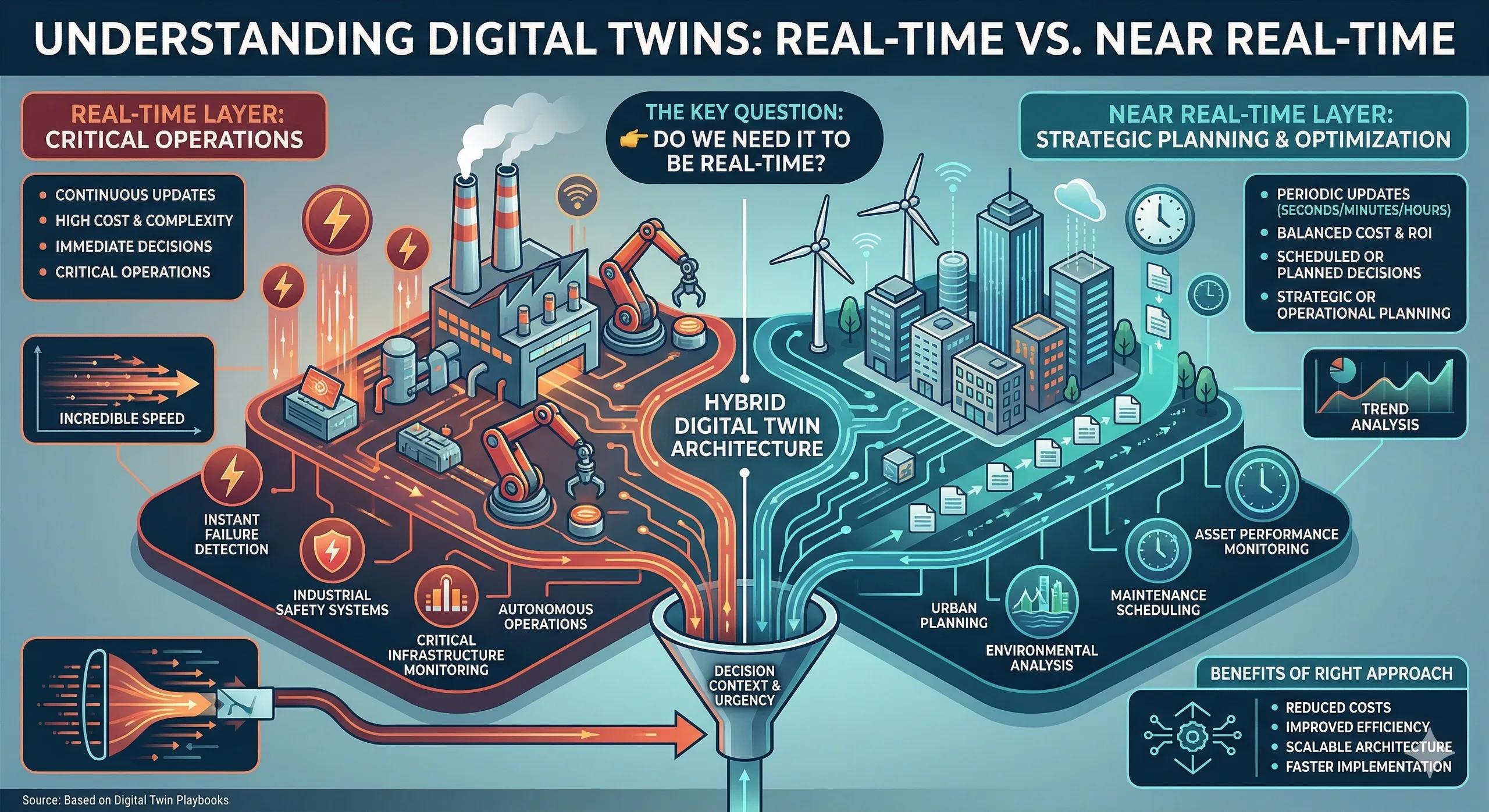
Does a Digital Twin always need to be real-time?
Many organizations assume it does.
In reality, that assumption can increase cost and complexity, without adding value.
Introduction
“Real-time” has become a default expectation in Digital Twin discussions.
But not all use cases require:
Millisecond updates
Continuous streaming
High-frequency data processing
The key question is not: 👉 Can we make it real-time?
It is: 👉 Do we need it to be real-time?
The Core Problem: Overengineering Real-Time Systems
Many projects aim for real-time capabilities without evaluating:
Actual decision requirements
Data processing needs
Cost implications
This leads to:
Complex architectures
Higher infrastructure costs
Unnecessary data loads
👉 And often, no improvement in outcomes
What is Real-Time?
A real-time Digital Twin:
Processes data instantly or within seconds
Reflects current system state continuously
Enables immediate response
Use Cases:
Industrial safety systems
Autonomous operations
Traffic signal optimization
Critical infrastructure monitoring
👉 Where delays can lead to risk or loss
What is Near Real-Time?
A near real-time Digital Twin:
Updates at defined intervals (seconds, minutes, hours)
Provides timely but not instantaneous insights
Balances accuracy and efficiency
Use Cases:
Asset performance monitoring
Urban planning systems
Environmental analysis
Maintenance scheduling
👉 Where decisions don’t require instant action
The Real Difference
Real-Time - Near Real-Time
Continuous updates - Periodic updates
High cost & complexity - Balanced cost & performance
Immediate decisions - Scheduled or planned decisions
Critical operations - Strategic or operational planning
👉 The choice depends on decision urgency
Practical Example
Scenario: Industrial Facility
Real-Time Requirement:
Detect equipment failure instantly
Trigger shutdown or alerts
Near Real-Time Requirement:
Monitor performance trends
Plan maintenance schedules
👉 Both can coexist in the same Digital Twin
Where Most Organizations Go Wrong
1. Assuming Everything Must Be Real-Time
Leads to overinvestment and complexity.
2. Ignoring Decision Context
Not all decisions require immediate data.
3. Underestimating Infrastructure Costs
Real-time systems demand:
High bandwidth
Low latency
Scalable processing
4. Lack of Prioritization
No differentiation between critical and non-critical data streams.
Ask Yourself
Are you building real-time systems because they are needed or because they are expected?
What a Better Approach Looks Like
1. Define Decision Speed
What decisions need seconds vs minutes vs hours?
2. Classify Data Streams
Critical vs non-critical
3. Design Hybrid Systems
Combine real-time and near real-time layers
4. Optimize Cost vs Value
Invest in real-time only where it delivers impact
Indian Context
In sectors like:
Smart Cities
Infrastructure
Manufacturing
A hybrid approach is often more practical:
Real-time for critical operations
Near real-time for planning and optimization
👉 This ensures scalability without excessive cost
Benefits of Choosing the Right Approach
Reduced infrastructure costs
Improved system efficiency
Better alignment with decision needs
Scalable architecture
Faster implementation
Conclusion
Real-time is not always better.
What matters is:
👉 timely data aligned with decision needs
A well-designed Digital Twin:
Uses real-time where necessary
Uses near real-time where sufficient
That balance is what drives both efficiency and ROI .