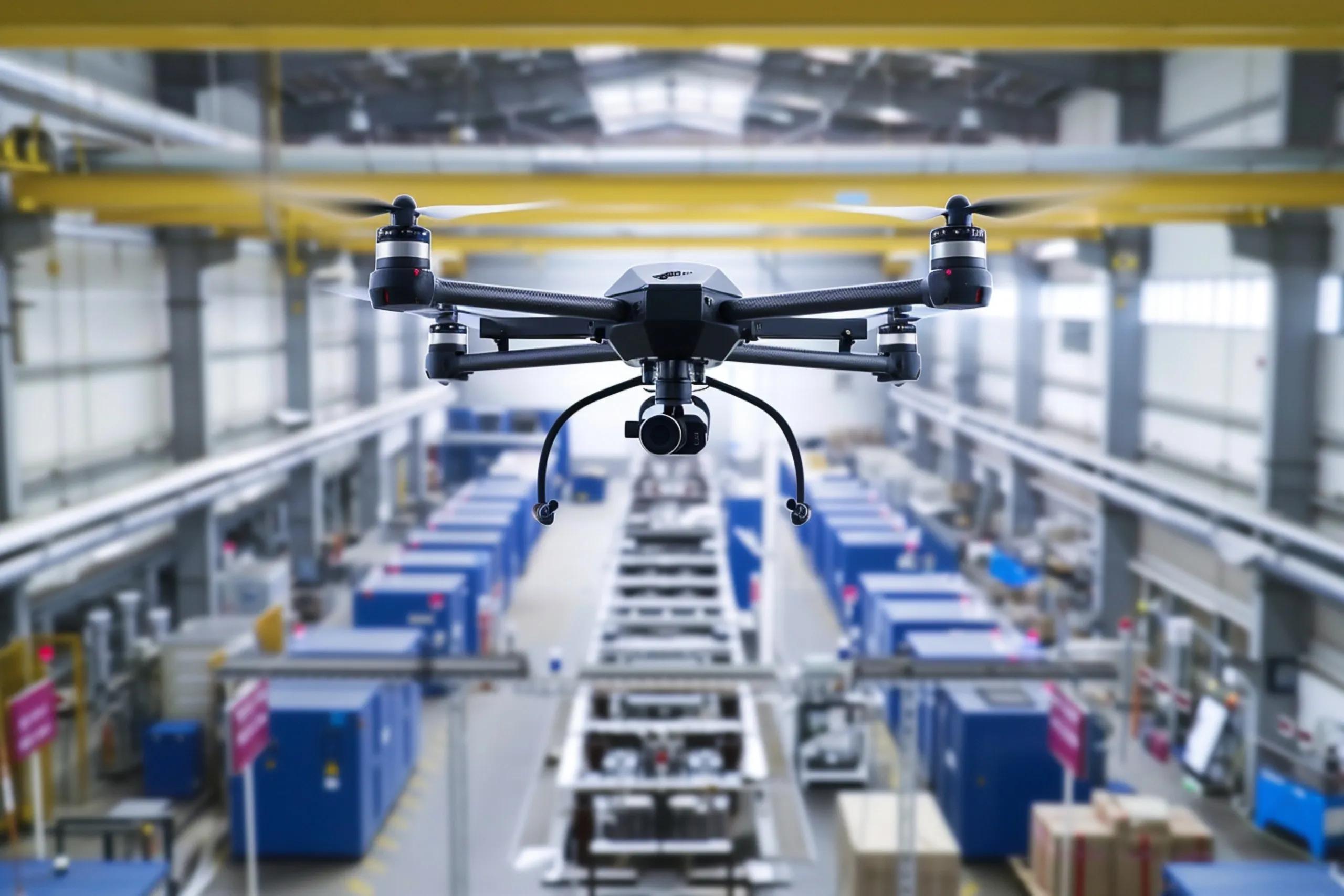
Unmanned Aerial Vehicles (UAVs), commonly known as drones, have seen rapid adoption across industries, from agriculture and construction to emergency response and environmental monitoring. Yet, one high-potential area remains relatively underutilized: warehouse yards and industrial plant operations. As global supply chains grow more complex and demand tighter efficiency, drones offer significant value in logistics management, inventory control, and operational security, especially for large-scale facilities.
This article examines the emerging use cases, benefits, challenges, and future outlook of UAV deployment in warehouse and plant environments.
1. The Operational Landscape
Modern warehouses and manufacturing plants have grown increasingly automated, with robotics, real-time inventory tracking, and digital twins transforming traditional workflows. However, outdoor yards and open storage areas often lag behind in automation due to their scale, layout variability, and environmental exposure.
UAVs are uniquely suited to bridge this gap. Unlike fixed cameras or ground-based robots, drones can easily navigate large, cluttered, or inaccessible zones. They operate efficiently in dynamic environments, collecting real-time data from a bird’s-eye view, enhancing visibility, traceability, and responsiveness.
2. UAV Use Cases in Warehouse Yards and Plant Operations
A. Inventory Audits and Stockpile Measurement
One of the most time-consuming tasks in large yards is physical inventory counting, especially for bulk materials, containers, or stacked pallets. Drones equipped with high-resolution cameras and LiDAR sensors can automate this process.
Use Case : In a logistics yard, drones fly over stacked containers, capturing images and 3D data to identify misplaced or under-utilized inventory. With integration into ERP or WMS platforms, the drone can match physical stock with digital records in near-real time.
Bulk Stockpile Monitoring : In cement, coal, or aggregates yards, UAVs help calculate volumetrics with high accuracy using photogrammetry or LiDAR, reducing the need for dangerous manual measurements.
B. Asset Location and Tracking
For yards storing hundreds or thousands of assets, from construction materials to spare parts, locating specific items quickly is crucial.
Solution : UAVs combined with geotagging and QR/barcode scanning can identify and transmit the exact GPS location of assets.
Outcome : Operators can reduce search time, improve loading accuracy, and minimize demurrage or downtime caused by misplaced items.
C. Operational Monitoring and Workflow Analysis
Drone footage helps supervisors monitor plant and yard operations, particularly for:
Vehicle movements (forklifts, trucks, loaders)
Queue management at loading/unloading bays
Safety compliance (e.g., detecting no-go zones or PPE usage)
By capturing overhead video and thermal images, drones provide data for heatmaps, activity tracking, and even AI-based process optimization.
D. Perimeter Security and Surveillance
Yards often span several acres and are prone to unauthorized access, theft, or hazards. Instead of relying solely on static CCTV, drones can:
Patrol the perimeter at programmed intervals
Detect movement or anomalies using AI-enabled vision
Alert security teams in real-time
With night-vision or thermal capabilities, drones offer round-the-clock vigilance, especially in remote or high-risk zones.
E. Infrastructure Inspection and Maintenance
Drones are effective in inspecting plant roofs, gutters, HVAC units, and hard-to-reach exterior structures without scaffolding or shutdowns.
Example : UAVs can capture corrosion signs on pipelines or heat leaks in insulation, supporting predictive maintenance and reducing risk exposure.
3. Advantages Over Traditional Methods
Feature - Traditional Approach - UAV Advantage
Speed - Manual scanning or driving across yard - Rapid aerial coverage in minutes
Accuracy - Prone to human error - GPS-tagged, sensor-validated data
Safety - Requires working at heights or around vehicles - No human exposure to hazardous areas
Cost - Labor-intensive, recurring costs - Lower long-term cost post deployment
Data Integration - Fragmented records - Centralized digital sync with ERP/WMS
4. Implementation Requirements
A. Hardware and Payloads
Drones : Multirotor drones (for stability in confined spaces) or fixed-wing (for large open yards)
Sensors : RGB cameras, LiDAR, thermal imaging, barcode/RFID readers
B. Software Ecosystem
Flight Planning : Autonomous route planning for systematic coverage
Data Processing : Cloud or edge-based tools for image stitching, 3D modeling, and AI analytics
Integration : APIs for linking drone data with WMS, ERP, or security dashboards
C. Infrastructure Needs
Charging stations, drone docks, or drone-in-a-box systems for autonomous operation
Secure data communication (e.g., 4G/5G, Wi-Fi mesh) for real-time uploads
5. Adoption Challenges
Despite the benefits, several bottlenecks slow adoption:
Regulatory Hurdles : In many regions, drone operations require permits, especially for BVLOS (Beyond Visual Line of Sight) flights
Data Privacy and Cybersecurity : Ensuring secure handling of aerial footage, especially in sensitive manufacturing units
Weather Dependency : UAVs may not perform optimally in rain, fog, or high winds
Skilled Operators : Need for trained personnel to operate and interpret drone data
6. Global Trends and Market Projections
According to research, the global warehouse automation market is projected to exceed USD 65 billion by 2030, with UAVs forming a key component of this growth. Companies like Percepto, DJI Enterprise, and American Robotics are investing in autonomous drone platforms tailored for industrial environments.
Early adopters such as Walmart, DHL, and GE Aviation have reported inventory accuracy improvements of 60-80% and significant reductions in manpower costs and downtime. Indian players are also entering this space, integrating drones with digital twins for smart plant management.
7. The Road Ahead
As AI and IoT continue to mature, drones will not function as isolated systems but as part of a connected industrial ecosystem. We expect to see:
AI-powered anomaly detection : Identifying issues like leaks, foreign objects, or operational inefficiencies autonomously
Real-time digital twins : Synchronizing drone data with 3D plant models for live operational visibility
Swarm drones : Coordinated drone fleets handling simultaneous tasks like inspection, inventory, and monitoring
Furthermore, regulatory reforms in India, the US, and EU nations are gradually opening the door for fully autonomous drone deployments.
Conclusion
The use of UAVs in warehouse yards and plant operations is still at a nascent stage, yet its potential is vast and largely untapped. From inventory management to security surveillance, drones offer clear advantages in speed, accuracy, safety, and cost-efficiency.
For companies looking to future-proof their logistics and industrial processes, investing in UAV technology is not just a technological upgrade, it’s a strategic move toward real-time, data-driven operations.