Most digital twin conversations still begin with visibility.
A 3D model of a city.
A dashboard for a factory.
A live map of road assets.
A sensor layer connected to a control room.
These are useful, but they are not enough.
The next phase of digital twins will not only be about seeing infrastructure better. It will be about testing how infrastructure behaves when something goes wrong.
A pump fails.
A drone swarm is disrupted.
A PLC receives abnormal commands.
A utility network faces a cyberattack.
A city emergency system is overloaded during flooding.
A warehouse automation workflow is interrupted.
A port or airport loses connectivity at a critical moment.
The question is no longer: “Can we visualize the asset?”
The better question is: “Can we safely test risk before the real system is exposed?”
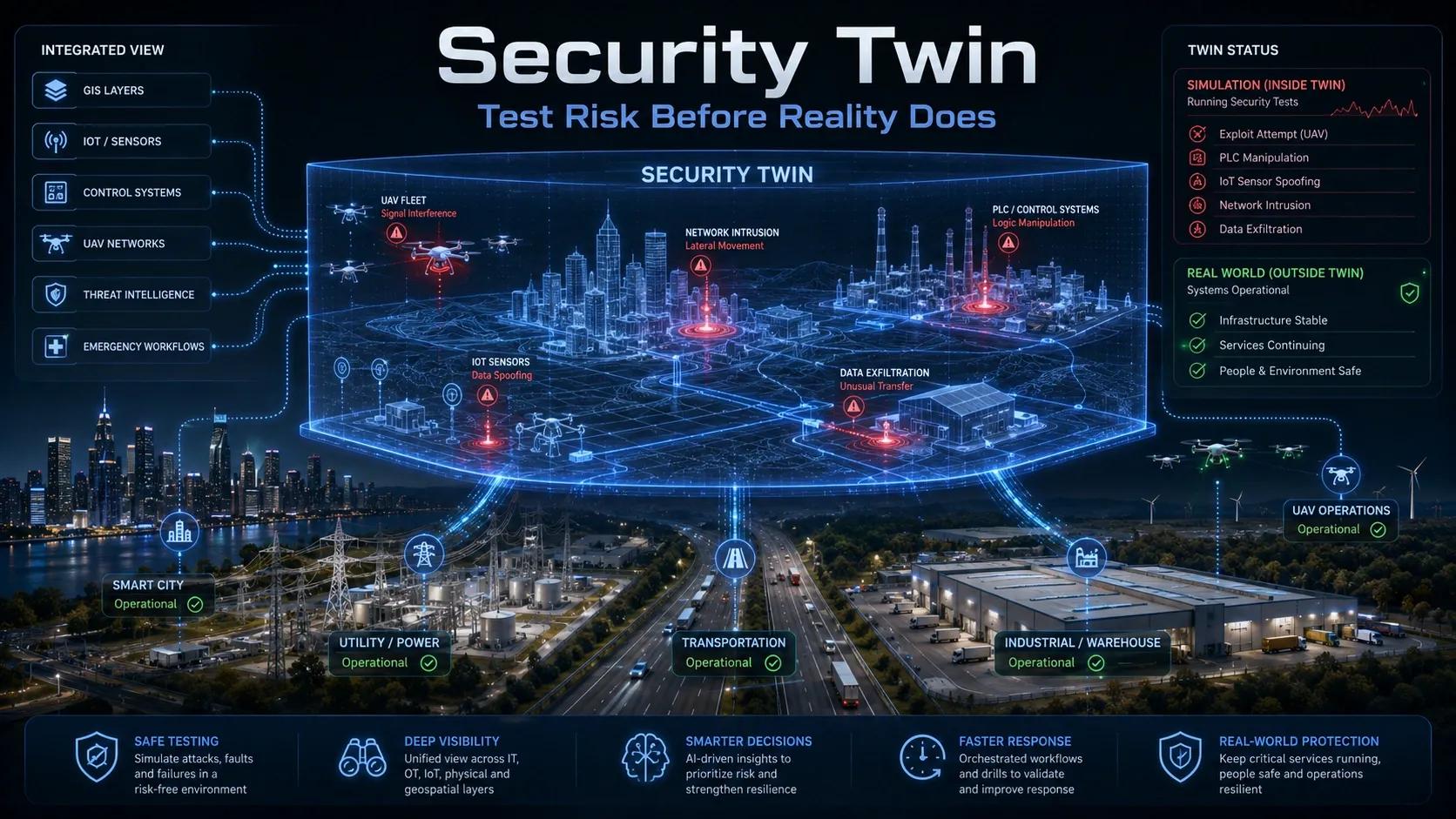
That is where the idea of a Security Twin becomes important.
What Is a Security Twin?
A Security Twin is a digital replica of a physical asset, network, process, or operating environment that is used to test faults, attacks, abnormal behavior, and recovery scenarios before they affect the real world.
It is not just a cybersecurity dashboard.
It is not just a simulation model.
It is not only a digital twin with some security logs added.
A Security Twin combines spatial context, operational logic, sensor data, system behavior, network activity, and response workflows into a controlled test environment.
In simple terms, it allows teams to ask:
What happens if this controller behaves abnormally?
What happens if this sensor sends false data?
What happens if a drone network is attacked?
What happens if a flood alert is delayed?
What happens if a command is issued from the wrong source?
What happens if an operator overrides automation at the wrong time?
These questions cannot always be tested safely on live infrastructure.
But they can be tested inside a twin.
Why This Matters for Critical Infrastructure
Infrastructure is becoming more connected, more automated, and more dependent on software.
Cities are linking GIS, 3D models, CCTV, IoT sensors, mobility data, weather feeds, and emergency workflows.
Factories and warehouses are connecting PLCs, robots, cameras, ERP systems, inventory platforms, and quality systems.
Utilities are integrating SCADA, smart meters, field sensors, substations, and remote monitoring.
Ports, highways, mines, farms, and airports are adding drones, edge devices, satellite connectivity, and AI-based decision support.
This creates huge operational value.
It also creates new risk.
Earlier, a failure was mostly local. A broken pump, a damaged cable, a faulty valve, or a delayed inspection.
Now, failure can move across systems.
A wrong sensor reading can trigger a wrong operational decision.
A cyber intrusion can look like a normal command.
A network disruption can affect field teams.
An AI model can recommend action without enough operational context.
A digital twin can become misleading if it is not synchronized with reality.
This is why security cannot remain a final checklist.
It must become part of the twin architecture itself.
Why Geospatial Context Matters
Cybersecurity teams often think in terms of networks, devices, users, permissions, logs, and attack paths.
Infrastructure teams think in terms of assets, locations, dependencies, field operations, service areas, risk zones, and public impact.
A Security Twin brings these two worlds together.
The location of an asset matters.
The upstream and downstream dependency matters.
The physical access point matters.
The surrounding population matters.
The terrain, weather, flood zone, route access, and response time matter.
For example, a cyber event at a pump station is not only a network issue. It may affect water pressure, emergency supply, public health, and field crew deployment.
A compromised UAV is not only a communication issue. It may affect inspection safety, airspace coordination, site security, and mission continuity.
A false flood sensor reading is not only a data issue. It may affect evacuation planning, traffic routing, emergency services, and public trust.
This is where geospatial technology becomes central to security.
It gives risk a location.
It shows which assets are exposed, which communities may be affected, which routes are available, and which decisions must be prioritized.
From Passive Monitoring to Active Testing
Most organizations already monitor something.
They monitor devices.
They monitor networks.
They monitor field assets.
They monitor alarms.
They monitor dashboards.
But monitoring usually tells us what is happening now.
A Security Twin helps answer what could happen next.
This is the shift from passive monitoring to active testing.
Instead of waiting for an incident, the organization can simulate scenarios:
A sensor spoofing attack.
A PLC command anomaly.
A drone communication failure.
A ransomware impact on field operations.
A flood response delay.
A traffic control disruption.
A warehouse automation breakdown.
A utility outage under extreme weather.
The twin becomes a safe testing ground.
It allows teams to validate detection rules, operator responses, fallback procedures, recovery workflows, and AI recommendations without risking the live environment.
The Role of AI and Autonomous Systems
As AI enters infrastructure operations, the need for Security Twins becomes even more urgent.
AI agents may soon support inspection planning, anomaly detection, dispatch decisions, asset prioritization, and emergency response.
But an AI system should not be trusted simply because it sounds confident.
It must be tested.
Can it show the spatial evidence behind its recommendation?
Can it respect operational permissions?
Can it escalate uncertainty to a human?
Can it avoid unsafe actions?
Can it explain which data layers influenced the decision?
Can it behave properly when data is incomplete, delayed, or manipulated?
A Security Twin gives us a place to test these questions.
This is especially important for GeoAI.
The winning GeoAI platform will not be the one that only recognizes more objects from imagery. It will be the one that can turn spatial evidence into a safe, auditable operational decision.
Where Security Twins Can Create Immediate Value
There are several practical use cases.
In smart cities, Security Twins can test emergency response workflows for floods, fires, crowd events, traffic disruptions, and command-center overload.
In utilities, they can test PLC, SCADA, IoT, and field-device behavior under abnormal conditions.
In ports and airports, they can test sensor failures, access-control risks, drone threats, and operational continuity.
In warehouses and factories, they can test automation failures, camera-based quality inspection issues, robotics disruptions, and cyber-physical risks.
In UAV operations, they can test swarm communication, intrusion detection, mission interruption, and degraded network behavior.
In roads and mobility, they can test connected infrastructure, traffic control, autonomous simulation environments, and emergency routing.
The common thread is simple:
Do not wait for the real system to fail before learning how it behaves under pressure.
A Practical Implementation Path
A Security Twin does not need to begin as a massive platform.
It can start with one critical workflow.
First, identify the high-risk asset or process.
Second, map the physical and digital dependencies.
Third, connect relevant data sources: GIS, sensors, control systems, logs, imagery, and operational records.
Fourth, build a simulation environment for selected fault and attack scenarios.
Fifth, define response workflows and human override points.
Sixth, test detection, response, and recovery.
Seventh, convert the lessons into operating procedures and system improvements.
This approach keeps the twin practical.
The purpose is not to build a perfect virtual world.
The purpose is to reduce operational uncertainty before an incident occurs.
The Bigger Shift
For years, digital twins were sold as visualization tools.
Then they became monitoring tools.
Now they are moving toward decision-support systems.
The Security Twin takes this one step further.
It turns the digital twin into a resilience layer.
A place where infrastructure owners can test risk, train teams, validate AI, audit decisions, and improve response before attackers, failures, or disasters expose weaknesses in the real world.
This matters because critical infrastructure is no longer only physical.
It is physical, digital, spatial, connected, and increasingly autonomous.
Security must follow the same path.
The future of infrastructure resilience will not depend only on stronger firewalls or better dashboards.
It will depend on our ability to understand how real-world systems behave under stress — before that stress becomes real.
That is the promise of the Security Twin.
Not just to see infrastructure.
Not just to monitor it.
But to test it, challenge it, and strengthen it before it is tested by the outside world.
What do you think: should Security Twins become a standard part of every critical infrastructure digital twin strategy?