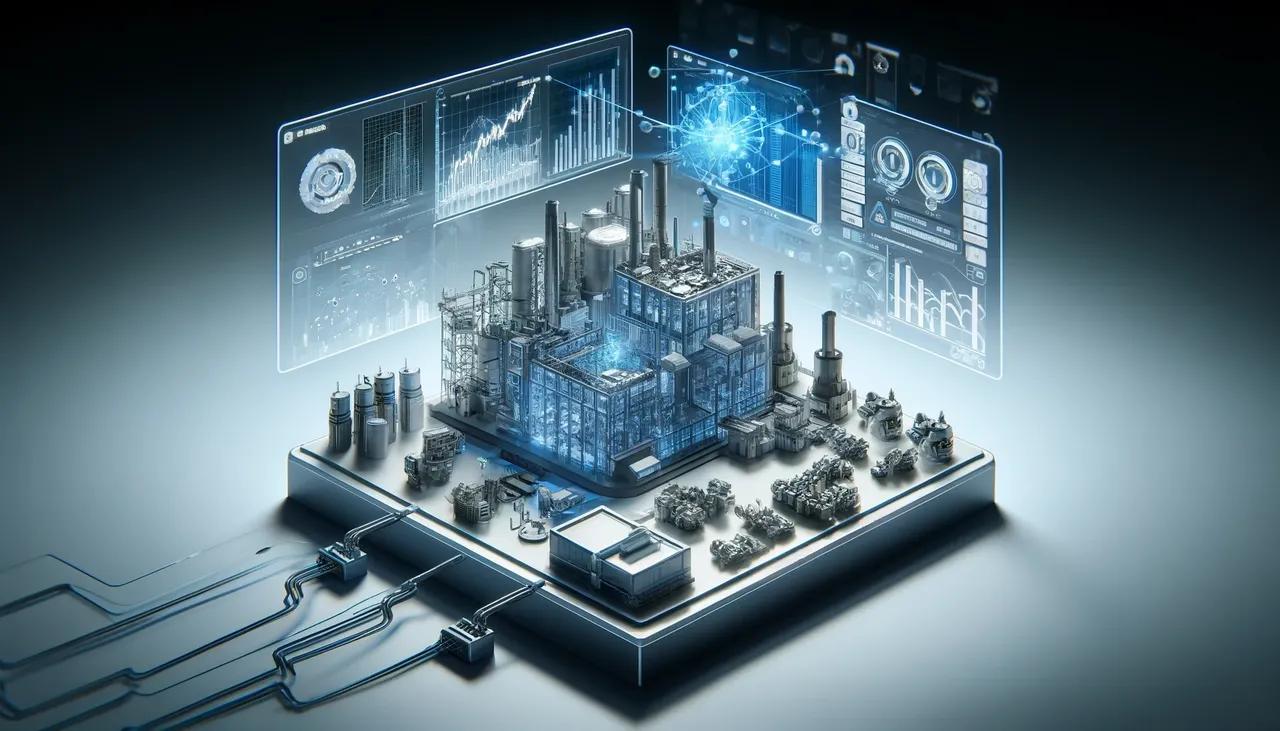
Advanced digital twin with AI integration in a factory.
In recent years, the convergence of Artificial Intelligence (AI) and Machine Learning (ML) with digital twins has been transforming the landscape of various industries. This integration is propelling the capabilities of digital twins beyond simple digital replicas, enabling them to predict outcomes, optimize processes, and enhance decision-making. In this article, we will explore how AI and ML are enhancing digital twins, making them more dynamic and intelligent.
Understanding Digital Twins
A digital twin is a virtual model designed to accurately reflect a physical object, process, or system. It is used in industries like manufacturing, automotive, healthcare, and urban planning, among others. Digital twins help organizations to simulate, predict, and understand their assets through real-time and historical data. Initially, digital twins were static models; however, the integration of AI and ML has revolutionized their potential, turning them into living models that grow and learn over time.
Role of AI in Digital Twins
AI contributes to the functionality of digital twins in several significant ways:
Predictive Analytics and Maintenance
One of the primary benefits of AI in digital twins is predictive analytics. AI algorithms can analyze historical and real-time data to predict future behavior and potential failures of the system or machinery. This capability is crucial in industries such as manufacturing and aviation, where equipment downtime can lead to significant financial losses. Predictive maintenance powered by AI can alert operators before failures occur, saving time and money and enhancing safety.
Process Optimization
AI algorithms can also analyze the operations of a system or process within a digital twin environment to identify inefficiencies or optimization opportunities. For instance, in a factory, an AI-enhanced digital twin can simulate different production scenarios to find the most effective way to increase output, reduce waste, or minimize energy consumption. This level of simulation can lead to substantial operational improvements and sustainability benefits.
Autonomous Control Systems
In more advanced applications, AI can enable digital twins to control physical systems autonomously. For example, in smart buildings, digital twins can manage HVAC systems in real-time, adjusting parameters for optimal energy use and comfort based on the data received from IoT sensors and external conditions. Such systems not only improve efficiency but also adapt dynamically to changing environments.
Role of Machine Learning in Digital Twins
Machine Learning enhances digital twins by allowing them to learn from data, recognize patterns, and make decisions with minimal human intervention. ML models are trained on vast amounts of data collected from sensors and other sources, which then enable the digital twins to improve their accuracy and functionality over time.
Enhancing Predictive Capabilities
ML models are particularly adept at processing complex and large datasets that would be difficult for traditional analytical methods to handle. In the context of digital twins, ML can forecast more accurately by learning continuously from operational data. This enhanced predictive capability is vital for critical applications like predicting system failures, energy consumption patterns, or even patient health outcomes in medical devices.
Adaptive Learning
Unlike static models, ML enables digital twins to adapt over time. As the physical counterpart changes or as new data becomes available, the ML models can update their predictions and simulations to reflect these changes accurately. This adaptivity is essential for long-term applications of digital twins, ensuring they remain accurate and relevant as conditions evolve.
Decision Making
With ML, digital twins can also support decision-making processes. By simulating different scenarios and learning from each iteration, digital twins can recommend the most effective course of action under various circumstances. This aspect is particularly beneficial in strategic planning and resource management, where different decisions can lead to significantly different outcomes.
Challenges and Future Directions
Despite the significant benefits, integrating AI and ML with digital twins is not without challenges. Issues such as data privacy, security, and the need for high-quality data are paramount. Moreover, the computational demand of running sophisticated AI and ML algorithms requires robust IT infrastructure, which can be a barrier for some organizations.
The future of AI and ML in digital twins looks promising, with advancements in technology continually enhancing their capabilities. As these technologies mature, they are expected to become more accessible and cost-effective, which could lead to broader adoption across industries.
In conclusion, the integration of AI and ML with digital twins represents a significant advancement in digital modeling. By making digital twins more dynamic, predictive, and capable of autonomous decision-making, AI and ML are not just enhancing digital replicas; they are transforming them into essential tools for innovation and efficiency in the digital age. As these technologies continue to evolve, their impact on digital twins will undoubtedly grow, leading to more sophisticated, intelligent, and useful digital twin solutions across all sectors.