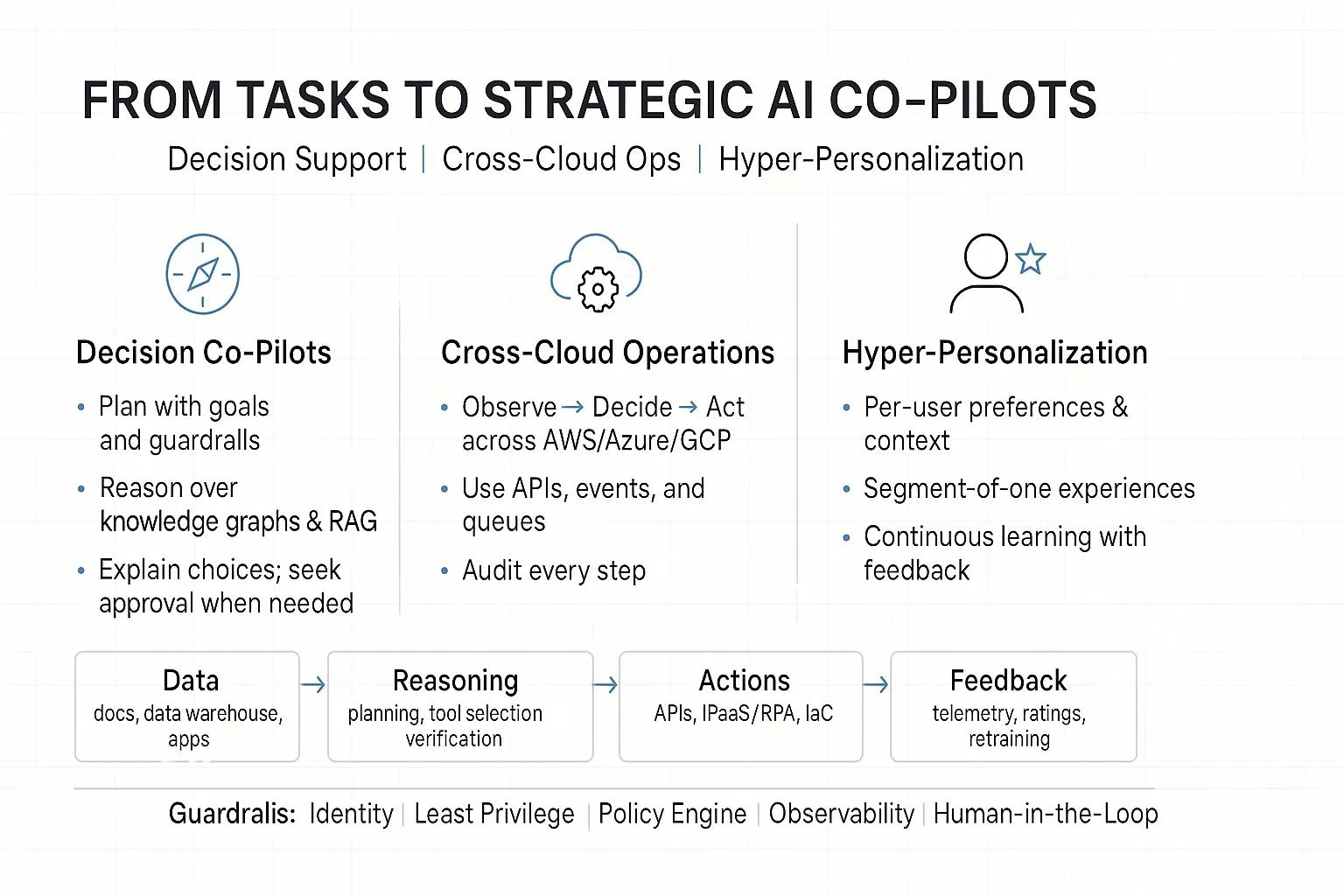
AI agents have moved beyond simple task bots. They now reason over enterprise knowledge, coordinate actions across clouds, and tailor outcomes to each user and customer. For CIOs and business leaders, this shift unlocks faster decisions, leaner operations, and differentiated experiences. The winners will be those who design agents as governed, measurable systems not one-off experiments.
From bots to co-pilots: how we got here
Scripts and macros automated keystrokes.
RPA and iPaaS connected systems with deterministic flows.
Tool-using LLMs invoked APIs with natural language plans.
Multi-agent orchestration introduced specialist agents with a supervisor.
Strategic co-pilots align to goals, weigh trade-offs, and learn from feedback while staying within guardrails.
What makes an enterprise-grade agent?
Perception & context. Connectors into email, chat, CRM/ERP, data warehouses, observability, and document stores. Ground the agent with Retrieval Augmented Generation (RAG) and structured facts.
Memory. Short-term task memory, long-term knowledge bases (vector stores, knowledge graphs), and safely scoped user context.
Planning & reasoning. Goal decomposition, tool selection, and self-checks. Prefer chain-of-thought hidden from end users but testable via rubrics.
Action. Idempotent API calls, queues, and event buses. Rehearse in sandbox, execute in production with approvals where needed.
Governance. Identity and least-privilege access, policy engine for “who can do what,” audit trails, cost limits, and human-in-the-loop for material decisions.
New capabilities that matter
1) Decision co-pilots
Agents don’t just “fetch and format.” They evaluate options against OKRs and constraints. Example: a supply chain co-pilot weighs expedite cost vs fill-rate risk , proposes scenarios, and executes the chosen plan with approvals.
2) Cross-cloud operations
Modern estates span AWS, Azure, GCP, and SaaS. Agents observe events, reason over telemetry and business data, then act via APIs, infrastructure pipelines, or RPA fallbacks. Event-driven patterns reduce polling and keep costs predictable.
3) Hyper-personalization
Agents tailor actions to each user and account: role, preferences, recent behavior, risk score, and segment. Think “segment of one” but with strong privacy controls and per-tenant boundaries.
“Would you let an agent approve a minor discount automatically if it demonstrably improves win-rate and stays within policy?”
Where enterprises get stuck (and how to unblock)
Reliability & accuracy. Hallucinations and flaky tool calls erode trust. Fix: constrain tools and schemas, add guardrails and JSON formats, implement test harnesses with golden tasks and offline evaluation.
Security, privacy, and compliance. Access sprawl, data leakage, cross-tenant risk. Fix: enforce least-privilege credentials, redact PII before model calls, maintain per-region routing for data residency (e.g., align with India’s DPDP Act), and log every action.
Cost & performance. Token waste and long latencies. Fix: prompt compression, retrieval filters, response caching, small-to-large model routing, batched tool invocations.
Change management. Teams worry about job impact or “black box” decisions. Fix: make the agent explain steps, require approvals at thresholds, publish metrics, and train users on “what the agent can/can’t do.”
Measurement. Without KPIs, pilots stall. Fix: track cycle time, SLA compliance, first-contact resolution, cost per transaction, CSAT/NPS, and “time-to-value.”
Multi-agent patterns that scale
Specialists with a supervisor. Planner assigns work; specialists (pricing, logistics, legal) execute; verifier checks output; operator handles exceptions.
Human-in-the-loop. Agents propose, humans approve at policy gates.
Self-healing. On failure, agents retry with a different tool or route to a fallback workflow.
Reference architecture (at a glance)
Interface: chat, email, workflow triggers, APIs.
Reasoning layer: LLM(s) + planning + tool router.
Knowledge layer: vector DB, KG, cataloged datasets.
Action layer: business APIs, RPA, iPaaS, IaC pipelines.
Ops & control: identity/roles, policy engine, observability, cost guards, evaluation and A/B.
Example: supply chain co-pilot (manufacturing)
Situation: A tier-1 manufacturer faces a supplier delay that threatens on-time delivery. Agent flow:
Detects risk from ETA events and purchase data.
Simulates alternatives: expedite from Supplier B, partial ship, or BOM substitute.
Scores options on cost, SLA risk, and customer priority.
Proposes plan: split shipment, expedite critical SKUs, inform customer with new promise date.
Executes via ERP/3PL APIs after manager approval; monitors exceptions and closes the loop with a post-mortem note.
Outcome: 30–40% faster mitigation, fewer SLA breaches, and transparent communication without adding headcount.
Fast path to value (90 days)
Week 0–2: Discover. Pick one high-leverage use case with clear KPIs; map systems and policies.
Week 3–6: Build pilot. RAG over your knowledge base; wire up 3–5 tools; add two policy gates.
Week 7–10: Harden. Tests, logs, cost guards, fail-safes; performance budget.
Week 11–12: Rollout. Train users, publish dashboards, set a weekly “agent ops” review.
Benefits & ROI (what to expect)
Cycle time down 25–40% in targeted workflows.
SLA breaches cut via earlier detection and faster action.
Cost per transaction lower through automation and fewer handoffs.
Revenue lift from faster quotes, better cross-sell, and reduced churn.
Risk reduction via complete audit trails and policy-bound actions.
Employee leverage teams focus on judgment, not swivel-chair tasks.
Conclusion
AI agents are shifting from helpful task runners to strategic co-pilots that plan, act, and learn while staying inside enterprise guardrails. Technology is ready, the patterns are known, and the advantages compound with scale. Start small, design for safety and measurability, and expand with confidence.