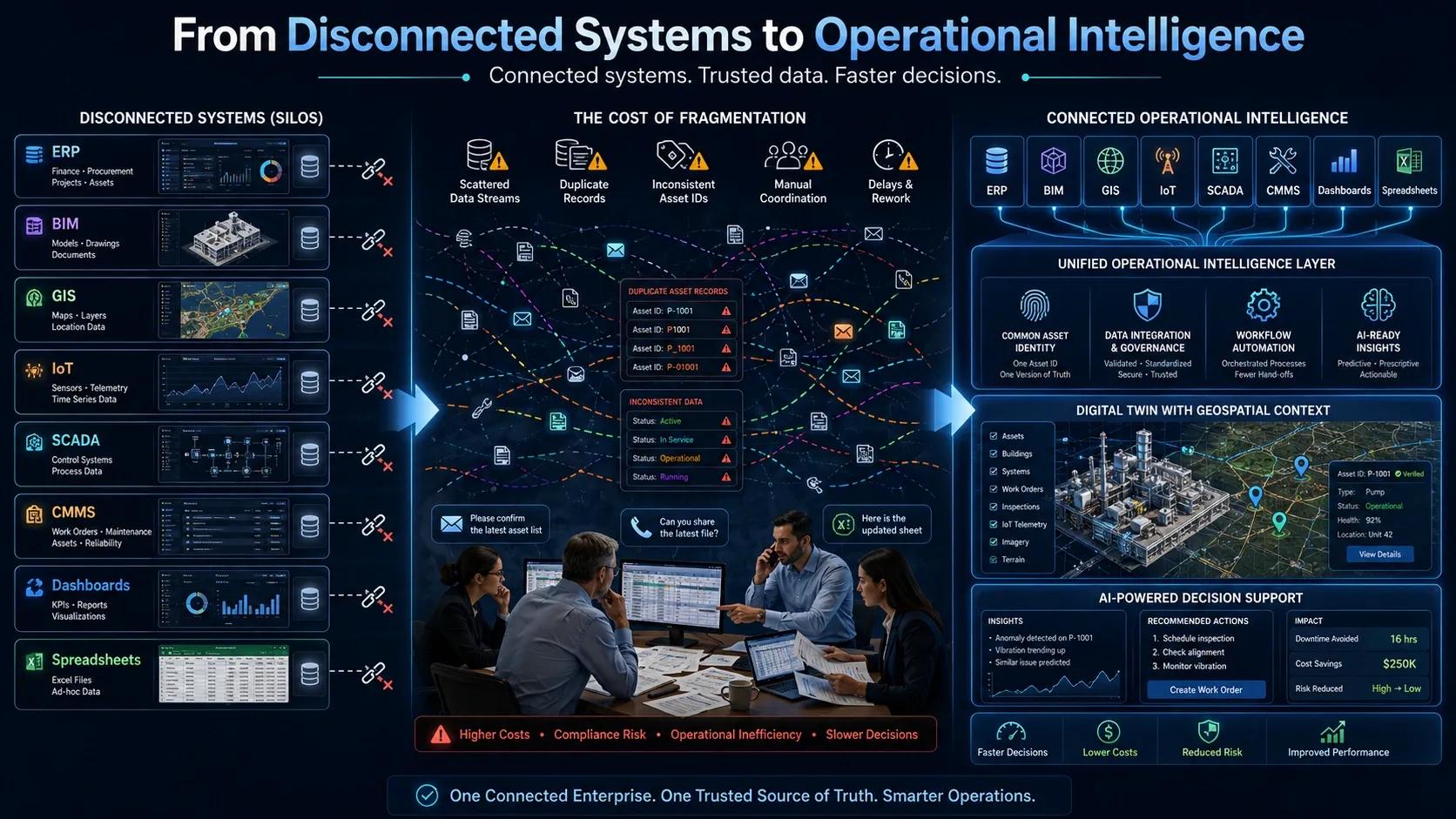
Most enterprises do not suffer from lack of technology.
They already have multiple systems.
ERP manages finance, procurement, and transactions.
BIM carries design and construction data.
GIS provides location intelligence.
IoT captures real-time signals.
SCADA monitors operational control systems.
CMMS manages maintenance workflows.
Dashboards present performance indicators.
Analytics tools generate reports and insights.
On paper, the organization looks digitally mature.
But in daily operations, teams may still struggle to make fast, reliable, and coordinated decisions.
Why?
Because the systems are often disconnected.
Each system may be useful within its own department. But when systems do not communicate with each other, the enterprise cannot operate as one intelligent system.
This is one of the biggest barriers to AI-ready operational intelligence.
Digital Systems Do Not Automatically Create Digital Intelligence
Many organizations assume that once they invest in digital systems, intelligence will follow.
But that is not always true.
A digital system can store data.
A dashboard can visualize data.
An analytics tool can process data.
A sensor can capture data.
A model can represent an asset.
But if these elements remain isolated, the organization still lacks a connected understanding of operations.
Digital intelligence emerges only when systems, data, context, workflows, and decisions are connected.
Without that connection, the enterprise may have many digital tools but still depend on manual coordination.
That is the real problem.
What Disconnection Looks Like in Daily Operations
Disconnected systems often show up in simple but costly ways.
A maintenance team receives an asset alert but has to check another system for asset history.
A planning team sees a delay on a dashboard but has to open project files, BIM models, procurement trackers, and site reports to understand the cause.
A utility team sees a network issue but must cross-check GIS layers, outage logs, field crew availability, and customer impact manually.
A construction team has BIM data, but the operations team receives incomplete handover information.
A city team has flood data, but drainage records, road closure data, emergency response routes, and vulnerable area maps are not connected.
A factory team has machine data, but quality records, production schedules, maintenance history, and downtime cost are not linked.
In each case, data exists.
But the decision is delayed because the context is scattered.
The Cost of Disconnected Systems
The cost of system disconnection is not always visible as a direct line item.
But it affects business performance in many ways.
1. Slow Decisions
When teams must search across multiple systems, decisions take longer.
This delay can affect production, maintenance, safety, customer service, project delivery, and emergency response.
2. Duplicate Work
Disconnected systems often create repeated data entry, duplicate records, repeated reporting, and parallel spreadsheets.
Teams spend time reconciling information instead of acting on it.
3. Different Versions of Truth
One department may trust the ERP record.
Another may trust the spreadsheet.
Another may trust the GIS layer.
Another may rely on field updates.
When each team works with a different version of truth, decisions become inconsistent.
4. Weak Accountability
If data, workflows, and ownership are not connected, it becomes difficult to know who should act, when they should act, and how outcomes should be tracked.
5. Poor AI Readiness
AI needs connected, contextual data.
If systems are disconnected, AI models may generate outputs that lack operational meaning.
The result is not intelligence.
It is another layer of isolated analysis.
Why Enterprise Systems Become Disconnected
Disconnected systems are rarely created intentionally.
They usually emerge over time.
Different departments buy tools for their own needs.
Projects adopt systems for specific phases.
Legacy platforms remain in use.
Data standards are not enforced.
Asset IDs are inconsistent.
Vendors use different formats.
Integrations are postponed.
Ownership is unclear.
Data governance is weak.
Over years, the enterprise becomes a collection of digital islands.
Each island may work.
But the organization as a whole struggles to connect information into decisions.
This is especially common in asset-heavy sectors such as infrastructure, manufacturing, utilities, construction, ports, real estate, smart cities, and logistics.
The Asset Identity Problem
One of the most common causes of disconnection is poor asset identity.
The same asset may appear differently across systems.
In ERP, it may have a finance code.
In CMMS, it may have a maintenance ID.
In BIM, it may have a model element ID.
In GIS, it may have a spatial feature ID.
In IoT, it may have a sensor tag.
In SCADA, it may have a control system reference.
In spreadsheets, it may have a local name.
If these identities are not connected, the organization cannot easily create a full picture of the asset.
This creates a major problem for Digital Twins and AI.
A Digital Twin must know which physical asset is being represented.
AI must know which data belongs to which asset.
Operations must know who is responsible for the asset and what action is required.
Without a common asset identity or mapping layer, the enterprise cannot move smoothly from data to decision.
The Missing Context Problem
Disconnected systems also create a context gap.
For example, a sensor may show high temperature.
But to make a decision, the organization needs more context:
What asset is the sensor attached to?
Where is the asset located?
Is this reading abnormal for that asset?
What is the asset’s operating range?
Has this happened before?
Is there an open work order?
What process depends on this asset?
What is the business impact if it fails?
Who should respond?
If this context sits across different systems, AI and analytics may detect the signal but still fail to support the decision.
This is why context integration is critical.
Data without context creates noise.
Connected data with context creates intelligence.
Disconnected Systems Limit Digital Twins
A Digital Twin depends on connected information.
It needs to bring together physical assets, spatial context, engineering data, real-time signals, historical records, workflows, and business logic.
If enterprise systems are disconnected, the Digital Twin may become only a visualization layer.
It may show a model.
It may show dashboards.
It may show some sensor readings.
But it may not support reliable operations.
For a Digital Twin to become useful, it must connect to the systems that manage real work.
This may include ERP, CMMS, BIM, GIS, IoT, SCADA, document management, field applications, and analytics platforms.
The value of a Digital Twin is not only in what it displays.
It is in how well it connects operational reality.
Disconnected Systems Limit AI
AI depends on data quality, context, and feedback.
When systems are disconnected, AI faces several problems.
It may receive incomplete data.
It may not understand asset relationships.
It may not know location context.
It may miss maintenance history.
It may ignore business impact.
It may generate alerts without workflow connection.
It may not receive feedback after action is taken.
This weakens AI performance.
For example, AI may predict a likely equipment failure. But if the system cannot connect that prediction to maintenance records, spare availability, downtime cost, and work order creation, the output remains limited.
AI value is not only in prediction.
It is in prediction connected to action.
Disconnected systems break that chain.
From System Integration to Decision Integration
Many organizations think the solution is system integration.
That is partly true.
But the real goal is not just connecting systems technically.
The real goal is decision integration.
Technical integration asks:
Can data move from one system to another?
Decision integration asks:
Can the right data reach the right person, in the right workflow, at the right time, with the right context, to support the right action?
This distinction is important.
A basic API connection may move data.
But unless the data supports a decision, business value may remain limited.
Enterprises should not integrate systems only for the sake of integration.
They should integrate systems around high-value decisions.
The Role of a Common Data and Context Layer
To overcome disconnected systems, enterprises need a common data and context layer.
This does not mean replacing every existing system.
Most organizations cannot and should not replace all systems at once.
Instead, they need a layer that can connect and organize information across systems.
This layer should help establish:
common asset identity,
data standards,
system interoperability,
spatial context,
engineering context,
workflow links,
governance rules,
access control,
data lineage,
decision logic.
This is where Digital Twins, geospatial platforms, data platforms, integration middleware, and AI-ready operational intelligence frameworks become important.
The goal is to create a connected enterprise view without forcing every department to abandon its core tools.
Why Geospatial Context Matters
Many enterprise operations are location-based.
Assets exist somewhere.
Incidents happen somewhere.
Risks spread across areas.
Field teams travel through routes.
Networks have spatial relationships.
Construction progress happens across sites.
Utilities depend on corridors and service areas.
Cities operate through wards, zones, roads, drains, and parcels.
GIS and geospatial intelligence help connect enterprise systems through location.
Location becomes a common reference layer.
It helps connect asset records, IoT readings, inspection observations, risk zones, field work, and business impact.
For infrastructure, utilities, smart cities, ports, mining, agriculture, logistics, and real estate, geospatial context is not optional.
It is a foundation for operational intelligence.
Why Governance Matters
Disconnected systems are not only a technical issue.
They are also a governance issue.
Who owns the data?
Who approves changes?
Which system is the source of truth?
Who manages asset IDs?
Who validates sensor data?
Who updates GIS layers?
Who maintains BIM or as-built information?
Who controls access?
Who tracks data quality?
Without governance, integrations may work temporarily but weaken over time.
Data becomes outdated.
Ownership becomes unclear.
Teams lose trust.
Workflows drift.
AI outputs become questionable.
Governance gives connected systems stability.
It turns integration into a sustainable operating model.
What Enterprises Should Do First
The first step is not to integrate everything.
That can become expensive and slow.
The first step is to identify the decisions that matter most.
Enterprises should ask:
Which decisions are currently delayed because data sits in multiple systems?
Which systems are involved in those decisions?
Which assets or processes are affected?
Is there a common asset ID across systems?
Is location context available?
Which data is trusted and which data is questionable?
Who owns each dataset?
What workflow should follow after an insight or alert?
What business value will better integration create?
What is the smallest integration that can prove value?
This approach keeps integration practical.
Start with one use case.
Connect the systems needed for that use case.
Prove value.
Then scale.
Example: Predictive Maintenance
A predictive maintenance use case may require data from:
IoT sensors,
CMMS,
asset register,
production system,
spare parts inventory,
maintenance history,
engineering specifications,
cost of downtime.
If these are disconnected, AI may only detect an anomaly.
If they are connected, the system can recommend maintenance priority, estimate risk, create a work order, assign responsibility, and track outcome.
That is the difference between alerting and operational intelligence.
Example: Construction Progress
A construction project may have:
BIM models,
project schedule,
procurement data,
site progress images,
drone surveys,
safety observations,
cost records,
change orders,
field reports.
If these are disconnected, project teams spend time reconciling updates.
If connected, the system can identify delay risk, link progress to schedule, show cost impact, highlight rework, and support better decisions.
That is where digital construction becomes decision-ready.
Example: Smart City Operations
A city may have systems for:
traffic,
drainage,
roads,
utilities,
emergency response,
weather,
public safety,
citizen complaints,
land records,
environmental monitoring.
If these systems remain separate, city response is fragmented.
If connected, the city can understand risk spatially, prioritize response, coordinate agencies, and act faster.
That is how smart cities move from dashboards to operational intelligence.
The Shift Enterprises Need
The next enterprise shift is not only about buying more technology.
It is about connecting existing technology around decisions.
Disconnected systems create visibility gaps, decision delays, duplicate work, and weak AI readiness.
Connected systems create context, coordination, trust, and measurable action.
This shift requires:
common asset identity,
data readiness,
system integration,
geospatial context,
workflow alignment,
governance,
decision clarity,
measurable outcomes.
Enterprises that solve system disconnection will be better positioned for AI, Digital Twins, automation, and operational intelligence.
Closing Thought
The problem with disconnected enterprise systems is not only technical.
It is strategic.
When systems remain disconnected, organizations cannot fully use the data they already have.
They may see more dashboards, but still make decisions slowly.
They may adopt AI, but still lack context.
They may build Digital Twins, but still struggle to connect them to real operations.
The future enterprise will not be defined by the number of systems it owns.
It will be defined by how intelligently those systems work together.
Because operational intelligence does not come from isolated technology.
It comes from connected systems, trusted data, clear workflows, and decisions that lead to measurable action.