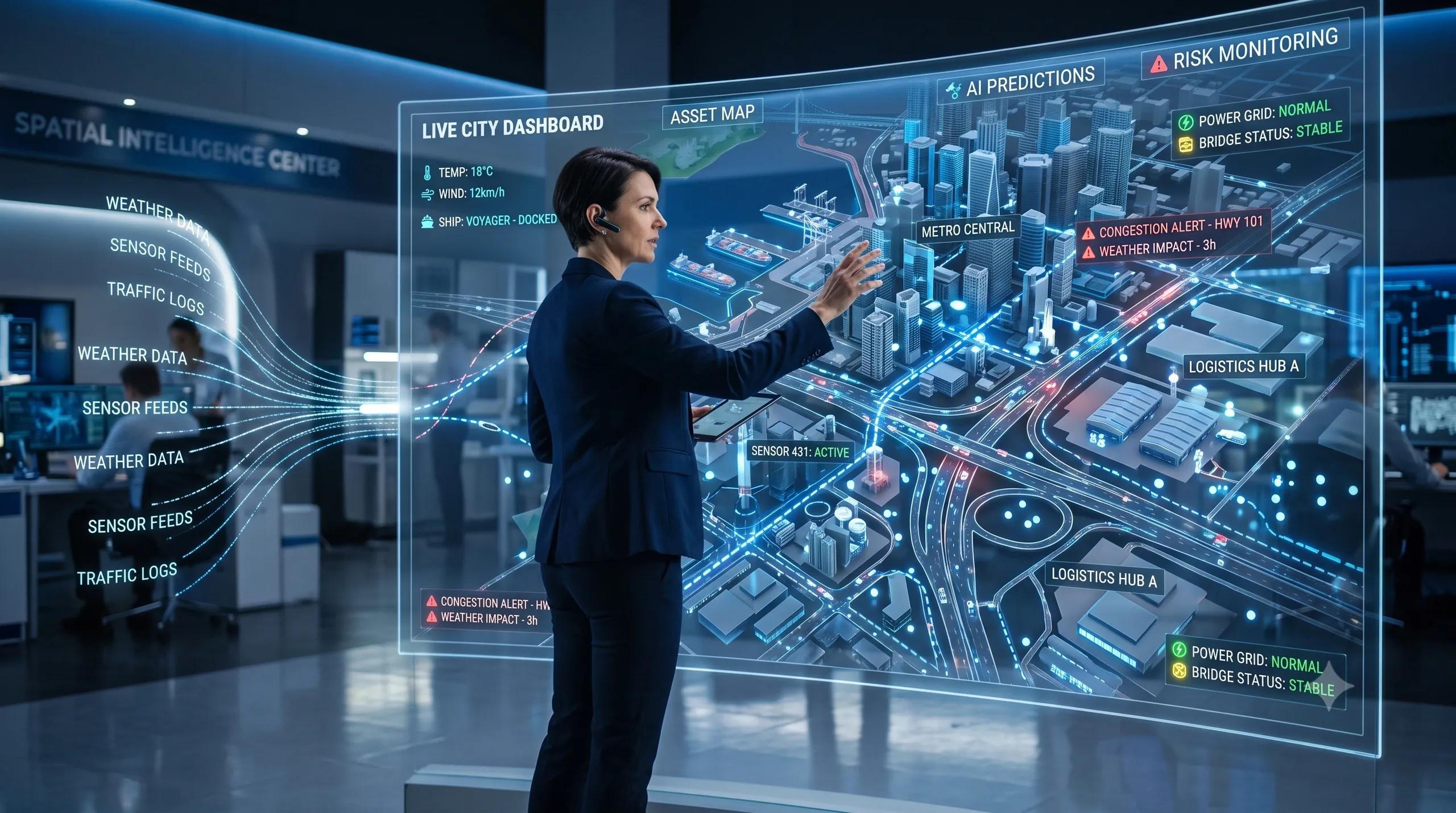
The Hidden Fear Behind Every Business Decision
Every business talks about growth, innovation, competition, and transformation.
But beneath all these words, there is one fear that quietly shapes every boardroom conversation, every operational review, every investment decision, and every digital transformation roadmap.
The fear of losing predictability.
Businesses can handle risk.
They can handle competition.
They can handle temporary losses.
They can even handle disruption, if they can understand its direction, timing, and impact.
What they cannot handle for long is not knowing what is coming next.
When demand becomes uncertain, planning weakens.
When costs fluctuate without warning, margins come under pressure.
When assets fail unexpectedly, operations become reactive.
When customer behavior changes faster than reporting cycles, strategy starts lagging behind reality.
When climate, supply chains, regulations, workforce availability, and infrastructure conditions keep shifting, leadership loses confidence in its own decisions.
That is when the real business problem begins.
Not the absence of data.
Not even the absence of technology.
The real problem is the absence of operational predictability.
Why Static Reporting Is No Longer Enough
For decades, businesses tried to manage predictability through reports, dashboards, meetings, spreadsheets, periodic inspections, and retrospective reviews.
These systems were useful when the operating environment was relatively stable.
A monthly report could explain what happened.
A quarterly review could guide course correction.
An annual plan could give direction.
But the world no longer moves at the speed of static reporting.
Supply chains shift in days.
Weather events disrupt infrastructure within hours.
Asset failures can affect service delivery immediately.
Customer expectations change continuously.
Regulations are becoming more dynamic.
Carbon, sustainability, safety, compliance, and resilience are no longer background concerns. They are becoming operating realities.
In this environment, static reports are not enough.
They tell us what happened.
They rarely tell us what is happening.
They almost never tell us what is likely to happen next.
This is why businesses are moving from static reports to live intelligence systems.
The goal is not only visibility.
The goal is to restore predictability in an increasingly volatile operating environment.
The New Role of Geospatial Intelligence
This is where geospatial intelligence, digital twins, IoT, AI, BIM, remote sensing, UAVs, and enterprise data systems begin to matter in a new way.
Not as isolated technologies.
Not as innovation showcases.
Not as digital decoration.
But as the intelligence layer that helps organizations understand reality before it turns into risk.
A map by itself does not restore predictability.
A dashboard by itself does not restore predictability.
A sensor by itself does not restore predictability.
A BIM model by itself does not restore predictability.
Even AI, without context, does not restore predictability.
Predictability emerges when physical reality, spatial context, asset data, operational systems, and decision logic are connected.
That connection is becoming the new foundation of business intelligence.
Predictability Is a Spatial Problem
Most business risks do not appear in isolation.
They happen somewhere.
A delayed shipment has a location.
A flooded road has a location.
A failing transformer has a location.
A weak bridge has a location.
An encroachment has a location.
A crop stress zone has a location.
A carbon claim has a location.
A safety incident has a location.
A business opportunity also has a location.
This is why geospatial intelligence is becoming more than a technical function.
It is becoming a business predictability layer.
For asset-heavy sectors, this shift is especially important.
Infrastructure, utilities, transportation, energy, mining, agriculture, logistics, manufacturing, and smart cities all operate in physical environments. Their risks are not abstract. Their assets are distributed. Their decisions are location-dependent. Their failures have real-world consequences.
The question is no longer only: “Where are our assets?”
The stronger question is:
“What is changing around them, what does it mean, and what should we do next?”
From Visibility to Anticipation
Take infrastructure as an example.
A highway authority does not only need to know where its roads are.
It needs to know which sections are deteriorating, which bridges are under stress, which traffic patterns are changing, which locations are exposed to flooding, which maintenance actions are overdue, and which risks may affect service continuity.
A utility company does not only need a network map.
It needs to know which assets are vulnerable, where demand is rising, where leakage or failure is likely, where vegetation or encroachment may create risk, and how field teams should be prioritized.
A smart city does not only need a command center.
It needs a live operating picture of mobility, drainage, utilities, public assets, energy use, safety, environment, and citizen impact.
A real estate or industrial facility owner does not only need BIM models.
They need a working digital twin that connects space, equipment, occupancy, energy, maintenance, safety, and cost.
An agriculture enterprise does not only need satellite imagery.
It needs predictive insight on soil, water, crop health, climate exposure, input usage, yield risk, and market-linked decisions.
In every case, the question is not: “Do we have data?”
The question is:
“Can we use data to reduce uncertainty?”
That is the real business value.
Why Many Digital Transformation Projects Fail
Many digital transformation projects fail because they start with technology instead of predictability.
Organizations buy platforms.
They build dashboards.
They deploy sensors.
They digitize workflows.
They create visualizations.
But after the excitement fades, leaders still ask the same questions:
What is at risk?
What will fail?
Where should we invest?
What should we prioritize?
Which decision will create the highest impact?
What will happen if we delay action?
If the system cannot answer these questions, it may be digital, but it is not yet strategic.
This is why the next stage of geospatial technology must move beyond mapping and visualization.
The future is not just about seeing assets on a map.
It is about understanding how location, time, condition, behavior, and consequence interact.
It is about moving from “where is it?” to “what does it mean?”
From “what happened?” to “what is changing?”
From “what changed?” to “what should we do next?”
The Intelligence Stack for Predictable Operations
Predictability improves when multiple layers of intelligence work together.
When geospatial intelligence connects with digital twins, it gives organizations a live model of their operating environment.
When it connects with IoT, it brings real-time signals from the field.
When it connects with AI, it helps detect patterns, forecast risks, and recommend actions.
When it connects with BIM, it links built assets to their spatial and operational context.
When it connects with UAVs, satellites, LiDAR, and remote sensing, it keeps the digital model aligned with physical reality.
When it connects with ERP, EAM, CRM, and project systems, it links operational intelligence with business decisions.
This is where the real transformation begins.
A digital twin should not be treated as a 3D model.
It should be treated as a decision environment.
A geospatial platform should not be treated as a map viewer.
It should be treated as a spatial intelligence system.
IoT should not be treated as a sensor network.
It should be treated as a real-time evidence layer.
AI should not be treated as a magic engine.
It should be treated as a decision-support capability that needs context, governance, and trusted data.
The purpose of all these technologies is not to make organizations look more digital.
The purpose is to help them act with more confidence.
Predictability Does Not Mean Certainty
Predictability does not mean knowing everything.
No business can fully predict markets, climate, customer behavior, policy changes, or operational shocks.
But a mature intelligence system can reduce blind spots.
It can detect weak signals earlier.
It can show risk concentration.
It can connect cause and effect.
It can help leaders compare scenarios.
It can turn fragmented data into informed action.
That is enough to change how decisions are made.
For business leaders, this creates a simple test.
Do your current systems only explain the past?
Or do they help you understand the present and prepare for what is coming?
Can your teams see risk before it becomes disruption?
Can your organization connect field reality with boardroom decisions?
Can your data support prioritization, not just reporting?
Can your digital systems improve timing, confidence, and accountability?
If the answer is no, then the issue is not only a technology gap.
It is a predictability gap.
And in today’s business environment, that gap is becoming expensive.
The Future Belongs to Businesses That Can Anticipate
The companies that win in the next decade will not be the ones with the most dashboards.
They will be the ones that build intelligence systems capable of connecting reality, data, context, and action.
They will know where their risks are forming.
They will understand how their assets are performing.
They will respond faster to change.
They will allocate resources with better confidence.
They will move from reactive management to informed anticipation.
That is the real promise of geospatial technology.
Not better maps alone.
Not smarter dashboards alone.
Not more data alone.
But better business predictability.
Because when organizations lose predictability, they lose control.
And when they restore predictability, they regain the ability to plan, invest, operate, and grow with confidence.
The future of digital transformation is not only about becoming more connected.
It is about becoming less blind.
It is about building systems that help businesses see change before it becomes crisis.
And in that future, geospatial intelligence will not sit at the edge of business strategy.
It will sit at the center of how organizations understand, manage, and shape their operating reality.