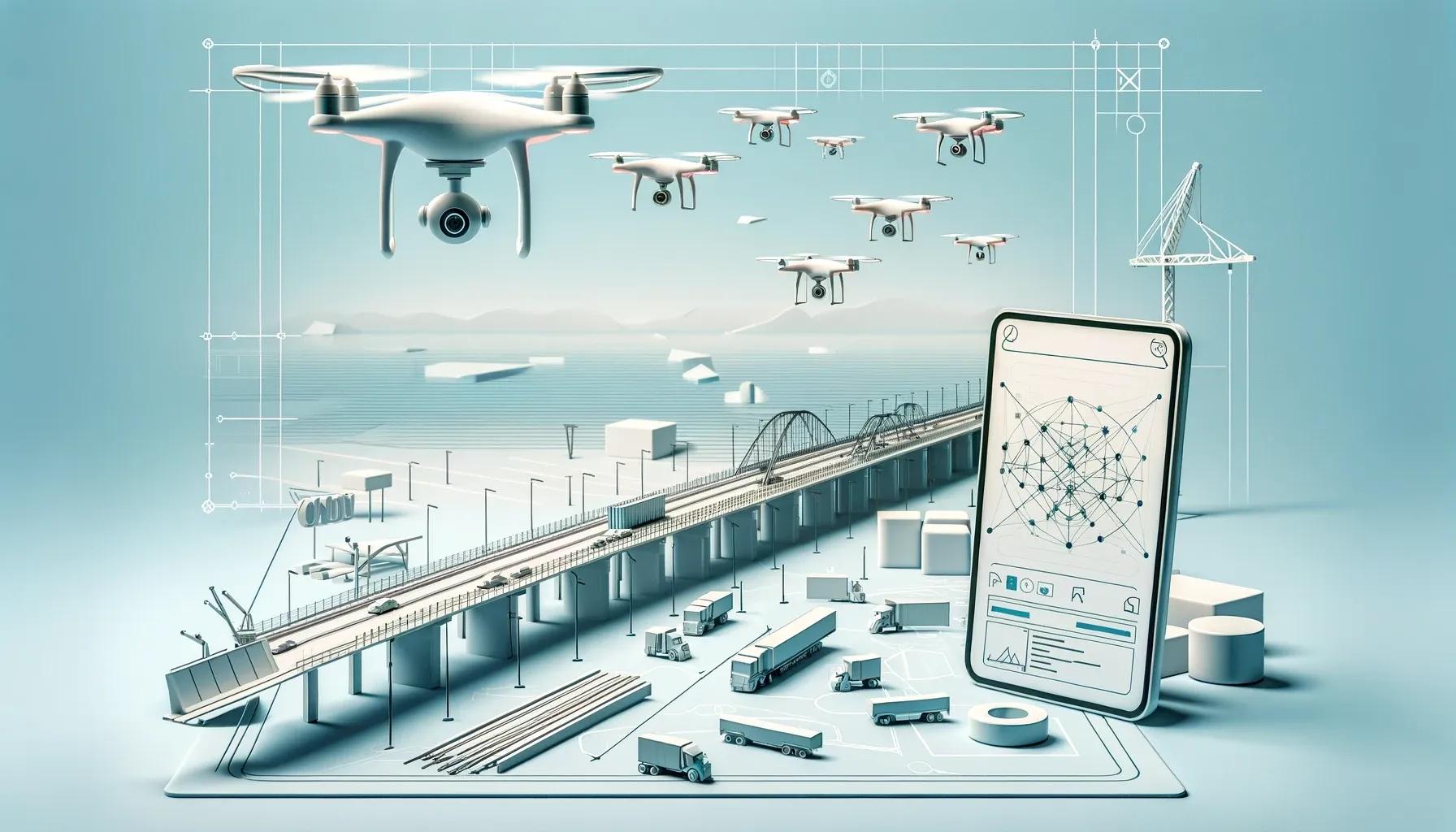
The construction industry is notorious for its slow pace of innovation. However, in recent years, we've seen a surge in the adoption of new technologies, such as Building Information Modeling (BIM) and drones. These technologies have the potential to revolutionize the way we build, and when integrated together, the possibilities are truly exciting.
BIM: The Digital Twin
BIM is a process for creating and managing a 3D model of a building or infrastructure project. This model contains not just geometric information but also data about the building's components, systems, and materials. This data can be used to improve collaboration, communication, and decision-making throughout the construction process.
Drones: The Flying Eyes
Drones, also known as Unmanned Aerial Vehicles (UAVs), are small, unmanned aircraft that can be equipped with cameras, sensors, and other payloads. They offer a unique perspective on construction sites, allowing for data collection and inspection that would be difficult or dangerous to do with traditional methods.
Integrating BIM and Drones: A Powerful Combination
When BIM and drones are integrated, the results can be truly transformative. Drones can be used to:
Collect data for BIM models: Drones can capture high-resolution aerial images and videos of construction sites. This data can be used to create accurate 3D models of the site, including progress tracking, as-built documentation, and volume calculations.
Perform inspections: Drones can be equipped with cameras and sensors to inspect buildings and infrastructure for safety hazards, quality defects, and other issues. This can help identify problems early on and prevent costly delays and rework.
Monitor progress: Drones can be used to track progress on construction projects, providing valuable insights to project managers and stakeholders. This data can be used to improve planning and scheduling, and to identify potential problems early on.
Material delivery: Drones can be used to deliver materials to remote or difficult-to-access areas on construction sites. This can improve efficiency and reduce costs.
Case Studies: Real-World Examples
Several construction companies have already begun to integrate drones and BIM with great success. For example, Skanska, a Swedish construction company, used drones to inspect a bridge project in Stockholm. The drones collected data that was used to create a 3D model of the bridge, which helped to identify several safety hazards. By fixing these hazards early on, Skanska was able to avoid costly delays and injuries.
Another example is AECOM, a global engineering and construction firm. AECOM used drones to survey a large construction site in Saudi Arabia. The drones collected data that was used to create a 3D model of the site, which helped to improve communication and collaboration among the different teams involved in the project.
Expert Opinions
Industry experts are bullish on the future of drones and BIM in the construction industry. For example, Ken Simonson, chief economist for the Associated General Contractors of America, said that "drones are going to be a game-changer for the construction industry." He added that "drones will allow us to do things that we can't do now, and they will make us more efficient and more productive."
Similarly, Frank Gehry, Pritzker Prize-winning architect, said that "drones are going to revolutionize the way we design and build buildings." He added that "drones will allow us to create more complex and beautiful buildings, and they will make the construction process more efficient."
The Future is Bright
The integration of drones and BIM is still in its early stages, but the potential is clear. These technologies have the potential to revolutionize the construction industry by:
Improving efficiency and productivity
Reducing costs
Enhancing safety
Improving quality
Increasing sustainability
As these technologies continue to develop and become more affordable, we can expect to see them used on a wider range of construction projects. This will ultimately lead to a more efficient, productive, and sustainable construction industry.
In conclusion, the future of construction is bright, and drones and BIM are playing a key role in shaping it. By integrating these technologies, we can create a construction industry that is more efficient, productive, and sustainable. With continued innovation and development, the sky is the limit for what we can achieve.