For the last 60 days, we’ve focused on one core idea:
closing the gap between design intent and field reality .
The next step is inevitable.
The future of BIM-to-Field is not just better coordination or faster feedback.
It is delegation , where systems don’t just inform humans, but act on their behalf .
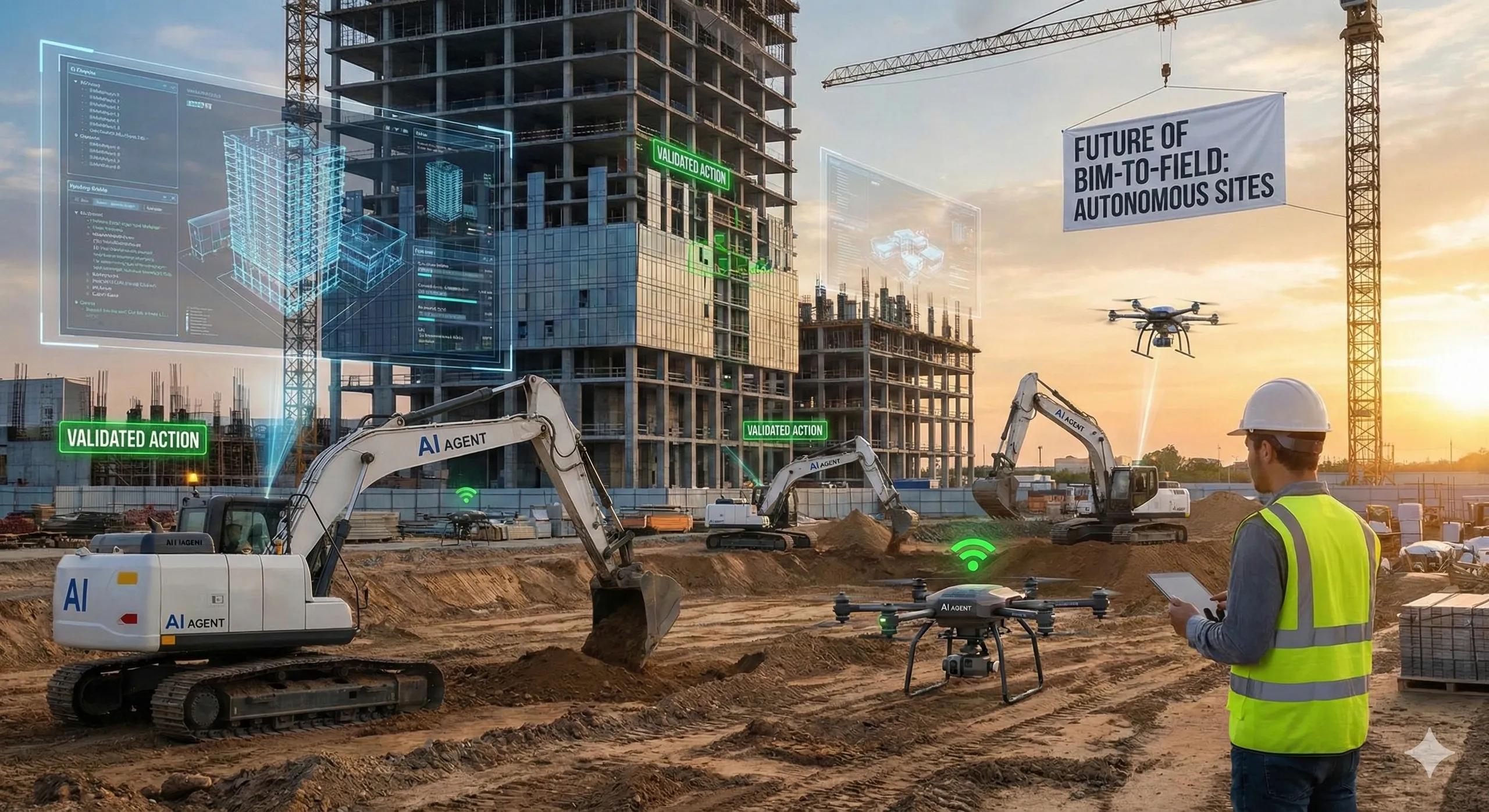
Welcome to the era of autonomous construction sites and AI agents .
1. Why Automation Alone Is Not Enough
Construction has already automated:
Modeling
Clash detection
Quantity takeoffs
Reporting
Yet the field still depends on:
Manual decisions
Human follow-ups
Delayed reactions
Automation speeds tasks.
Autonomy changes who decides and when .
2. What “Autonomous” Really Means in Construction
Autonomy does not mean no humans.
It means:
Systems sense conditions in real time
Decisions are made within defined boundaries
Actions are triggered automatically
Humans supervise, intervene, and optimize
The site becomes self-aware, not self-willed .
3. The Role of BIM in Autonomous Sites
BIM is not replaced, it becomes the instruction manual for machines .
BIM provides:
Geometry for spatial reasoning
Rules and constraints
Asset identity
Process logic
Without BIM, autonomy has no structure.
4. AI Agents: The New Site Managers
AI agents operate across layers:
Monitoring progress and quality
Interpreting sensor data
Flagging risks before thresholds are crossed
Optimizing schedules dynamically
Coordinating logistics
They don’t replace site managers; they absorb cognitive load .
5. From Alerts to Actions
Today:
Sensor → alert → email → meeting → decision
Tomorrow:
Sensor → AI agent → validated action → human oversight
Examples:
Auto-resequence work when delays propagate
Adjust logistics routes based on live congestion
Halt unsafe operations when risk thresholds are crossed
Latency disappears.
6. Why This Will Start in High-Risk Zones
Autonomy will first appear where:
Safety risk is high
Margins are tight
Scale is large
Repetition exists
Think:
Infrastructure corridors
Mega industrial projects
Energy facilities
High-rise repetitive floors
Not because they’re futuristic, because failure is expensive .
7. Governance Becomes the Real Challenge
Autonomous sites demand answers to:
Who defines decision boundaries?
Who is accountable when systems act?
How is bias avoided?
How are overrides handled?
The future problem is not technology.
It is trust and governance .
8. India Context: Leapfrogging Is Possible
India doesn’t need to replicate every step of global evolution.
With:
Young digital workforce
Large-scale infrastructure push
Cost sensitivity driving efficiency
India can skip fragmented digitization and move toward integrated, agent-driven workflows faster than expected.
9. What Survives in an Autonomous Future
What will always matter:
Clear intent
Verified data
Human judgment
Ethical boundaries
Autonomous systems amplify discipline.
They expose chaos.
10. The Final BIM-to-Field Truth
The future site won’t ask, “What should we do next?”
It will ask, “Is this within the rules, and if not, why?”
Conclusion
BIM-to-Field integration has been about alignment .
Autonomous sites are about anticipation .
When BIM, IoT, AI agents, and governance converge:
Sites respond faster than humans can
Risk is managed proactively
Decisions scale without overload
The future of construction isn’t human vs machine.
It’s humans defining intent and systems executing it faithfully .