The future of Digital Twins may not be about creating better digital replicas.
It may be about building systems that can sense, learn, adapt, and continuously evolve .
Introduction: The Next Stage of Digital Twin Maturity
In the previous article, we discussed how organizations must become Digital Twin-ready before they can scale these technologies effectively.
Today, we move toward the larger future direction.
For many years, Digital Twins have been described as digital representations of physical assets, systems, or processes.
That definition was useful in the early stages.
But as Digital Twins begin integrating:
real-time IoT data
geospatial intelligence
BIM and engineering models
AI and predictive analytics
event-driven workflows
edge computing
XR interfaces
governance and feedback loops
they are no longer just representations.
They are becoming living systems .
A living system is not static.
It changes with the environment.
It learns from feedback.
It adapts to new conditions.
It responds to signals.
It evolves over time.
That is where the future of Digital Twins is heading.
The Core Shift: From Digital Representation to Adaptive Intelligence
A traditional Digital Twin answers:
👉 What does the asset look like?
👉 What is its current condition?
👉 What data is coming from sensors?
👉 What is the performance trend?
A more mature Digital Twin answers:
👉 What is changing?
👉 Why is it changing?
👉 What may happen next?
👉 What action should be taken?
👉 What did we learn from the outcome?
But a living system goes one step further.
It continuously adjusts its understanding of the physical world based on new evidence.
This means the Twin is no longer only a model of reality.
It becomes a continuously learning operational layer.
Why “Living Systems” Matter
The real world is dynamic.
Cities change.
Roads deteriorate.
Machines wear out.
Weather patterns shift.
Supply chains get disrupted.
Energy demand fluctuates.
Land use changes.
Workforces move.
Risks emerge unexpectedly.
A Digital Twin that remains static quickly becomes outdated.
A living system stays connected to change.
It does not only store information.
It continuously updates context.
That is the difference between a digital model and a living operational system.
1. Living Systems Sense Continuously
The first characteristic of a living system is sensing.
Digital Twins increasingly receive data from:
IoT sensors
cameras
drones
satellites
LiDAR
SCADA systems
ERP and CMMS platforms
field applications
weather feeds
mobility data
energy meters
environmental sensors
This creates a continuous stream of signals.
But sensing alone is not enough.
A system must know which signals matter.
A water-level sensor, machine vibration spike, traffic slowdown, temperature rise, structural movement, or power load variation may all be important.
But their meaning depends on context.
That is where Digital Twins begin to evolve into living systems.
They do not simply collect signals.
They interpret them.
2. Living Systems Understand Context
In the physical world, data has meaning only when placed in context.
A temperature rise in one machine may be normal.
The same temperature rise in another machine may indicate failure.
A traffic jam may be routine during peak hours.
The same traffic jam during an emergency may become a risk.
A water-level increase may be acceptable during monsoon.
But combined with rainfall forecast, drainage blockage, and vulnerable settlements, it becomes a disaster warning.
Living systems connect data with:
location
time
asset condition
environmental exposure
operational state
historical behavior
risk thresholds
business rules
decision workflows
This contextual intelligence is what separates a dashboard from a Digital Twin-based operating system.
3. Living Systems Learn from Feedback
The most important feature of a living system is learning.
A Digital Twin should not only predict.
It should learn whether its prediction was useful.
For example:
If a Twin predicts equipment failure and maintenance is done, the system should record:
Was the prediction correct?
Was the intervention timely?
Was downtime avoided?
Was the cost justified?
Did the model improve?
Did the workflow respond correctly?
Similarly, in flood management:
Was the predicted inundation accurate?
Were evacuation routes usable?
Did alerts reach the right teams?
Which communities were affected?
What should be changed for the next event?
This feedback loop is critical.
Without feedback, the Twin remains a one-way intelligence system.
With feedback, it becomes adaptive.
4. Living Systems Can Act
A mature Digital Twin should not stop at insight.
It should help trigger action.
This may include:
generating work orders
sending alerts
recommending maintenance
adjusting machine parameters
activating emergency response
rerouting traffic
optimizing energy load
updating inspection schedules
escalating compliance risks
guiding field teams
In some cases, the action may remain human-approved.
In other cases, low-risk actions may become automated.
The key is governance.
A living system should not act blindly.
It should act within defined boundaries, rules, permissions, and accountability structures.
This is where the future of Digital Twins will depend on controlled autonomy.
5. Living Systems Are Governed
A system that senses, learns, and acts must also be governed.
Without governance, intelligence can become risk.
Governance defines:
who owns the data
who validates the model
who approves action
what can be automated
when human review is required
how decisions are logged
how errors are corrected
how privacy is protected
how cybersecurity is managed
As Digital Twins move toward living systems, governance becomes part of the runtime architecture.
It cannot remain a policy document sitting outside the system.
It must be embedded into workflows, permissions, audit trails, and decision logic.
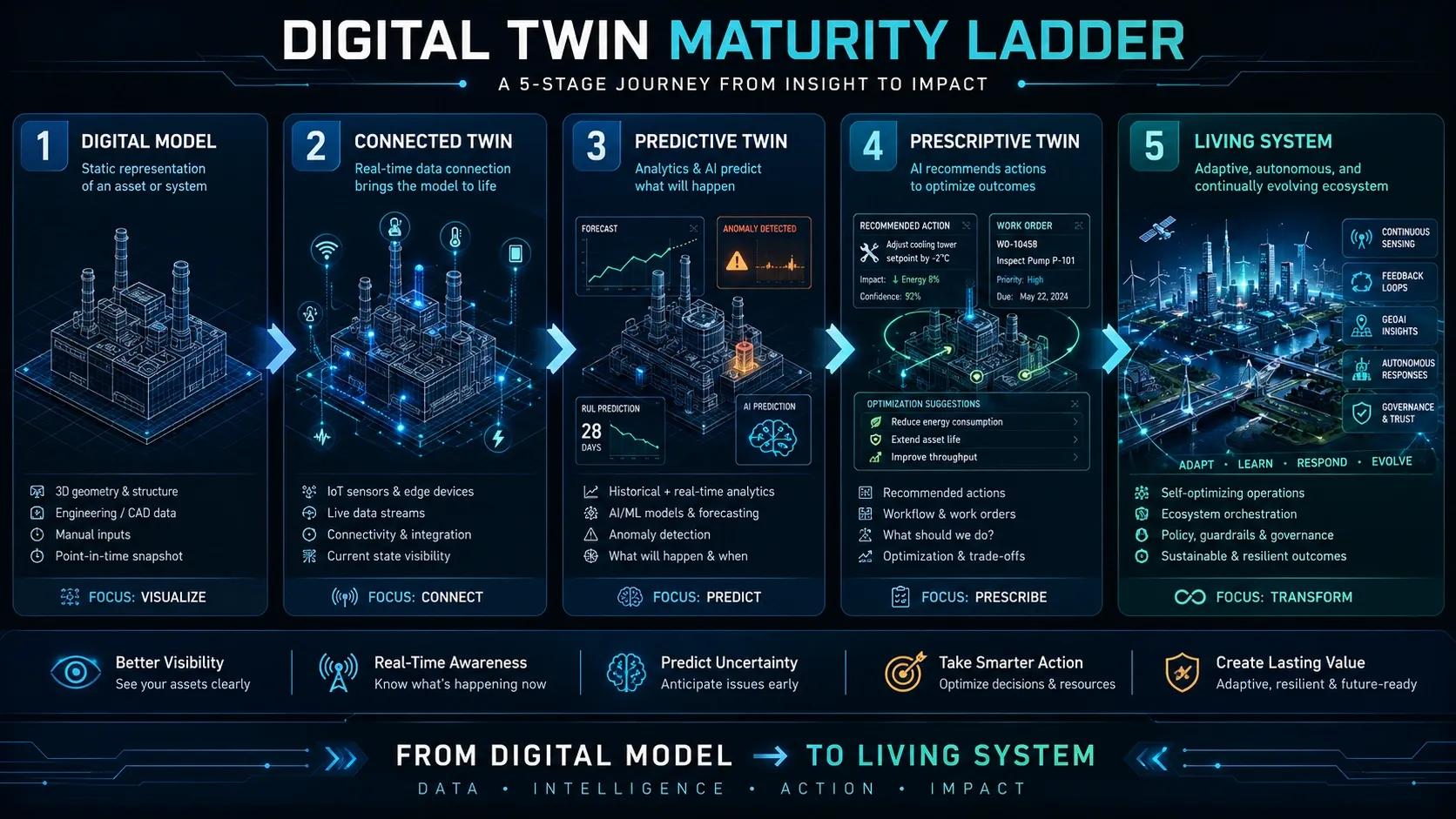
From Static Twin to Living System: A Maturity Path
The evolution can be understood in five stages.
Stage 1: Digital Model
The organization creates a 3D model, BIM model, GIS map, or asset representation.
This helps improve visualization and documentation.
Stage 2: Connected Twin
The model is connected to live or periodic data from sensors, systems, or field updates.
This enables monitoring.
Stage 3: Predictive Twin
AI and analytics are added to predict risks, failures, demand, or performance changes.
This enables anticipation.
Stage 4: Prescriptive Twin
The system recommends what action should be taken, by whom, and when.
This enables decision support.
Stage 5: Living System
The Twin senses, learns, adapts, acts within governance boundaries, and improves continuously.
This enables operational intelligence at scale.
Example: Smart City as a Living System
A smart city Digital Twin may begin as a 3D city model.
Then it connects to traffic sensors, air quality stations, water networks, waste systems, utilities, and public infrastructure.
As it matures, it can predict:
traffic congestion
flood risk
utility demand
heat island impact
public service gaps
infrastructure stress
But as a living system, it goes further.
It can continuously learn from city behavior and recommend:
where traffic signals should be adjusted
where drainage cleaning should be prioritized
where emergency vehicles should be routed
where energy load should be balanced
where public services should be expanded
The city is no longer just mapped.
It becomes responsive.
Example: Factory as a Living System
A factory Twin may start with machine models and production dashboards.
Then it connects to PLCs, cameras, metrology systems, IoT sensors, ERP, MES, and quality systems.
As it matures, it can predict:
machine failure
quality deviation
production bottlenecks
energy inefficiency
safety risks
As a living system, the factory can adapt in real time.
It can:
adjust machine parameters
trigger quality checks
rebalance production flow
alert technicians
update maintenance schedules
learn from defects
refine process settings
This is where the Digital Twin becomes part of the operating rhythm of the factory.
Example: Infrastructure Networks as Living Systems
Highways, railways, utilities, ports, pipelines, and telecom networks are not static assets.
They are constantly exposed to weather, load, usage, degradation, and external disruption.
A living infrastructure Twin can connect:
asset condition
geospatial exposure
inspection history
traffic or load patterns
environmental risk
maintenance records
field reports
predictive models
It can then help prioritize interventions based on:
risk
urgency
cost
criticality
service impact
safety exposure
This allows infrastructure owners to move from scheduled maintenance to adaptive maintenance.
Why GeoAI Will Be Central to Living Systems
Living systems need spatial intelligence.
Every physical system exists somewhere.
Location influences:
risk
access
exposure
demand
maintenance priority
environmental impact
operational performance
GeoAI helps living systems understand spatial patterns.
It can identify:
where risk is emerging
where assets are degrading faster
where demand is shifting
where interventions should happen first
where environmental change is affecting operations
This is why the future of Digital Twins will be closely linked to geospatial intelligence.
The more physical the system, the more spatial the intelligence must be.
Indian Context
India is entering a phase where Digital Twins can support national-scale decision-making.
The opportunity is visible across:
smart cities
PM GatiShakti-linked infrastructure planning
highways
railways
ports
airports
utilities
industrial corridors
water systems
agriculture
disaster management
healthcare infrastructure
But India’s challenge is not only to build Digital Twins.
The challenge is to build adaptive systems that can respond to complexity.
India’s infrastructure, population density, climate variability, urban growth, and regional diversity require systems that can continuously update and learn.
A static model will not be enough.
India needs living Digital Twin ecosystems that can support:
resilience planning
climate response
infrastructure maintenance
logistics optimization
urban governance
public service delivery
industrial productivity
disaster preparedness
This is where the next decade can become very important.
The Risk: Living Systems Without Accountability
As Digital Twins become more adaptive, there is also risk.
A system that learns and acts must be explainable.
Organizations must avoid creating black-box operational systems.
Important questions must be answered:
👉 Why did the system recommend this action?
👉 What data was used?
👉 Which model produced the insight?
👉 Who approved the action?
👉 Was the outcome recorded?
👉 Can the decision be audited?
👉 What happens if the system is wrong?
Living systems must not only be intelligent.
They must be accountable.
What Organizations Should Prepare For
To move toward living systems, organizations should prepare across six areas:
1. Continuous Data Pipelines
Data should flow reliably from sensors, field teams, enterprise systems, and geospatial sources.
2. Contextual Models
The Twin must understand assets, location, time, risk, workflows, and operational rules.
3. Feedback Loops
Every prediction, action, and outcome should improve future intelligence.
4. Human-in-the-Loop Governance
High-impact decisions should remain reviewable and accountable.
5. Interoperable Architecture
GIS, BIM, IoT, ERP, CMMS, AI, and field systems must connect.
6. Change-Ready Culture
Teams must be ready to act on insights, not only observe them.
Conclusion
The future of Digital Twins is not just better visualization.
It is not only predictive analytics.
It is not only AI or automation.
The future is the rise of living systems .
Systems that sense.
Systems that learn.
Systems that adapt.
Systems that act.
Systems that remain governed.
This is the next evolution:
👉 from digital model
To
👉 connected Twin
To
👉 predictive Twin
To
👉 prescriptive Twin
To
👉 living system
For organizations, the opportunity is enormous.
But the responsibility is equally large.
Because when Digital Twins become living systems, they begin to shape how the physical world is planned, operated, maintained, and governed.
The real question is no longer:
👉 Can we create a Digital Twin?
The real question is:
👉 Can we create a living system that improves decisions responsibly over time?