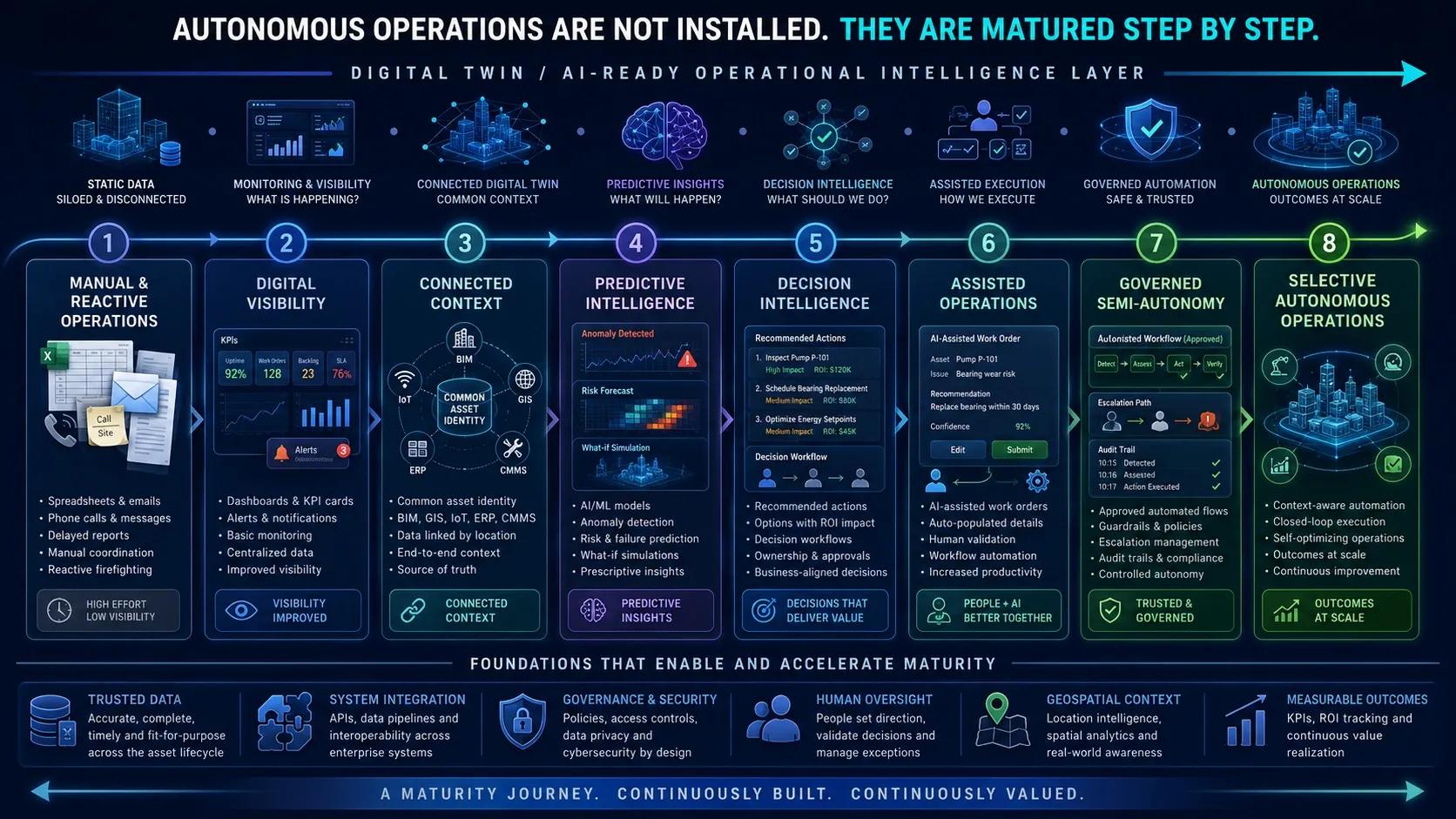
Autonomous operations have become an attractive idea for many enterprises.
The vision is powerful.
Assets that monitor themselves.
Systems that detect risk early.
AI that recommends the next best action.
Workflows that trigger automatically.
Operations that respond faster.
Decisions that become more data-driven, predictive, and intelligent.
But autonomous operations do not happen suddenly.
They are not achieved by deploying one AI tool, one Digital Twin, one dashboard, or one automation platform.
They require maturity.
Enterprises must first build the foundations of trusted data, connected systems, contextual intelligence, decision workflows, governance, and human oversight.
Without these foundations, autonomy can become risky, fragmented, or unreliable.
This is why organizations need to understand the enterprise maturity path toward autonomous operations.
Autonomous Operations Are Not the Starting Point
Many organizations want to move directly to automation.
They want AI to predict problems.
They want systems to recommend action.
They want workflows to trigger automatically.
They want human effort to reduce.
They want decisions to become faster and more consistent.
These are valid goals.
But autonomy is not the first step.
Autonomy is the result of a mature operating model.
Before an enterprise can automate decisions, it must first understand how those decisions are made.
Before AI can recommend actions, it must understand the operational context.
Before workflows can trigger automatically, ownership and governance must be clear.
Before systems can act intelligently, data must be trusted.
Autonomous operations are built step by step.
The Maturity Question
The key question is not:
How quickly can we automate?
The better question is:
Which decisions are mature enough to support automation?
Some decisions may be ready for automation.
Some may require AI-assisted recommendations.
Some may need human approval.
Some may remain fully human-driven because of safety, complexity, regulation, or business sensitivity.
This distinction matters.
An enterprise maturity path helps organizations decide where they are, what should come next, and how to scale responsibly.
Level 1: Manual and Reactive Operations
At the first level, operations are largely manual and reactive.
Data exists, but it is scattered.
Teams depend on spreadsheets, emails, phone calls, field updates, paper records, and individual experience.
Issues are often addressed after they become visible.
Maintenance happens after failure.
Reports are prepared manually.
Decisions depend on meetings and follow-ups.
Data is difficult to trust.
Asset records may be incomplete.
Workflows are informal.
This is where many organizations begin.
The challenge at this level is not AI.
The challenge is operational visibility and data discipline.
Before moving toward autonomy, organizations must first understand what is happening across assets, systems, and workflows.
Level 2: Digital Visibility
The second level is digital visibility.
At this stage, organizations begin digitizing records, building dashboards, deploying sensors, and using digital platforms.
They may have ERP, BIM, GIS, IoT, CMMS, SCADA, and reporting tools.
This improves visibility.
Teams can see asset status.
Managers can monitor KPIs.
Leadership can review dashboards.
Alerts can be captured.
Historical data becomes more accessible.
This is an important stage.
But it is not the same as intelligence.
A dashboard may show what is happening, but decisions may still depend on manual interpretation.
Teams may still move across systems to understand context.
Data may still be duplicated.
Workflows may still be disconnected.
At this level, organizations can see more, but they may not yet decide faster.
Level 3: Connected Context
The third level is connected context.
This is where the enterprise starts connecting data across systems.
BIM connects engineering and asset information.
GIS connects location, networks, routes, and spatial risk.
IoT provides real-time operational signals.
ERP connects cost, procurement, inventory, and financial impact.
CMMS connects maintenance history and work orders.
Digital Twins begin connecting physical assets with digital information.
At this stage, the organization begins to understand the meaning behind data.
A sensor alert is linked to an asset.
The asset is linked to location.
The location is linked to risk exposure.
Maintenance history is linked to performance.
Cost data is linked to business impact.
Workflows are linked to ownership.
This is a major maturity shift.
The enterprise moves from simply seeing data to understanding operational context.
This is where AI readiness begins.
Level 4: Predictive Intelligence
The fourth level is predictive intelligence.
At this stage, AI and analytics begin supporting operations.
The organization can start identifying patterns, forecasting risks, detecting anomalies, and anticipating future conditions.
AI may predict asset failure.
Analytics may forecast energy demand.
Computer vision may detect defects.
Models may identify risk zones.
Algorithms may prioritize maintenance.
Simulations may test future scenarios.
But prediction alone is not enough.
A prediction becomes valuable only when it is connected to context and action.
If AI predicts a failure, the organization must know which asset is affected, where it is located, how critical it is, what workflow should follow, what the business impact is, and who should approve action.
This is why predictive intelligence must be connected with Digital Twins, geospatial intelligence, workflows, governance, and human oversight.
At this level, the organization begins moving from reactive operations to proactive operations.
Level 5: Decision Intelligence
The fifth level is decision intelligence.
This is where enterprise systems begin supporting not only visibility and prediction, but decisions.
The system can help answer:
What is happening?
Why is it happening?
Where does it matter?
What may happen next?
What action should be taken?
Who should act?
What value will the action create?
How will the outcome be measured?
This is the point where AI, Digital Twins, BIM, GIS, IoT, ERP, CMMS, and workflows start working together as an operational intelligence layer.
A decision intelligence system can generate recommendations, show explanations, assign priority, trigger workflows, and measure outcomes.
For example:
An asset risk is detected.
The system identifies the asset, location, failure pattern, maintenance history, spare availability, downtime cost, and business impact.
It recommends action.
A human reviewer validates the recommendation.
A work order is created.
The outcome is tracked.
The system learns from the result.
This is where AI becomes operationally useful.
Level 6: Assisted Operations
The sixth level is assisted operations.
At this level, AI and automation begin supporting routine operational tasks under human oversight.
The system may recommend maintenance actions.
It may auto-create draft work orders.
It may prioritize field inspections.
It may suggest resource allocation.
It may flag safety risks.
It may optimize energy schedules.
It may recommend route planning.
It may provide decision options to managers.
Humans remain in control.
They validate, approve, modify, or reject recommendations.
This stage is important because it builds trust.
Teams learn how AI performs.
Models receive feedback.
Workflows are refined.
Governance is tested.
User adoption improves.
Business value becomes measurable.
Assisted operations are often the safest bridge between decision intelligence and partial autonomy.
Level 7: Semi-Autonomous Operations
The seventh level is semi-autonomous operations.
At this stage, some decisions and workflows can be automated within defined boundaries.
For example:
Low-risk maintenance alerts may automatically create work orders.
Energy optimization may adjust setpoints within approved limits.
Routine inspections may be scheduled automatically.
Field tasks may be routed based on location and priority.
Inventory alerts may trigger reorder recommendations.
Operational alerts may escalate based on predefined risk rules.
However, human oversight remains important.
High-risk actions still require approval.
Exceptions are escalated.
Audit trails are maintained.
Governance rules define boundaries.
Humans can override automation.
Performance is continuously monitored.
This is not blind automation.
It is governed autonomy.
The organization defines where automation is safe and where human judgment is required.
Level 8: Autonomous Operations
The final level is autonomous operations.
At this maturity level, systems can monitor, analyze, decide, and act in selected workflows with limited human intervention.
But even here, autonomy is not universal.
Autonomous operations should be applied selectively.
Routine, low-risk, well-governed workflows may become highly automated.
Complex, high-risk, ethical, safety-critical, or financially sensitive decisions may still require human approval.
A mature autonomous system should include:
trusted data,
real-time monitoring,
contextual Digital Twin,
geospatial intelligence,
AI models,
simulation capability,
workflow automation,
governance rules,
human override,
audit trails,
outcome measurement,
continuous learning.
Autonomy should not mean absence of accountability.
It should mean intelligent systems operating within clear boundaries.
Why Most Enterprises Are Not Yet Ready for Full Autonomy
Many organizations are still in the early stages.
They may have dashboards but not connected context.
They may have sensors but weak asset identity.
They may have BIM but incomplete operational handover.
They may have GIS but disconnected business workflows.
They may have ERP but limited connection to asset condition.
They may have AI pilots but no governance.
They may have Digital Twins but limited decision logic.
This does not mean they are failing.
It means they are still maturing.
The important step is to identify the current maturity level honestly.
Autonomous operations should not be rushed.
They should be built responsibly.
The Role of Digital Twins in the Maturity Path
Digital Twins can support the entire maturity journey.
At early stages, they improve visibility.
At intermediate stages, they connect asset, spatial, engineering, and operational context.
At advanced stages, they support prediction, simulation, decision intelligence, and workflow automation.
At higher maturity levels, they become operating environments for AI-assisted and semi-autonomous operations.
But Digital Twins must evolve beyond visualization.
They must become connected, contextual, governed, and decision-ready.
A Digital Twin should not only show the asset.
It should help the organization understand, decide, act, and learn.
The Role of Geospatial Intelligence
Geospatial intelligence is also critical in the maturity journey.
As operations become more intelligent, location becomes more important.
Where is the asset?
Where is the risk?
Which area is impacted?
Which route is available?
Which team is closest?
Which network segment is affected?
Which zone should be prioritized?
Geospatial intelligence helps AI understand place, proximity, network relationships, terrain, exposure, and service impact.
Without spatial context, autonomous operations can make incomplete decisions.
With geospatial intelligence, operational decisions become more grounded in real-world context.
The Role of Human Oversight
Even as operations become more autonomous, human oversight remains essential.
Humans define goals.
Humans set boundaries.
Humans approve high-risk actions.
Humans handle exceptions.
Humans ensure accountability.
Humans validate outcomes.
Humans manage ethics and trust.
The maturity path should not be seen as a journey from humans to machines.
It should be seen as a journey toward better human-machine collaboration.
At lower maturity levels, humans do most of the work.
At higher maturity levels, AI and automation handle more routine tasks.
But humans remain responsible for governance, judgment, and accountability.
Governance Enables Responsible Autonomy
Autonomous operations require strong governance.
Without governance, automation can create risk.
Organizations need clear rules for:
data quality,
model validation,
system access,
cybersecurity,
decision rights,
workflow approvals,
escalation paths,
audit trails,
human override,
compliance,
outcome measurement.
Governance defines where autonomy is allowed and where human approval is mandatory.
It also creates trust.
Teams are more likely to adopt AI and automation when they understand how decisions are made, who is accountable, and how risks are controlled.
Measuring Maturity
The maturity path should be measurable.
Organizations should assess:
data readiness,
asset identity,
system integration,
BIM-GIS-IoT-ERP convergence,
workflow clarity,
AI readiness,
geospatial context,
governance strength,
user adoption,
decision improvement,
ROI evidence,
automation readiness.
This helps avoid unrealistic expectations.
It also helps leadership decide which use cases are ready for AI assistance, which are ready for automation, and which still need foundational work.
Start with One Decision
The best way to begin is not to automate everything.
Start with one decision.
For example:
Which asset should be maintained first?
Which road defect should be repaired first?
Which energy action should be prioritized?
Which site risk should be escalated?
Which field team should be dispatched?
Which project delay needs intervention?
Which equipment failure is likely to affect production?
Then ask:
What data is needed?
Which systems must connect?
What context is missing?
Who owns the decision?
What workflow follows the insight?
What risk is involved?
Can AI support the decision?
Can automation safely act?
How will value be measured?
This use-case-led approach makes the maturity path practical.
Sector Examples
In manufacturing, the path may begin with machine dashboards, move to connected asset health, then predictive maintenance, then AI-assisted maintenance planning, and eventually semi-autonomous work order creation.
In buildings, the path may begin with energy dashboards, move to connected HVAC and occupancy context, then AI-based optimization, then controlled automation of comfort and energy settings.
In utilities, the path may begin with network visibility, move to GIS-linked asset intelligence, then predictive risk scoring, then AI-assisted crew dispatch, and eventually automated low-risk workflow triggers.
In construction, the path may begin with project dashboards, move to BIM-linked site progress, then AI-based delay detection, then decision workflows for rework, procurement, and schedule risk.
In smart cities, the path may begin with city dashboards, move to connected geospatial operations, then predictive risk models, then coordinated response workflows, and eventually semi-autonomous service prioritization.
In every sector, the journey is progressive.
Visibility comes first.
Context comes next.
Prediction follows.
Decision intelligence matures.
Automation becomes possible.
Closing Thought
Autonomous operations are not a single destination reached by installing AI.
They are the result of enterprise maturity.
The path begins with visibility.
It advances through connected context.
It strengthens with predictive intelligence.
It becomes useful through decision intelligence.
It scales through human oversight and governance.
It becomes autonomous only where trust, data, workflows, and accountability are strong enough.
The future of enterprise operations will not be fully manual.
It will not be blindly automated either.
It will be intelligently governed, context-aware, and increasingly autonomous where it makes sense.
The organizations that succeed will be those that understand this maturity path and move with discipline.
Because autonomous operations are not built by replacing human judgment.
They are built by connecting data, context, AI, workflows, governance, and human accountability into one intelligent operating system.