Opening Reflection
We have spent decades teaching machines to see the world.
From satellites mapping terrain to sensors tracking movement, our systems today can measure almost everything that exists in physical space. But there is a deeper question we have rarely asked:
What if space could understand how we feel within it?
Context: The Technological Shift
The evolution from Geospatial Systems to Digital Twins has been about increasing fidelity, better data, better models, better simulations. We moved from static maps to dynamic environments, from representation to near real-time synchronization.
Now, a new layer is emerging.
It is not about infrastructure.
It is not about assets.
It is not even about environments.
It is about human experience within space .
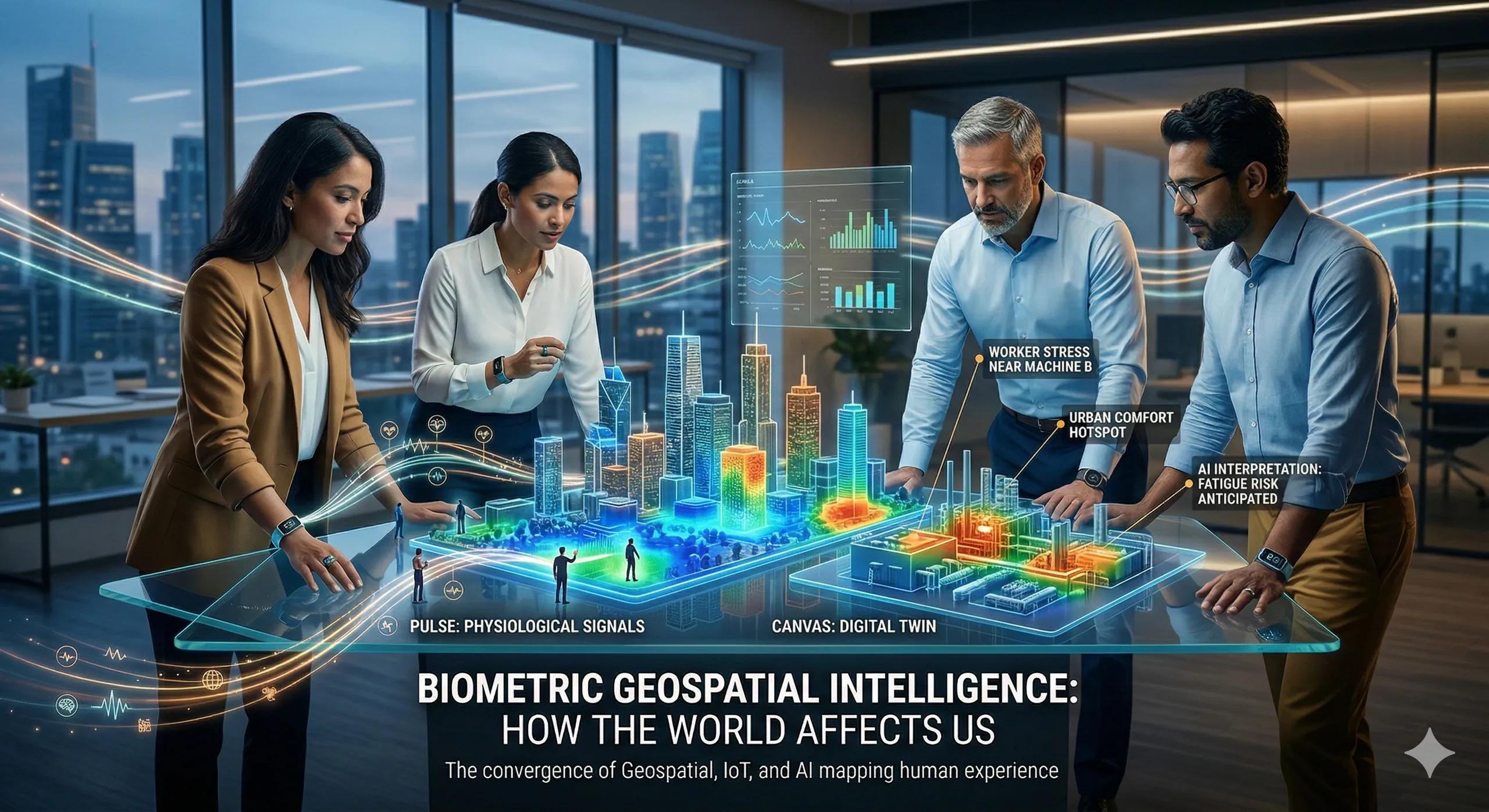
This shift is giving rise to what can be defined as Biometric Geospatial Intelligence (Bio-Geo) , a convergence of geospatial systems, IoT wearables, and AI that maps physiological human responses directly onto spatial environments.
The Deeper Question
For years, spatial intelligence has answered two fundamental questions:
What is happening?
Where is it happening?
Bio-Geo introduces a third dimension:
How is it being experienced?
This is not just a technical upgrade. It is a philosophical shift.
Because once systems begin to capture human response, stress, fatigue, cognitive load, they move from observing reality to interpreting human interaction with reality .
Spatial Intelligence Perspective
At its core, Bio-Geo is built on a simple but powerful integration:
A high-fidelity Digital Twin or BIM model (the spatial layer)
Real-time biometric data from wearables (the human layer)
AI models that correlate both (the intelligence layer)
Think of it as three layers working together:
1. The Canvas A digital representation of the physical environment, factories, cities, infrastructure systems.
2. The Pulse Continuous streams of physiological signals, heart rate variability, skin conductance, neural activity.
3. The Synthesis AI-driven interpretation that links human responses to specific spatial coordinates or events.
The result is not just a Digital Twin.
It is a system that can answer questions like:
Why do workers consistently experience stress near a specific machine?
Which part of a facility creates cognitive overload during operations?
Where in a city do people feel discomfort, not just congestion?
Real-World Implication
This convergence is already reshaping how we think about design, safety, and planning.
1. From Visualization to Experience in XR
In immersive environments, we often measure success by visual realism.
But realism does not guarantee usability.
With Bio-Geo, XR environments can track how users physiologically respond to layouts, workflows, and interactions.
Instead of asking users for feedback after a session, the system captures their response in real time.
This changes design validation from opinion-based to evidence-based.
2. Emotional Mapping in Smart Cities
Urban planning traditionally relies on metrics like traffic flow, pollution levels, and population density.
But cities are not just systems. They are lived experiences.
Bio-Geo introduces the concept of emotional heatmaps , mapping stress, comfort, or engagement across urban spaces.
A street may be efficient in movement but stressful in experience.
A public space may be underutilized not because of access, but because of discomfort.
This layer of insight changes how cities are designed, from functional optimization to human-centric planning.
3. Safety Intelligence in Hazardous Environments
In industrial and field operations, safety is often reactive.
We detect incidents after they occur.
Bio-Geo allows systems to anticipate risk by monitoring physiological signals like fatigue and stress in real time, linked with precise location data.
A worker’s elevated heart rate is no longer just a health metric.
It becomes a spatial signal , indicating a potential risk zone or unsafe condition.
This is where Digital Twins begin to move from monitoring systems to protective systems .
The “Aha” Insight
We have built systems that understand the world.
Now we are beginning to build systems that understand how the world affects us .
This is the shift from:
Data → Meaning
Observation → Interpretation
Systems → Experience
And this is where the true value of Bio-Geo lies.
Because the most critical decisions in infrastructure, cities, and industries are not just about efficiency.
They are about human response .
GeoThinking Perspective
The emergence of Biometric Geospatial Intelligence forces a rethink of what spatial intelligence should aim to achieve.
Until now, the goal has been clarity, making the invisible visible.
But visibility alone is no longer enough.
A system can show everything and still fail to guide action.
Bio-Geo introduces a new standard:
Systems must not only represent reality. They must interpret human experience within that reality.
This has deeper implications:
Digital Twins evolve from operational tools to decision companions
Geospatial systems shift from infrastructure-centric to human-centric
AI moves from pattern detection to experience interpretation
But this also raises important considerations:
Who owns biometric data?
How is consent managed in real-time environments?
Can human experience be reduced to measurable signals without losing context?
These are not technical challenges alone.
They are governance and ethical questions that will define how this technology is adopted.
Closing Reflection
There was a time when maps helped us understand the world.
Then came systems that allowed us to simulate it.
Now, we are entering a phase where systems can begin to understand how we feel within it .
The question is no longer:
Can we build these systems?
The real question is:
Are we ready to design environments that respond to human experience in real time?