Many organizations are interested in Digital Twins.
They want real-time asset visibility, predictive maintenance, better planning, 3D visualization, operational intelligence, and improved decision-making. The ambition is valid. The opportunity is real.
But one important question often gets missed:
How ready is the organization to actually benefit from a Digital Twin?
This question matters because Digital Twin success does not begin with technology deployment. It begins with readiness.
A Digital Twin can only create value when the organization has clarity on its business problem, data maturity, system integration, workflows, governance, and ROI expectations.
Without this clarity, even a technically advanced Digital Twin may become just another dashboard, model, or isolated platform.
That is why organizations need a Digital Twin Readiness Scorecard before they start building.
Why a Readiness Scorecard Matters
A scorecard helps organizations move from interest to informed action.
Instead of asking only:
“Which Digital Twin platform should we use?”
The organization first asks:
“Are we prepared to use a Digital Twin to solve a real operational problem?”
This shift is important.
The purpose of a readiness scorecard is not to discourage implementation. It is to identify where the organization currently stands and what must be strengthened before investing in a pilot or full-scale solution.
It helps answer practical questions:
Is the business problem clearly defined?
Is the asset data reliable?
Are existing systems connected?
Are users ready to adopt the solution?
Is ownership clear?
Is there a measurable ROI pathway?
When these questions are answered early, the Digital Twin journey becomes more structured and less risky.
The Six Pillars of Digital Twin Readiness
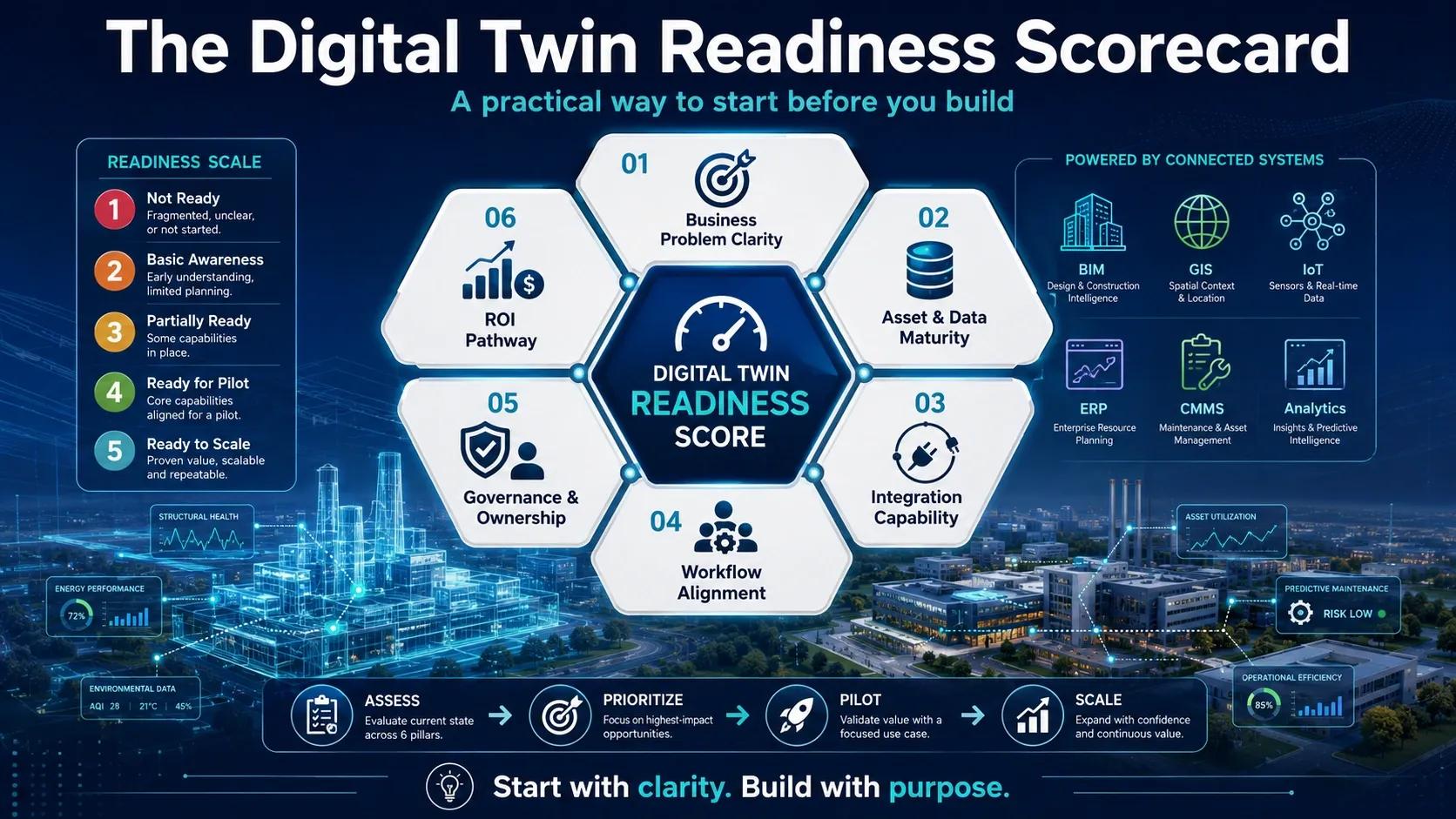
A practical Digital Twin Readiness Scorecard can be built around six key pillars.
1. Business Problem Clarity
The first pillar is clarity on the problem.
Many Digital Twin initiatives begin with a broad ambition:
“We want to build a Digital Twin.”
But this is not enough.
A better starting point is:
“Which operational decision do we want to improve?”
For example:
reducing equipment downtime,
improving energy performance,
optimizing facility maintenance,
monitoring road conditions,
improving port operations,
tracking warehouse movement,
managing city infrastructure,
improving safety response,
reducing inspection time.
The use case should be specific enough to guide implementation.
A good scorecard should ask:
What problem are we trying to solve?
Who is affected by this problem?
What is the cost of not solving it?
What decision needs to improve?
What outcome will define success?
If the problem is unclear, the Digital Twin may look impressive but fail to deliver measurable value.
2. Asset and Data Maturity
The second pillar is asset and data maturity.
A Digital Twin depends on data. But in many organizations, asset data is scattered across Excel sheets, CAD drawings, BIM models, GIS layers, ERP systems, maintenance records, IoT platforms, and manual registers.
This creates a fragmented foundation.
A readiness scorecard should check:
Is there an updated asset register?
Are assets uniquely identified?
Is location data available?
Are drawings, BIM models, or GIS layers reliable?
Is maintenance history available?
Are sensors installed?
Is real-time data accessible?
Are data formats standardized?
Who owns and updates the data?
This is one of the most important areas of readiness.
A Digital Twin is not only a 3D model. It is a connected information system. If the underlying data is incomplete, outdated, or untrusted, the twin cannot support reliable decisions.
3. Integration Capability
The third pillar is integration.
A Digital Twin becomes useful when it connects multiple systems.
These may include:
BIM,
GIS,
IoT,
ERP,
CMMS,
SCADA,
energy management systems,
security systems,
mobile applications,
document management platforms,
analytics dashboards.
The challenge is that many organizations already have these systems, but they are not properly connected.
Data moves through emails, spreadsheets, manual exports, screenshots, and repeated follow-ups.
A scorecard should ask:
Which systems need to be connected?
Are APIs available?
Is data exchange possible?
Are data standards defined?
Is there a common asset ID structure?
Can real-time and historical data be linked?
Can insights trigger workflows or actions?
Integration is what moves a Digital Twin from visualization to operational intelligence.
Without integration, the Digital Twin becomes another digital layer. With integration, it becomes part of the operating system of the organization.
4. Workflow and User Alignment
The fourth pillar is workflow alignment.
This is often underestimated.
A Digital Twin may be technically well-built, but if it does not fit into daily workflows, users may not adopt it.
The scorecard should check:
Who will use the Digital Twin?
What decisions will they make using it?
How often will they use it?
What alerts do they need?
What actions should follow?
Which reports should be automated?
Which manual tasks should be reduced?
What training will users need?
A Digital Twin should not become another screen that people are forced to monitor.
It should reduce friction.
It should make work easier, faster, clearer, or more reliable.
If the user workflow is not mapped, the solution may remain underused even if the technology works.
5. Governance and Ownership
The fifth pillar is governance.
A Digital Twin is a living system. It must be maintained, updated, validated, and improved over time.
That requires ownership.
A readiness scorecard should ask:
Who owns the Digital Twin?
Who owns the data?
Who validates updates?
Who manages access and security?
Who maintains integrations?
Who approves changes?
Who measures performance?
Who ensures the twin remains aligned with business needs?
Without ownership, the Digital Twin can become outdated.
Without governance, different teams may continue working with different versions of truth.
This is where many projects struggle.
The technical system may exist, but the organizational system around it is weak.
Governance creates trust. Trust creates adoption. Adoption creates value.
6. ROI Pathway
The sixth pillar is ROI clarity.
A Digital Twin should not be justified only as an innovation project. It should be connected to measurable business value.
The scorecard should identify possible value areas such as:
reduced downtime,
faster inspections,
lower maintenance cost,
reduced energy consumption,
improved asset utilization,
reduced rework,
better safety response,
faster reporting,
improved compliance,
better capital planning,
reduced site visits,
improved customer or citizen service.
The ROI pathway should be linked to the selected use case.
For example, if the use case is predictive maintenance, ROI should be measured through downtime reduction, avoided failures, maintenance efficiency, and asset life extension.
If the use case is energy optimization, ROI should be measured through energy savings, peak load reduction, sustainability reporting, and operational efficiency.
A Digital Twin should be designed with value in mind from the beginning.
A Simple Scoring Method
Organizations can score each pillar on a scale of 1 to 5.
Score - Meaning
1 - Not ready
2 - Basic awareness
3 - Partially ready
4 - Ready for pilot
5 - Ready to scale
For example:
Readiness Pillar - Score
Business Problem Clarity - 4
Asset and Data Maturity - 2
Integration Capability - 3
Workflow Alignment - 3
Governance and Ownership - 2
ROI Pathway - 4
This kind of scoring quickly shows where the gaps are.
In the example above, the organization may have a good use case and ROI logic, but weak data maturity and governance. That means the next step should not be full-scale implementation. It should be data structuring, ownership definition, and a focused pilot.
How to Interpret the Score
A simple interpretation can help:
Total Score - Readiness Level - Suggested Action
6–12 - Low readiness - Start with data, problem definition, and internal alignment
13–20 - Moderate readiness - Conduct a focused readiness workshop and define a pilot
21–26 - Good readiness - Start a controlled pilot with measurable outcomes
27–30 - High readiness - Prepare for scalable implementation
The goal is not to achieve a perfect score before starting.
The goal is to know where the risks are.
A Digital Twin project can begin even if some areas are weak, but those weaknesses must be visible and planned for.
From Scorecard to Action
The readiness scorecard should lead to action.
After assessment, the organization should be able to define:
The right first use case.
The current data gaps.
The systems that need integration.
The users and workflows involved.
The ownership model.
The expected ROI.
The scope of the first pilot.
The roadmap for scaling.
This makes the Digital Twin journey practical.
It also prevents overinvestment in large platforms before the organization is ready to use them effectively.
Closing Thought
A Digital Twin should not begin with a platform demo.
It should begin with a readiness conversation.
The Digital Twin Readiness Scorecard gives organizations a simple way to understand whether they are prepared to move from interest to implementation.
It brings clarity before cost.
It brings structure before scale.
It brings business purpose before technology deployment.
Most importantly, it reminds us that Digital Twin success is not only about what we can build.
It is about whether the organization is ready to use it for better decisions, better operations, and measurable value.