Most Digital Twin discussions focus on outcomes.
Very few explain how the system is actually built.
Introduction
Over the last 10 days, this series focused on one objective: 👉 building clarity around what a Digital Twin is, and what it is not
We explored:
why dashboards are not Digital Twins
the gap between data and decisions
the importance of geospatial context and data readiness
where and why most implementations fail
That was Phase 1: Foundations .
Now we move into Phase 2: Architecture & Technology Stack .
The focus shifts from:
👉 What a Digital Twin means to 👉 How a Digital Twin is actually built
Because in practice, most Digital Twin failures don’t happen at the idea level, they happen at the architecture level .
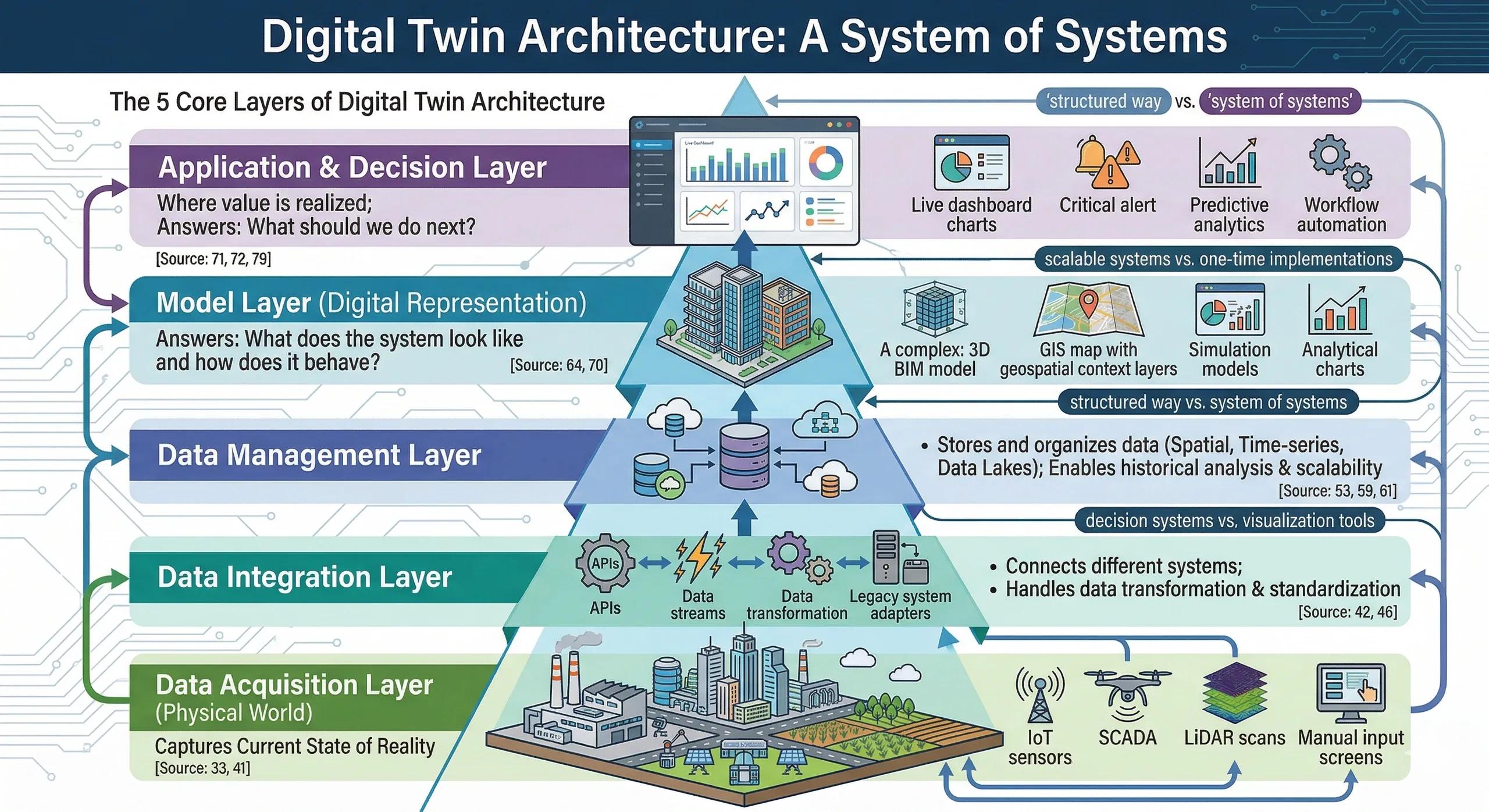
A Digital Twin is not a single platform or tool.
It is a system of systems , designed to connect data, models, and decisions in a structured way.
Understanding this architecture is what separates:
scalable systems from one-time implementations
decision systems from visualization tools
The Core Idea: It’s Not One System
A Digital Twin is often misunderstood as:
a 3D model
a dashboard
a software platform
In reality, it is a layered system that connects:
physical assets
digital models
live data
decision workflows
The 5 Core Layers of Digital Twin Architecture
1. Data Acquisition Layer (Physical World)
This is where data originates.
Sources include:
IoT sensors
SCADA systems
UAV/drone surveys
LiDAR scans
Manual inputs
👉 This layer captures the current state of reality
2. Data Integration Layer
This layer connects different systems.
Key functions:
Data ingestion (APIs, streams, batch)
Data transformation and standardization
Handling legacy systems
👉 This is where most projects struggle
Without proper integration:
systems remain siloed
data cannot be trusted
3. Data Management Layer
This layer stores and organizes data.
Components:
Spatial databases (PostGIS, geodatabases)
Time-series databases
Cloud storage (data lakes)
👉 Enables:
historical analysis
real-time access
scalability
4. Model Layer (Digital Representation)
This is where models are created.
Includes:
BIM models (structure)
GIS layers (context)
Simulation models
Analytical models
👉 This layer answers:
What does the system look like and how does it behave?
5. Application & Decision Layer
This is where value is realized.
Functions:
Dashboards
Alerts and notifications
Predictive analytics
Workflow automation
👉 This layer answers:
What should we do next?
How These Layers Work Together
A simplified flow:
👉 Physical Asset → Data Capture → Integration → Storage → Model → Decision
Each layer depends on the others.
If one fails:
the system becomes unreliable
decisions lose credibility
Where Most Architectures Fail
1. Skipping the Integration Layer
Teams jump from:
👉 data collection → dashboards
Result:
fragmented systems
inconsistent insights
2. Weak Data Management
No unified data structure
No governance
Result:
👉 loss of trust in the system
3. Overfocus on Visualization
Heavy investment in 3D and dashboards
Limited focus on workflows
Result:
👉 impressive systems, low impact
4. No Decision Layer
Insights are generated
No action is triggered
Result:
👉 no operational value
Practical Example
Scenario: Urban Flood Monitoring
Data Layer: Rainfall sensors, satellite data
Integration: APIs combine multiple data sources
Management: Historical rainfall + terrain data
Model: GIS flood models + elevation data
Application: Alerts for high-risk zones
👉 Outcome:
Authorities can act before flooding occurs
Ask Yourself
Is your Digital Twin architecture designed for visualization or for decision-making?
Indian Context
In India, many projects:
start with dashboards
add data later
struggle with integration
A structured architecture:
reduces rework
improves scalability
supports long-term adoption
Benefits of a Well-Designed Architecture
Scalable systems
Reliable data flow
Faster integration
Better decision-making
Long-term sustainability
Conclusion
A Digital Twin is not built by selecting a platform.
It is built by designing an architecture that connects data, models, and decisions .
When this architecture is clear:
systems scale
teams trust the outputs
decisions improve