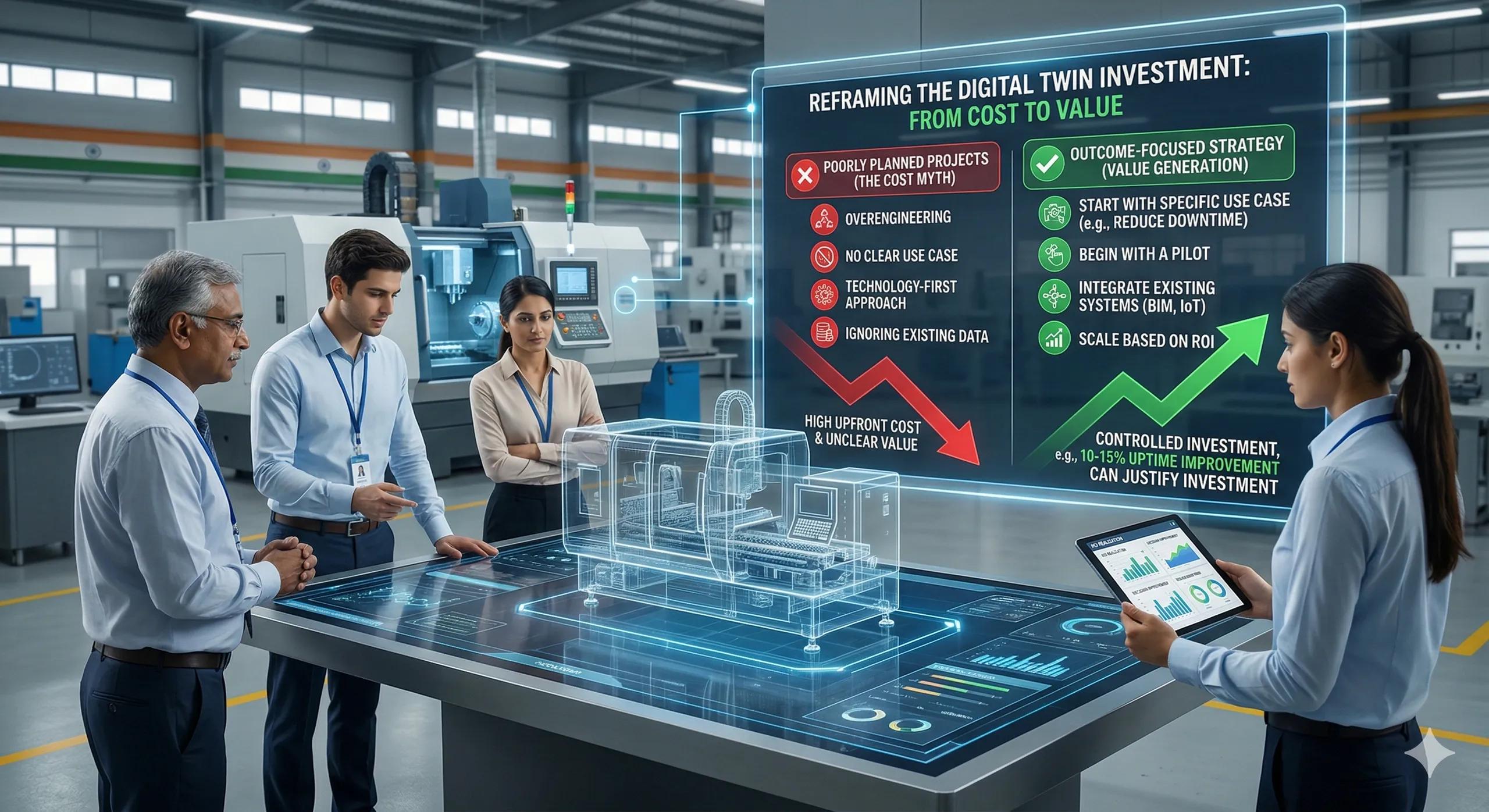
Are Digital Twins expensive or are they just poorly planned investments ?
Introduction
One of the most common concerns organizations have is:
👉 “Digital Twins are too expensive”
This perception often stops initiatives before they begin.
But in reality, the issue is rarely the cost itself.
It is how the investment is structured, justified, and executed .
The Core Problem: Looking at Cost Without Context
Most discussions focus on:
Software costs
Hardware (sensors, infrastructure)
Implementation effort
But ignore:
👉 what the system is supposed to deliver
Without linking cost to outcomes:
Investments seem high
Value seems unclear
Where the Cost Perception Comes From
1. Overengineering the System
Trying to build everything at once
Real-time everywhere
Full-scale deployment from day one
👉 Result: High upfront cost
2. Starting Without a Use Case
No defined outcome
No measurable impact
👉 Cost exists, value does not
3. Treating It as a Technology Project
Focus on tools, not decisions
Procurement-driven approach
👉 Leads to unnecessary components
4. Ignoring Existing Systems
Rebuilding instead of integrating
Not leveraging BIM, GIS, or existing data
👉 Duplication of effort and cost
What Actually Drives Cost
Digital Twin cost typically comes from:
Data collection & preparation
Integration of systems
Infrastructure (cloud, sensors, storage)
Development & customization
Ongoing maintenance and updates
👉 Not just software licenses
Reframing the Question
Instead of asking:
❌ “How much does a Digital Twin cost?”
Ask:
✅ “What decision improvement justifies this investment?”
Practical Example
Scenario: Industrial Maintenance
Without Digital Twin:
Reactive maintenance
Unplanned downtime
High repair costs
With Digital Twin:
Predictive maintenance
Reduced downtime
Optimized operations
👉 Even a 10–15% improvement in uptime can justify the investment
Where Organizations Get It Right
1. Start with a Specific Use Case
Example: Reduce downtime, improve traffic flow
2. Begin with a Pilot
Validate value before scaling
3. Use Existing Data and Systems
BIM, GIS, IoT
4. Scale Based on ROI
Expand only after proven outcomes
The Hidden Cost of Not Investing
Often overlooked:
Inefficient operations
Delayed decision-making
Increased risk
Lost revenue opportunities
👉 The cost of inaction can be higher than the cost of implementation
Ask Yourself
Are you evaluating Digital Twins based on cost or on the value of better decisions?
Indian Context
In India, budget sensitivity is high.
But so is the scale of infrastructure and operations.
Organizations that:
Start small
Focus on outcomes
Scale strategically
👉 Can achieve high ROI without excessive upfront investment
Benefits of the Right Approach
Controlled investment
Faster ROI realization
Reduced risk
Scalable implementation
Better decision-making
Conclusion
Digital Twins are not inherently expensive.
Poorly defined projects are.
When aligned with:
Clear use cases
Structured data
Measurable outcomes
👉 They become value-generating systems , not cost centers