The convergence of Artificial Intelligence (AI), the Internet of Things (IoT), and advanced analytics is unlocking one of the largest transformation opportunities in modern history. Analysts project a $400+ billion addressable market spanning digital twins, Building Information Modeling (BIM), and geospatial analytics. These technologies are no longer niche enablers; they are becoming foundational layers of how industries design, build, and operate.
This isn’t just about technology adoption, it’s about a fundamental reconfiguration of industry workflows, value chains, and competitive advantage.
Market Growth Trajectories
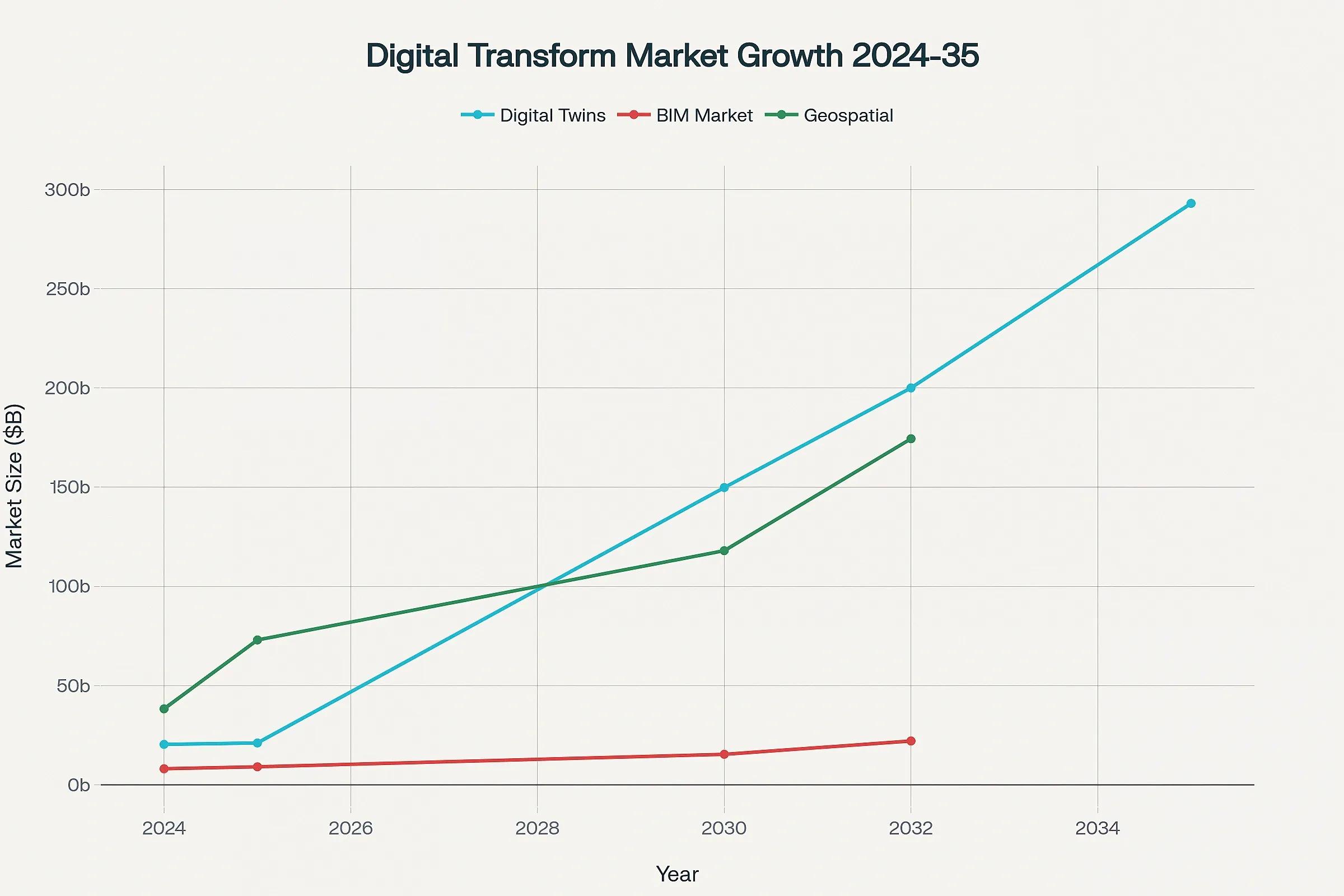
Digital Twins Valued at $20.4 billion in 2024, digital twins are forecasted to reach $293 billion by 2035. That represents a 27.4% compound annual growth rate (CAGR), a pace that places digital twins among the fastest-growing segments in the digital transformation ecosystem.
Building Information Modeling (BIM) From $8.1 billion today, BIM adoption will grow to $22.1 billion by 2032. Governments, infrastructure developers, and private builders are making BIM compliance mandatory, accelerating market expansion.
Geospatial Analytics Expanding from $38.3 billion today to $174.4 billion by 2032, geospatial intelligence is embedding itself into urban planning, climate resilience, agriculture, logistics, and defense.
Together, these markets form the backbone of a digitally integrated economy, where physical and digital environments are no longer distinct but deeply intertwined.
Why This Shift Matters
Technology adoption in itself does not define transformation. What makes this wave unique is its impact on operational performance and value delivery.
Digital twins are not just models, they are live, data-driven ecosystems that continuously mirror and optimize assets, processes, or entire cities.
BIM is not just a 3D visualization tool, it is becoming the collaborative foundation for reducing costs, compressing project timelines, and improving transparency across stakeholders.
Geospatial analytics is no longer about static maps, it provides real-time situational awareness for decision-making in energy, infrastructure, and public policy.
Tangible Benefits
The impact of adoption is measurable:
Digital Twins 30–50% reduction in machine downtime 10–30% increase in throughput 15–30% improvement in labor productivity
Building Information Modeling (BIM) Up to 50% reduction in project timelines Up to 52.36% savings in costs
These statistics underscore why these technologies are moving from optional innovation projects to strategic imperatives.
Sectoral Implications
Manufacturing Digital twins are optimizing production lines with predictive maintenance. Edge-enabled IoT reduces unplanned downtime.
Construction and Infrastructure BIM adoption cuts rework, improves collaboration, and ensures regulatory compliance. Digital twins provide real-time monitoring of bridges, roads, and utilities.
Energy and Utilities Geospatial analytics enhances grid management and renewable energy planning. Digital twins optimize wind farms and solar installations.
Urban Planning and Governance Cities leverage geospatial data for traffic optimization, zoning, and disaster management. Digital twin platforms provide scenario planning for sustainability.
The Strategic Shift
This transformation signals a shift from reactive operations to predictive and prescriptive ecosystems. Enterprises that adopt these technologies are not just saving costs, they are reshaping competitive landscapes.
Three trends are particularly decisive:
Integration of AI with IoT sensor networks → enabling autonomous optimization.
Cloud-based BIM and geospatial platforms → democratizing access and scalability.
Standardization and interoperability frameworks → making cross-industry collaboration viable.
Challenges to Watch
Data interoperability: Integrating CAD, GIS, IoT, and ERP data remains a hurdle.
Cybersecurity: Expanding digital-physical integration increases attack surfaces.
Talent gaps: Skilled professionals in digital twins, BIM, and spatial analytics remain in short supply.
Change management: Cultural resistance within industries slows adoption timelines.
Looking Ahead
The convergence of AI, IoT, and advanced analytics is more than a technology story, it’s an economic reordering. By 2035, industries that embrace these tools will not just cut costs but redefine customer experience, resilience, and sustainability.
The key question is no longer whether to adopt these technologies but how fast enterprises can integrate them into their operating fabric.