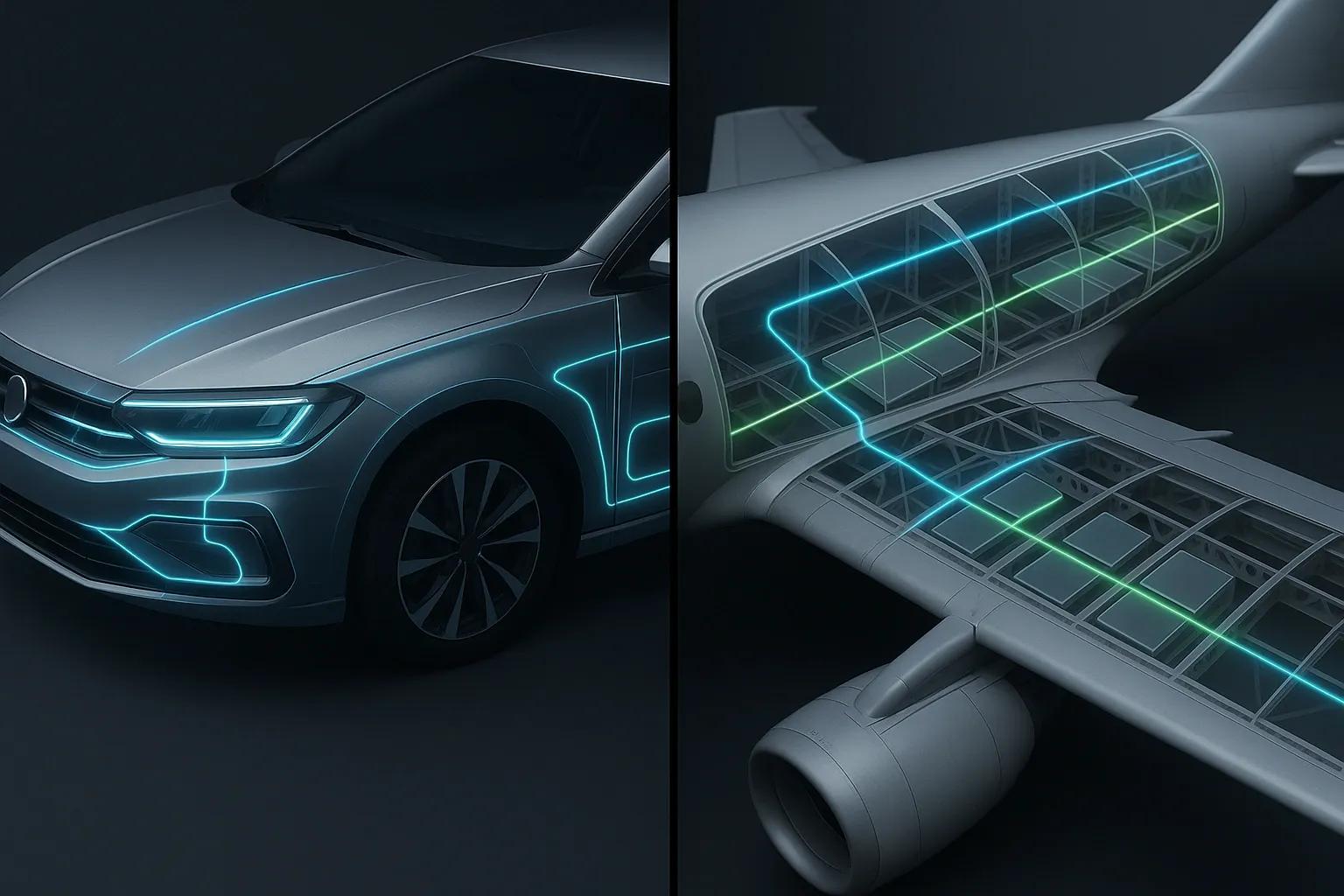
The transportation and aerospace industries stand on the brink of a revolutionary transformation as structural battery composites (SBCs) emerge from research laboratories into commercial reality. Featured prominently in the World Economic Forum's Top 10 Emerging Technologies of 2025 report, this groundbreaking innovation represents a paradigm shift from traditional design philosophy, where energy storage and structural integrity have historically been separate functions. The convergence of these dual purposes is driving what industry analysts project to be a $57 billion market explosion, fundamentally restructuring how we conceptualize vehicle and aircraft design.
The Economics of "Massless" Energy Storage
At its core, structural battery technology addresses one of the most persistent challenges in electric transportation: the weight penalty imposed by conventional battery systems. Traditional lithium-ion batteries function solely as energy storage devices, requiring separate housing and structural support that adds "parasitic weight" to vehicles and aircraft. This conventional approach forces engineers into a perpetual trade-off between range, performance, and structural integrity.
Structural batteries eliminate this compromise by integrating energy storage directly into load-bearing materials. Current market projections indicate the global structural battery market will grow from USD 243.1 million in 2025 to USD 923.2 million by 2032, representing a compound annual growth rate of 21%. However, broader market analyses suggest an even more aggressive trajectory, with some forecasts projecting the market could reach USD 1.6 billion by 2025, driven by a 16% CAGR. These projections reflect not merely incremental improvement but fundamental economic restructuring across multiple industries.
The economic implications extend far beyond the battery sector itself. In automotive applications, a 10% reduction in vehicle weight can improve fuel efficiency by 6-8% and increase electric vehicle range by up to 70%. For the aviation industry, the benefits are even more pronounced, with potential fuel efficiency improvements of 15% over a 1,500-kilometer flight. These performance gains translate directly into operational cost reductions and enhanced competitiveness for manufacturers who successfully integrate this technology.
Tesla's Pioneering Implementation
Tesla's approach to structural batteries exemplifies the technology's commercial viability and manufacturing scalability. The company's 4680 cell technology, integrated with Cell-to-Chassis (CTC) architecture, represents the first large-scale implementation of structural battery principles. In Tesla's Model Y produced at Gigafactory Texas, the battery pack literally becomes the vehicle's floor structure, eliminating traditional floor panels entirely.
This integration delivers quantifiable economic benefits: Tesla reports a 10% reduction in vehicle weight, a 14% increase in cruising range, a reduction of 370 parts, 7% lower unit cost, and 8% lower unit investment. The structural pack requires only 38 bolts for removal, demonstrating exceptional design for manufacturability while drastically reducing assembly complexity compared to traditional stamped floor assemblies with hundreds of parts. Tesla's CTC technology predicts a 55% reduction in investment per GWh and a 35% reduction in space occupied, fundamentally altering the economics of battery manufacturing and vehicle assembly.
The manufacturing innovations extend beyond assembly efficiency. Tesla's use of multifunctional adhesives that serve both structural and fire-resistant purposes, combined with self-piercing rivets instead of traditional fasteners, showcases how structural battery integration drives broader manufacturing innovation. These changes represent a comprehensive reimagining of automotive production processes, with implications extending throughout the supply chain.
Aerospace Applications and Market Transformation
While automotive applications have captured significant attention, the aerospace sector presents equally compelling opportunities for structural battery integration. Airbus is actively experimenting with structural battery composites for aircraft applications, focusing initially on less critical components like floor panels before progressing to more demanding applications such as wing structures.
Research indicates that replacing floorboards in an Airbus A320 with structural batteries could reduce aircraft weight by more than 570 pounds, lowering carbon dioxide emissions by more than 280 tons annually per aircraft. These weight savings become increasingly valuable as aircraft size increases, with larger structural volumes providing greater energy storage potential and more significant performance improvements.
The aerospace market for structural batteries is particularly driven by the emerging electric vertical take-off and landing (eVTOL) aircraft sector, where weight optimization is absolutely critical. Drones using structural battery composite wings or fuselages could double flight times, providing significant advantages for surveillance, delivery, and mapping applications where payload and endurance are paramount. Current research demonstrates that structural batteries could enable 25% weight reduction in total vehicle weight, dramatically improving payload capacity and operational flexibility.
Technical Progress and Manufacturing Scalability
The technical advancement of structural battery composites has accelerated significantly in recent years. Researchers at Chalmers University of Technology have achieved a tenfold improvement in performance compared to previous structural battery iterations, reaching an energy density of 30 Wh/kg while maintaining an elastic modulus of 76 GPa - comparable to aluminum's structural properties.
While current energy density remains approximately 20% of conventional lithium-ion batteries, this limitation is offset by the elimination of separate structural materials. The next generation of structural batteries aims to achieve 75 Wh/kg energy density and 75 GPa stiffness, potentially setting new performance benchmarks while significantly reducing weight. These improvements position structural batteries not merely as alternative energy storage solutions but as fundamental enablers of next-generation transportation design.
Manufacturing scalability represents a critical factor in market adoption. Current prototypes are primarily produced through labor-intensive laboratory processes, but industry leaders are developing automated manufacturing techniques compatible with existing aerospace and automotive production systems. The successful scaling of production processes will determine whether structural batteries remain niche applications or become mainstream technologies driving industry transformation.
Market Dynamics and Economic Disruption
The structural battery market's growth trajectory reflects broader economic forces reshaping the transportation and aerospace industries. Government regulations aimed at reducing carbon emissions, combined with substantial investments in electric vehicle infrastructure, are creating sustained demand for innovative energy storage solutions. The global transition toward electric mobility, with over 26 million electric vehicles projected for annual sales by 2030, represents a fundamental shift in energy storage requirements.
Supply chain implications are equally significant. With 85% of lithium currently refined by just three countries, structural batteries offer potential pathway to diversify and decentralize energy material supply chains. This technological shift could reshape global economic dependencies, transforming how nations approach energy infrastructure and technological sovereignty.
The economic transformation extends beyond direct market value to encompass manufacturing cost reductions, material requirements optimization, and enhanced recyclability. As structural battery composites mature, they promise to enable energy-efficient designs that reduce material requirements and accelerate reuse, repurposing, and recycling processes.
Future Outlook and Industry Transformation
The convergence of structural battery technology with advanced manufacturing processes represents more than incremental improvement - it signals a fundamental restructuring of how transportation and aerospace industries approach design, manufacturing, and operation. Success in this transformation requires careful attention to process optimization, quality control, and scaling strategies, but the potential benefits justify the substantial development investments currently underway.
As structural battery technology matures from laboratory demonstrations to commercial applications, it will likely catalyze broader industry transformation. The next decade may witness the emergence of new aerospace and automotive leaders built on foundations of structural battery integration and advanced manufacturing capabilities, fundamentally reshaping competitive dynamics across these critical industries.