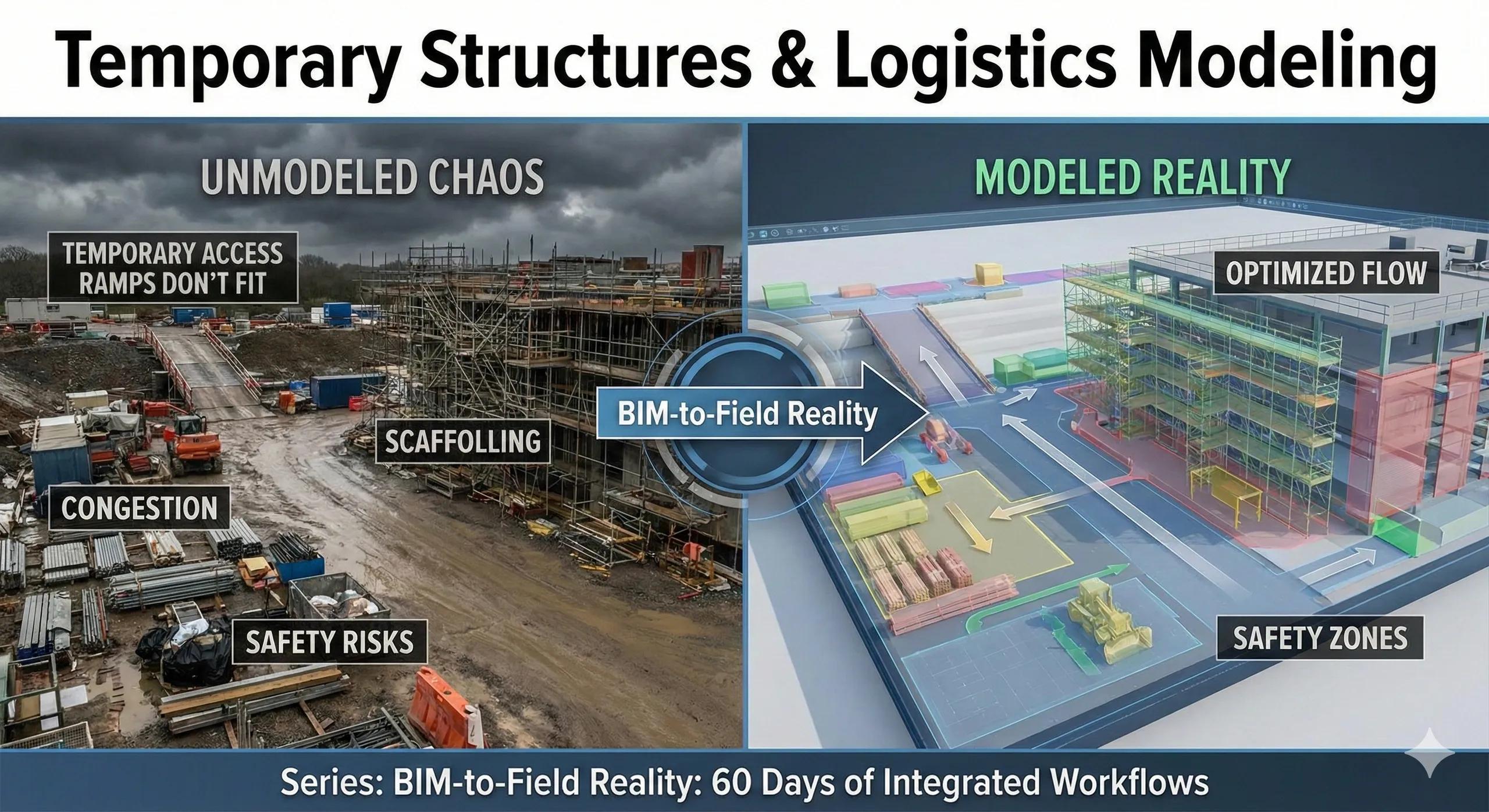
Many construction failures don’t come from permanent design.
They come from temporary reality .
Access ramps that don’t fit.
Scaffolding that blocks logistics.
Laydown areas that collapse circulation.
Temporary roads that fail under load.
Temporary structures and logistics are often planned informally, yet they govern daily productivity, safety, and sequence .
Modeling them properly is not overhead.
It’s operational intelligence.
1. Why Temporary Works Are Underestimated
Temporary works are often:
Designed late
Modeled minimally or not at all
Treated as contractor “means and methods”
Yet they control:
How people move
How materials flow
How equipment operates
How safe the site really is
Ignoring them creates blind spots.
2. What Counts as Temporary Structures
Temporary structures include:
Scaffolding and formwork systems
Access ramps and stair towers
Temporary roads and hardstands
Laydown and storage zones
Site offices, welfare units
Barricades, fencing, and exclusion zones
These are not secondary elements, they are the site during construction.
3. Why Logistics Modeling Must Include Temporaries
Logistics fails when:
Temporary routes conflict with work fronts
Laydown areas shrink unexpectedly
Access is blocked by evolving structures
Modeling logistics with temporary works allows teams to:
Test routes before execution
Validate turning radii and clearances
Prevent congestion and rehandling
4. Temporary Works Change Over Time
Temporary structures are:
Installed
Modified
Relocated
Removed
This makes them 4D assets , not static geometry.
When linked to sequencing:
Conflicts surface early
Access plans stay valid
Safety improves
5. Spatial Context Matters More Than Detail
Temporary works do not need design-level detail.
They need:
Correct footprint
Correct height
Correct load and clearance envelopes
Decision accuracy matters more than visual fidelity.
6. Safety Lives in the Temporary Layer
Many safety incidents involve:
Temporary access
Improvised routes
Congested logistics
Modeling temporary works spatially helps:
Validate safe movement paths
Maintain separation of people and equipment
Update exclusion zones dynamically
7. India Context: Why This Is Critical
On Indian sites:
Space is constrained
Temporary solutions evolve daily
Informal routing is common
Explicit modeling:
Reduces improvisation
Improves coordination
Supports safer execution
8. Common Reasons Temporary Modeling Fails
It fails when:
Responsibility is unclear
Updates are not maintained
Temporary works are excluded from coordination
Models are treated as “nice to have”
Temporary works need ownership , not assumptions.
9. From Blind Spots to Managed Reality
When temporary works are modeled:
Site planning becomes proactive
Logistics stabilize
Safety risks surface early
Sequences become buildable
Temporary reality stops being chaotic.
10. A Simple Temporary Works Rule
If it controls daily movement, it deserves to be modeled.
Conclusion
Temporary structures and logistics are where:
Plans meet reality
Safety is tested
Productivity is won or lost
Modeling them properly:
Improves coordination
Reduces risk
Increases predictability
Permanent assets define the project’s future.
Temporary assets define how you get there .