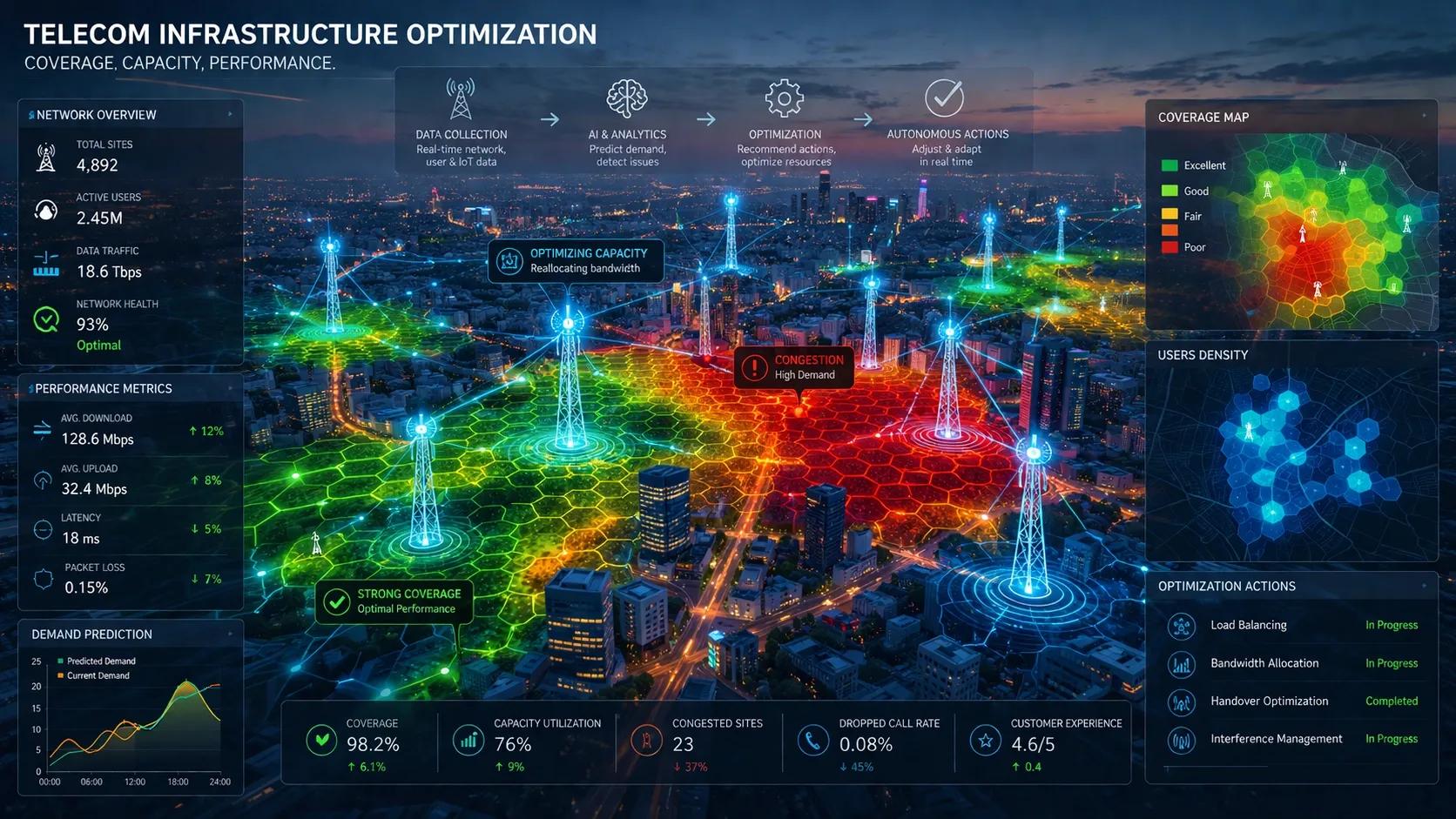
Telecom networks don’t fail because of outages.
They fail when coverage, capacity, and demand fall out of alignment.
Introduction
In the previous articles, we explored how Digital Twins enable:
infrastructure monitoring
operational optimization across industries
facility and campus performance
renewable energy systems
port and logistics coordination
Now we move to a sector that underpins all digital systems:
👉 Telecom Infrastructure
Telecom networks involve:
towers and base stations
fiber networks
user demand and mobility
spectrum and bandwidth
In Phase 3, the focus remains:
👉 how Digital Twins enable coverage optimization, capacity planning, and real-time performance management
The Core Problem: Demand Outpaces Planning
Most telecom systems today:
monitor network performance
plan infrastructure periodically
respond to congestion after it occurs
But:
👉 user demand is dynamic
This leads to:
coverage gaps
network congestion
dropped connections
inefficient infrastructure utilization
Where Digital Twins Change the Approach
A Telecom Digital Twin enables:
👉 continuous monitoring and predictive optimization of network performance
Instead of:
reactive network management
It creates:
a dynamic, demand-aware network model
Key Components of a Telecom Digital Twin
1. Data Layer
network performance metrics
user density and mobility data
signal strength and coverage data
infrastructure data (towers, fiber)
2. Integration Layer
combines: spatial data network data user behavior
👉 creates a unified network view
3. AI/ML Layer
predicts network congestion
identifies coverage gaps
optimizes capacity
4. Simulation Layer
models network scenarios
evaluates infrastructure changes
5. Visualization Layer
GIS-based coverage maps
performance dashboards
network heatmaps
Use Case 1: Coverage Optimization
Traditional Approach
periodic network surveys
manual planning
👉 slow response
Digital Twin Approach
analyze real-time signal strength
identify coverage gaps
👉 Outcome:
optimized tower placement
Use Case 2: Capacity Planning
monitor user density
predict peak demand
👉 Outcome:
improved bandwidth allocation
Use Case 3: Network Performance Optimization
detect congestion patterns
adjust network parameters dynamically
👉 Outcome:
improved user experience
Use Case 4: Infrastructure Planning
simulate new tower placement
evaluate coverage impact
👉 Outcome:
efficient investment decisions
Practical Example
Scenario: Urban Network Congestion
user density spikes in a specific area
Digital Twin identifies:
👉 congestion hotspot
System triggers:
bandwidth reallocation
load balancing
👉 Outcome:
improved network performance
Where Most Implementations Fail
1. Static Planning
infrastructure planning not aligned with real-time demand
2. Data Silos
network and spatial data not integrated
3. Delayed Response
actions taken after congestion occurs
4. Lack of Predictive Capability
focus on monitoring, not forecasting
Ask Yourself
Is your network:
👉 reacting to demand
Or
👉 adapting to it continuously?
Indian Context
India’s telecom sector faces:
rapid growth in mobile users
increasing data consumption
urban-rural coverage challenges
Digital Twins can help:
👉 optimize coverage
👉 improve network performance
👉 support infrastructure planning
Benefits & ROI
improved network coverage
reduced congestion
better user experience
optimized infrastructure investment
enhanced operational efficiency
Conclusion
Telecom networks are dynamic systems.
Managing them requires:
👉 real-time data
👉 predictive insight
👉 adaptive control
Digital Twins enable this shift.
From:
👉 reactive network management
To
👉 intelligent, adaptive telecom systems