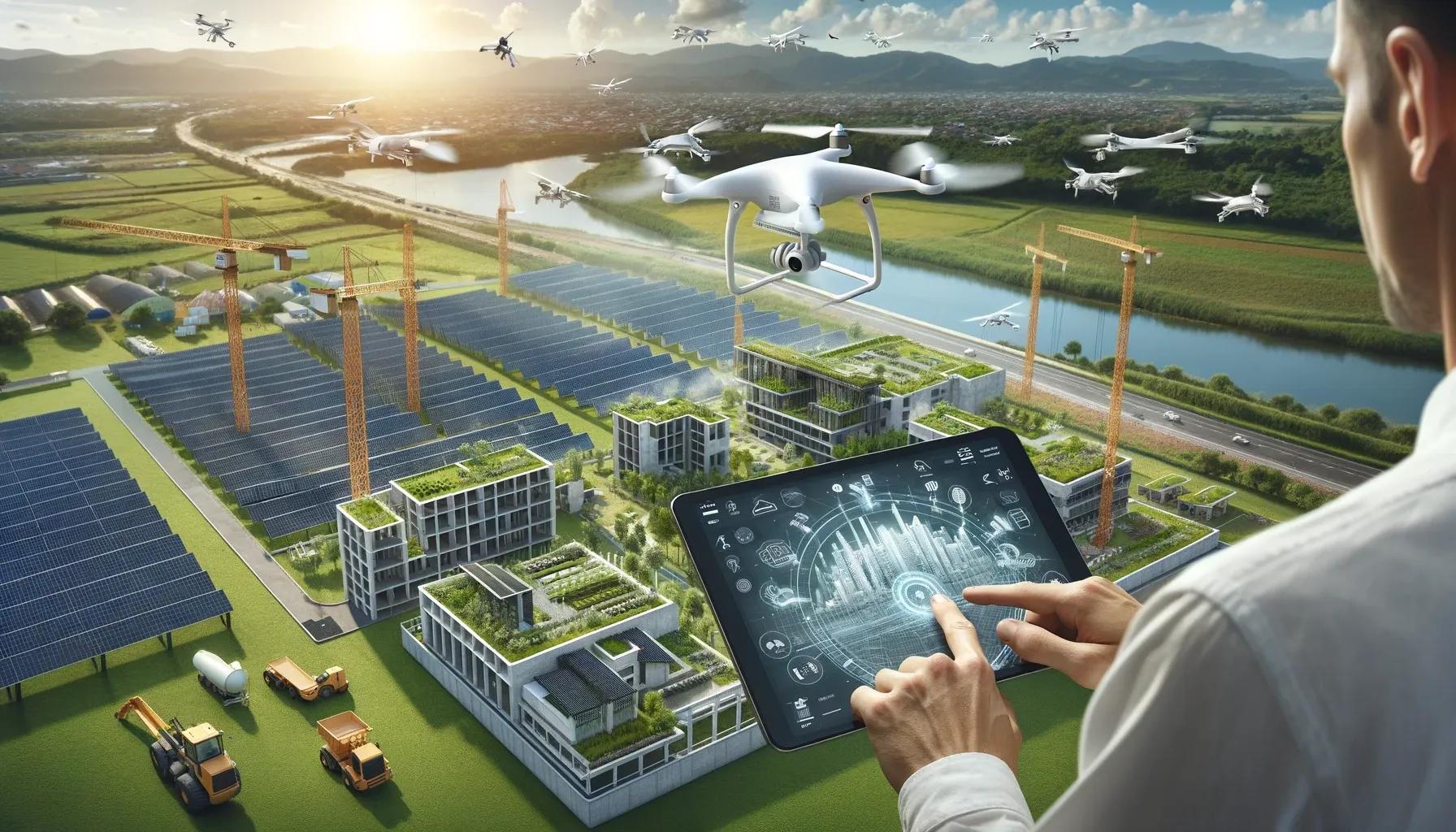
In today’s world, where sustainability has become a pressing concern, the construction industry is rapidly evolving to incorporate green practices. Drones and Building Information Modeling (BIM) are at the forefront of this revolution, offering innovative solutions to traditional construction challenges. This article delves into how these technologies contribute to sustainable building design, focusing on energy efficiency and waste reduction.
The Emergence of Drones in Construction
Drones, or Unmanned Aerial Vehicles (UAVs), have transitioned from military tools to versatile assets in various industries, especially construction. Their ability to capture high-resolution images and data from hard-to-reach areas makes them invaluable for sustainable construction practices.
Site Analysis and Planning: Before construction begins, drones can perform detailed site surveys. They provide accurate topographical data, enabling architects and engineers to design buildings that harmoniously blend with their natural surroundings. This careful planning is essential for minimizing environmental impact and optimizing natural light and heat, which significantly contributes to a building's energy efficiency.
Monitoring and Inspecting: During construction, drones offer a bird's-eye view to monitor progress and ensure adherence to sustainable practices. They can inspect hard-to-reach areas, identifying potential issues like thermal leaks or areas where energy efficiency can be improved. This proactive approach reduces the need for costly and disruptive rectifications post-construction.
Building Information Modeling: A Game-Changer
BIM goes beyond traditional 2D and 3D modeling by incorporating time and cost as the fourth and fifth dimensions, respectively. This comprehensive approach has a profound impact on sustainable building practices.
Design Efficiency: BIM allows for the creation of more energy-efficient designs. By simulating various scenarios, designers can assess the energy performance of different designs, materials, and orientations before the actual construction begins. This predictive capability ensures optimal energy use and reduces the carbon footprint of buildings.
Resource Management: BIM plays a crucial role in resource management, aiding in the precise estimation and optimization of materials. This accuracy significantly reduces waste during construction, a vital aspect of sustainable building. Furthermore, BIM’s detailed documentation helps in recycling or reusing materials, further contributing to environmental sustainability.
Lifecycle Management: Perhaps the most significant contribution of BIM is in the lifecycle management of a building. It provides a comprehensive database of the building’s components, facilitating efficient maintenance and operation. Energy consumption can be monitored and optimized throughout the building's lifecycle, ensuring long-term sustainability.
Integration of Drones and BIM
The real power lies in the integration of drones and BIM. Drones can feed real-time data into BIM models, keeping them constantly updated. This integration allows for:
Accurate Modeling: The data collected by drones can be used to create or update BIM models, ensuring they accurately reflect the real-world scenario. This accuracy is crucial for sustainable building, as it allows for precise energy modeling and waste management.
Enhanced Collaboration: With up-to-date BIM models fed by drone data, all stakeholders can have access to the latest information. This collaboration fosters a more cohesive approach to sustainable building, where every decision is informed by the latest data.
Predictive Maintenance: Integrating drone data with BIM facilitates predictive maintenance. By regularly monitoring the building’s condition, it’s possible to identify and rectify potential issues before they escalate. This approach not only prolongs the building’s lifespan but also ensures it continues to operate at optimal energy efficiency.
Challenges and Future Prospects
While the integration of drones and BIM in sustainable construction is promising, it is not without challenges. Regulatory hurdles, data security, and the need for skilled professionals are some of the barriers. However, as technology advances and awareness grows, these challenges are gradually being overcome.
Looking ahead, the potential of drones and BIM in green construction is immense. With continuous innovation, these tools will become more sophisticated, further enhancing their contribution to sustainable building design.
In conclusion, the synergy between drones and BIM is transforming the construction industry, paving the way for more sustainable practices. By enabling better planning, efficient resource use, and lifecycle management, they play a pivotal role in reducing the environmental impact of buildings. As the world moves towards a more sustainable future, the role of these technologies in green construction will only become more significant.