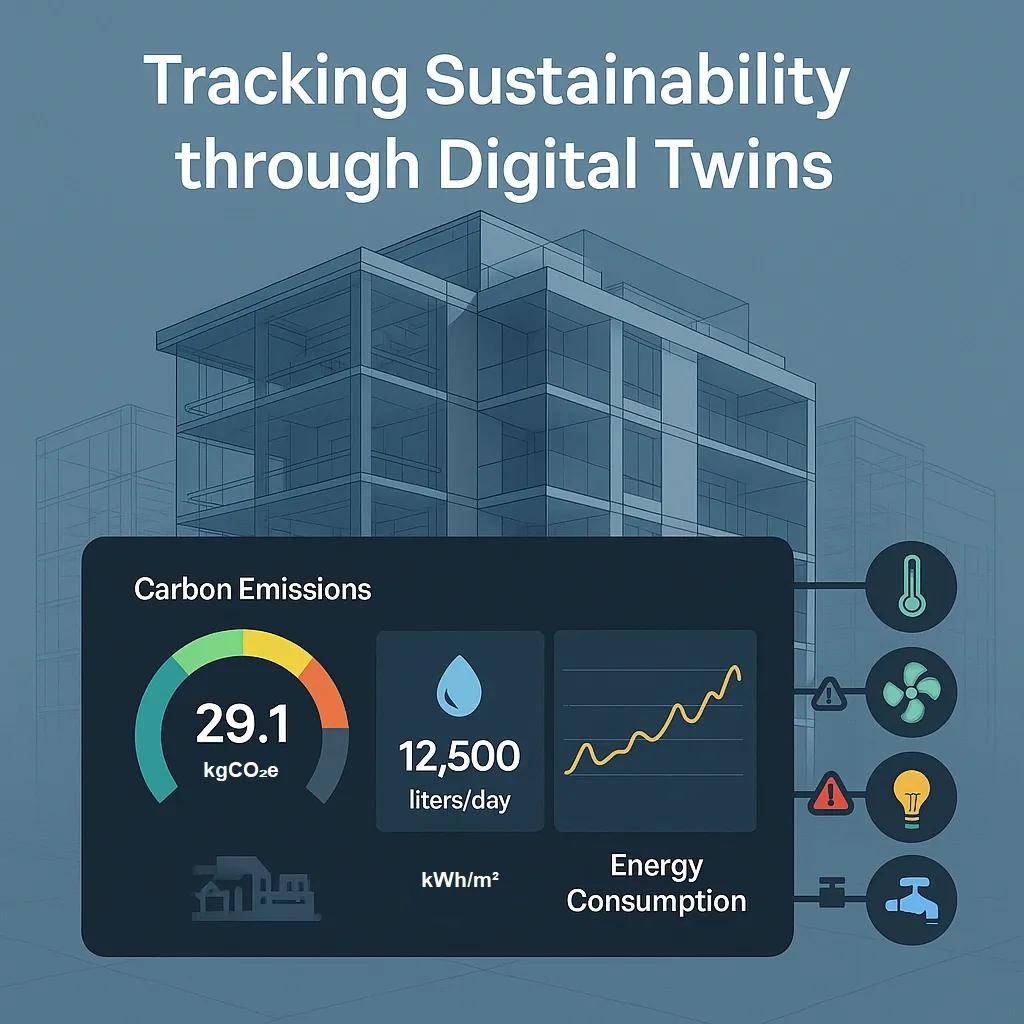
As sustainability becomes a critical focus in construction and infrastructure, the integration of Digital Twin platforms with Building Information Modeling (BIM) is emerging as a powerful approach for tracking environmental performance. By embedding sustainability Key Performance Indicators (KPIs) such as carbon footprint, water usage, and energy consumption into digital workflows, project teams can monitor, analyze, and optimize operations throughout the asset lifecycle.
This article explores how digital twin platforms can help achieve environmental goals by integrating real-time data and simulation with BIM models, enabling effective decision-making and compliance with sustainability standards.
1. Understanding Sustainability KPIs in Built Environments
Sustainability KPIs are measurable values that reflect the environmental performance of a building or infrastructure. The most commonly tracked indicators include:
Carbon Emissions (kgCO₂e): Emissions resulting from materials (embodied carbon), construction activities, and operational energy use (operational carbon).
Water Usage (liters or m³): Consumption in domestic, HVAC, irrigation, or industrial processes.
Energy Consumption (kWh/m²/year): Total energy use, including heating, cooling, lighting, and appliances.
These KPIs serve as benchmarks for green certifications (LEED, BREEAM, IGBC) and regulatory compliance (e.g., ECBC in India, ASHRAE standards globally).
2. The Role of Digital Twins in Sustainability Tracking
A digital twin is a virtual replica of a physical asset that uses real-time sensor data, historical records, and machine learning models to simulate performance. When applied to sustainability, digital twins become intelligent monitors that continuously assess how a facility’s design and operations align with environmental goals.
Digital twins extend beyond static BIM models by enabling:
Real-time tracking of environmental performance.
Simulation of alternative scenarios (e.g., materials substitution, HVAC tuning).
Predictive analytics to forecast future consumption and emissions.
Closed-loop feedback from operational data into design improvement.
3. Integration of BIM with Digital Twin Platforms
BIM provides the foundational data model for the digital twin. Architectural, structural, and MEP components are already tagged with metadata such as material properties, insulation values, and occupancy zones. These are crucial for calculating sustainability KPIs.
Workflow Integration:
BIM Stage - Twin Integration - Sustainability Output
Design - Material analysis - Embodied carbon estimation
Construction - IoT sensors on-site - Equipment emissions, water use
Operation - BMS + IoT + Digital Twin - Energy, water, and carbon KPIs
Software platforms like Autodesk Tandem, Bentley iTwin, and Siemens NX integrate BIM models with operational data layers to track and simulate sustainability metrics.
4. Tracking Carbon Emissions
Carbon tracking within a digital twin includes both embodied carbon and operational carbon.
a. Embodied Carbon:
Derived from the materials used during design and construction phases. BIM models enriched with Environmental Product Declarations (EPDs) can quantify carbon intensity.
Workflow:
Extract material quantities from BIM.
Match with carbon intensity data from EPD libraries (e.g., EC3, OneClickLCA).
Aggregate to get embodied carbon (kgCO₂e).
b. Operational Carbon:
Generated from energy consumption during asset use.
Workflow:
Integrate with Building Management Systems (BMS).
Pull data from HVAC, lighting, and power meters.
Apply carbon emission factors (location-based or market-based).
The digital twin can compare actual versus baseline carbon emissions, track peak loads, and simulate the impact of renewable energy systems.
5. Monitoring Water Usage
Water conservation is vital in regions with limited resources. A digital twin uses sensor data (flow meters, occupancy sensors) to analyze water use by zone or function.
Applications:
Track domestic vs. landscape water use.
Detect leaks through anomaly detection.
Optimize irrigation schedules based on weather and occupancy.
Integration with BIM:
Plumbing models in BIM identify water fixtures and pipe networks.
Digital twin maps water consumption data to fixture zones.
Enable scenario testing (e.g., low-flow fixtures, greywater reuse).
KPIs such as liters per occupant per day or m³/year can be visualized and benchmarked.
6. Energy Performance Management
Energy consumption is one of the most dynamic sustainability indicators. Digital twins enhance energy management through simulation and real-time control.
Data Sources:
Smart meters
Occupancy sensors
Environmental sensors (temperature, humidity)
BIM Inputs:
Thermal properties of materials
HVAC zoning and equipment types
Lighting layout and daylighting features
KPI Outputs:
Energy Use Intensity (EUI)
Peak load trends
Energy savings from retrofit scenarios
Simulations:
Calibrate energy models (e.g., EnergyPlus) using real-time feedback.
Evaluate passive design strategies and retrofits.
Predict HVAC performance under extreme weather.
7. Dashboards and Reporting
Digital twin platforms offer interactive dashboards to visualize sustainability KPIs. These interfaces allow:
Real-time alerts on exceeding carbon or energy thresholds.
Drill-downs by zone, floor, or equipment.
Exportable reports for compliance and audits.
Popular Visualization Tools:
Power BI integrated with BIM 360 or iTwin
Custom web dashboards from open APIs
GIS overlays for multi-building campuses
Dashboards bridge the gap between technical data and stakeholder understanding, enabling informed decisions.
8. Use Case: Campus-Wide Energy and Water Optimization
In higher education or industrial campuses, digital twins enable sustainability KPIs to be managed at the portfolio level.
Example:
Digital twins of individual buildings feeding into a central monitoring platform.
Real-time tracking of water and energy consumption by building.
Predictive models alerting about potential overuse during peak periods.
Integration with solar panel systems to track renewable contribution.
The result is not just energy savings, but also enhanced resilience and budget optimization.
9. Challenges and Considerations
Data Accuracy: Garbage-in, garbage-out remains true. Sensor calibration and BIM model fidelity are crucial.
Data Interoperability: BIM and IoT systems must communicate seamlessly. Standards like IFC, MQTT, and OPC UA help.
Privacy and Security: Real-time monitoring introduces risks. Role-based access and data governance policies are essential.
Skill Gaps: Teams must be trained in both sustainability metrics and digital tools.
10. Future Outlook
With increasing pressure to meet global climate goals and national mandates (e.g., India’s National Building Code 2016 and Energy Conservation Building Code), sustainability KPIs will become default requirements. Digital twins with embedded BIM data will serve as the backbone for:
Lifecycle sustainability assessments.
ESG (Environmental, Social, Governance) reporting.
Circular economy planning via material passports.
Advanced analytics, AI-driven predictions, and automated compliance checks will further improve how we design, build, and operate sustainable infrastructure.
Conclusion
Integrating sustainability KPIs into digital twin platforms powered by BIM offers a transformative approach to environmental performance tracking. From carbon footprint to energy and water management, digital twins convert raw data into actionable insights across the building lifecycle. As regulations tighten and stakeholder expectations rise, these tools will become indispensable in achieving meaningful sustainability outcomes. For organizations committed to climate action and operational efficiency, investing in digital twin platforms with robust sustainability tracking is no longer optional, it’s essential.