Why do some digital systems look impressive but fail to influence real-world decisions?
Because they are built as static models , not living systems .
Introduction
Many organizations invest in:
BIM models
GIS platforms
Dashboards
These systems are valuable but they often share one limitation:
👉 They represent a snapshot in time
A Digital Twin, on the other hand, is not a snapshot.
It is a continuously evolving system .
Understanding this difference is critical.
The Core Problem: Confusing Representation with Reality
Most digital systems are designed to:
Capture what was built
Show what exists
But they don’t:
Reflect what is changing
Adapt to real-world conditions
👉 This creates a gap between digital representation and operational reality
What is a Static Model?
A static model:
Is created at a specific point in time
Reflects design or survey data
Is updated manually or infrequently
Examples:
BIM model after construction
GIS map updated periodically
Reports and dashboards
👉 Useful for reference, but limited for decision-making
What is a Living System?
A living system:
Continuously receives data
Updates itself dynamically
Reflects current conditions
Supports ongoing decisions
Examples:
Real-time asset monitoring system
Traffic flow optimization platform
Predictive maintenance system
👉 It evolves with the physical world
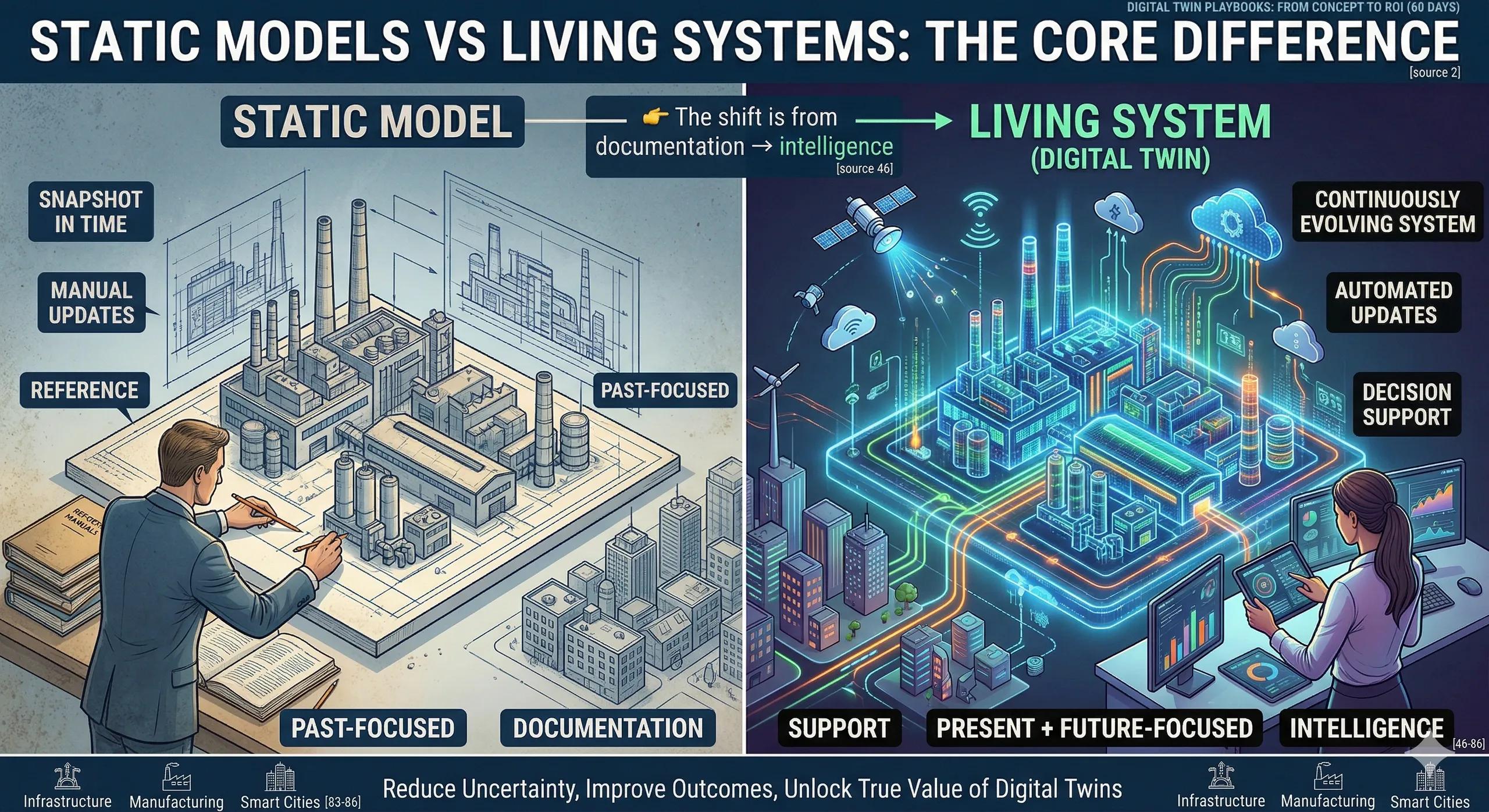
The Real Difference
Static Model - Living System
Snapshot - Continuous
Manual updates - Automated updates
Reference - Decision support
Past-focused - Present + future-focused
👉 The shift is from documentation → intelligence
Practical Example
Scenario: Industrial Equipment
Static Model:
Shows equipment design and specifications
Useful for understanding structure
Living System (Digital Twin):
Tracks performance in real time
Predicts failures
Recommends maintenance actions
👉 One explains the asset
👉 The other guides decisions about the asset
Why Static Models Fail in Operations
1. They Become Outdated Quickly
Real-world conditions change faster than updates.
2. They Don’t Reflect Behavior
No visibility into performance or usage.
3. They Don’t Drive Action
They inform but don’t influence decisions.
Ask Yourself
Are your current systems helping you understand what was built or what is happening right now?
Where Most Organizations Get Stuck
Even when organizations attempt to build Digital Twins:
They start with static models
But don’t integrate real-time data
Or fail to maintain continuous updates
👉 The system remains static, just more sophisticated
What a Better Approach Looks Like
1. Start with Data Flow
Ensure real-time or near real-time inputs.
2. Enable Continuous Updates
Automate data integration.
3. Connect to Decisions
Define how insights will influence actions.
4. Maintain System Relevance
Regular validation and updates.
Indian Context
In sectors like:
Infrastructure
Manufacturing
Smart Cities
Systems are often:
Well-designed initially
But not maintained dynamically
👉 Moving toward living systems can significantly improve:
Efficiency
Reliability
Decision speed
Benefits of Living Systems
Real-time situational awareness
Predictive capabilities
Faster response times
Improved operational efficiency
Better decision outcomes
Conclusion
A static model shows you what exists.
A living system helps you decide what to do next.
That is the core difference.
Organizations that move toward living systems will:
Reduce uncertainty
Improve outcomes
And unlock the true value of Digital Twins