Backhaul is the hidden throttle for digital twins. Whether you’re streaming machine telemetry, point clouds, or video analytics, your link dictates latency, uptime, and time-to-value. This week’s brief compares Starlink (LEO), Fiber, and 5G FWA using a simple decision matrix and a 12-month ROI lens for three common scenarios: an urban plant, an industrial-fringe plant, and a remote construction camp.
The decision matrix (what matters)
Key variables
Latency & jitter: affects control loops, teleoperation, and live dashboards.
Uptime/SLA: impacts reliability of alarms and shift operations.
Deploy speed: time to benefits; delays crush ROI.
Total cost: capex + opex.
Coverage certainty: fiber routes, cell signal quality, or sky visibility.
At-a-glance
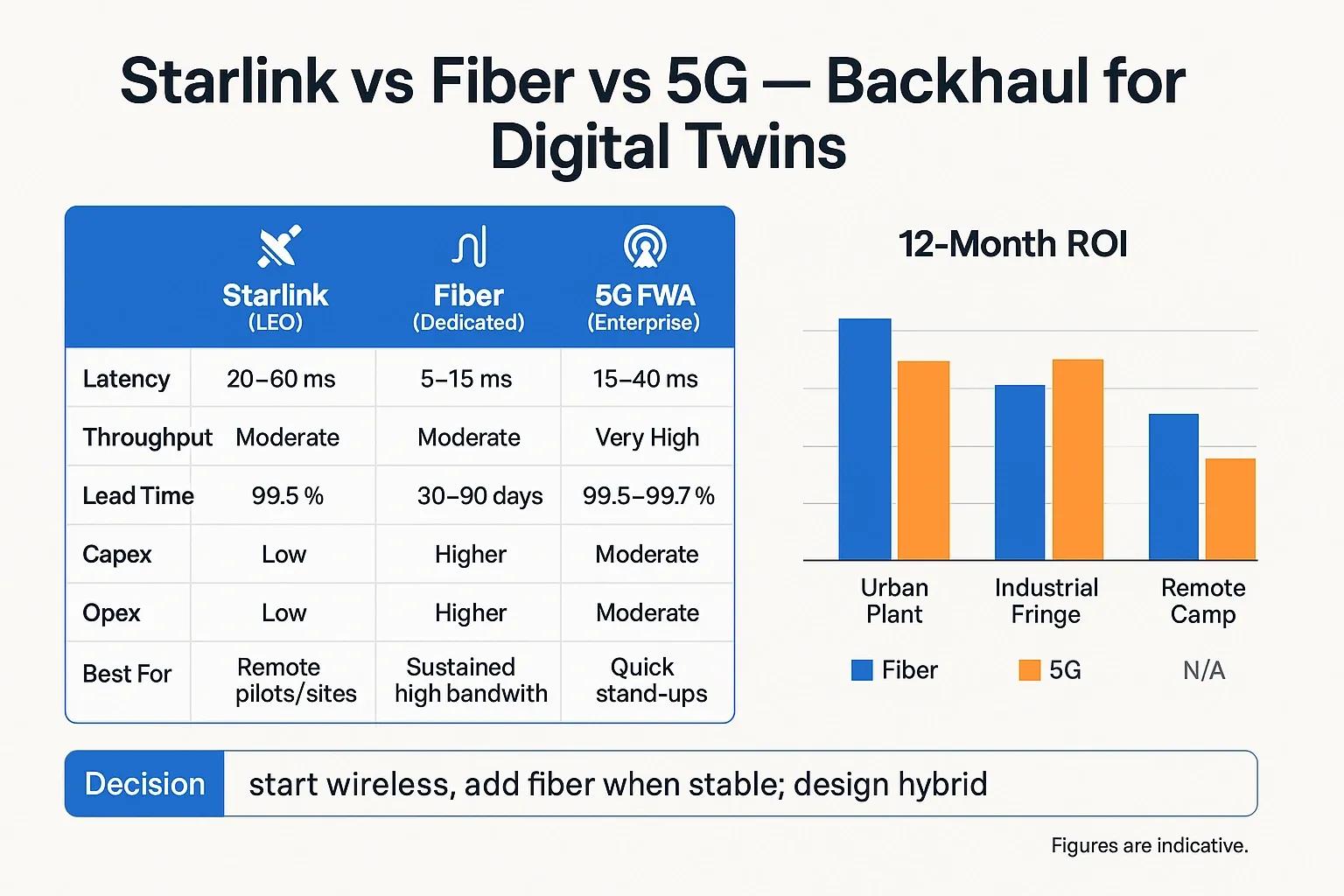
Fiber: 5–15 ms, 99.9% SLA, best throughput; lead time 30–90 days; higher install cost.
5G FWA: 15–40 ms, 99.5–99.7% with enterprise plans; 7–21 days; moderate capex/opex; signal/load dependent.
Starlink (LEO): 20–60 ms, ~99.5%; 3–7 days; low capex/opex; needs clear sky; excellent for remote and fast pilots.
“Which hurts your program more today, lead time or unpredictable uptime?”
Workload fit by technology
Fiber: Best for: stable plants needing sustained high bandwidth (video analytics, multi-sensor twins, large BIM/point-cloud sync). Watch-outs: trenching/permissions, long provisioning; consider LTE/5G or Starlink as a temporary fit-for-purpose bridge.
5G FWA (enterprise): Best for: quick stand-ups in urban/suburban areas; mobile or semi-permanent footprints; mid-bandwidth twins. Watch-outs: cell edge variability, contention at peak hours, RF planning for metal-dense sites.
Starlink (LEO): Best for: remote camps, mines, highways, and fast pilots; rapid time-to-first-value. Watch-outs: sky obstructions, weather/terminal placement; add local QoS and caching for heavy uploads.
Three site archetypes (12-month ROI snapshot)
Assumptions used for modeling (kept conservative and consistent):
Benefits once live (net ops value from the digital twin): Urban Plant $30k/mo , Industrial Fringe $20k/mo , Remote Camp $15k/mo .
Typical lead times/costs (order-of-magnitude): Fiber : capex $2–5k, opex $500–700/mo, 60–90 days; 5G FWA : capex ~$800, opex ~$150/mo, 14–30 days; Starlink : capex ~$599, opex ~$120/mo, 3–7 days.
1) Urban Plant (fiber available)
Fiber: highest stability, but ~60 days to go live.
5G FWA: solid backup or interim primary; go-live ~2 weeks.
Starlink: rapid pilot link; keep as tertiary failover once fiber arrives.
Takeaway: Start on 5G or Starlink to capture value in weeks, then cut over to fiber primary with wireless/LEO as active-passive failover.
2) Industrial-Fringe Plant (fiber slow/expensive)
Fiber: 90-day wait + higher install.
5G FWA: often adequate if signal is clean; deploy in ~3 weeks.
Starlink: the fastest time-to-benefit; pair with 5G for availability.
Takeaway: Starlink + 5G in active-active or active-passive gives better 12-mo ROI than waiting for fiber.
3) Remote Construction Camp (no fiber)
Fiber: not practical.
5G FWA: viable where coverage exists (lead ~30 days).
Starlink: default primary; go live in days.
Takeaway: Starlink primary, add 5G where available for redundancy.
Architecture tips (keep it simple and resilient)
Dual-WAN edge with QoS: prioritize telemetry/alarm traffic over bulk media.
Store-and-forward buffers: local caching for video/point-cloud bursts.
Health checks & auto-failover: active monitoring on packet loss/latency.
SRT/QUIC for media: improves video over variable links.
Small-footprint observability: edge metrics → NOC; alert on SLA drift.
The numbers (what the charts show)
Comparison table: Fiber leads on latency/stability; Starlink leads on deploy speed; 5G balances speed and cost where signal is strong.
12-month ROI: Faster go-live dominates. In our model: Urban Plant: Fiber wins on steady-state, but 5G/Starlink capture 1–2 extra months of value, often worth >$30–60k. Industrial-Fringe: Starlink or 5G beat a fiber-only plan over 12 months due to delay costs. Remote Camp: Starlink provides the best ROI; add 5G for resilience where available.
Recommended patterns (by site)
Urban plant: Start 5G/Starlink day-1 → migrate to fiber primary → keep wireless failover.
Industrial fringe: Starlink + 5G now → reassess fiber only if cost-to-value is justified.
Remote camp: Starlink primary with 5G as coverage allows; satellite remains the anchor.
Benefits & ROI (summary)
Faster time-to-value: weeks vs months; more net benefit within year one.
Operational resilience: dual-path designs protect shifts and safety workflows.
Scalable costs: start lean; add bandwidth as telemetry/video grows.
Lower risk: pilot quickly; avoid sunk costs while de-risking the twin.
Conclusion
Backhaul isn’t one-size-fits-all. Think time-to-benefit first, then optimize for latency and resilience. In practice, that means wireless-first to start, fiber when stable, and hybrid for uptime. This approach keeps your digital twin online, performant, and ROI-positive from month one.