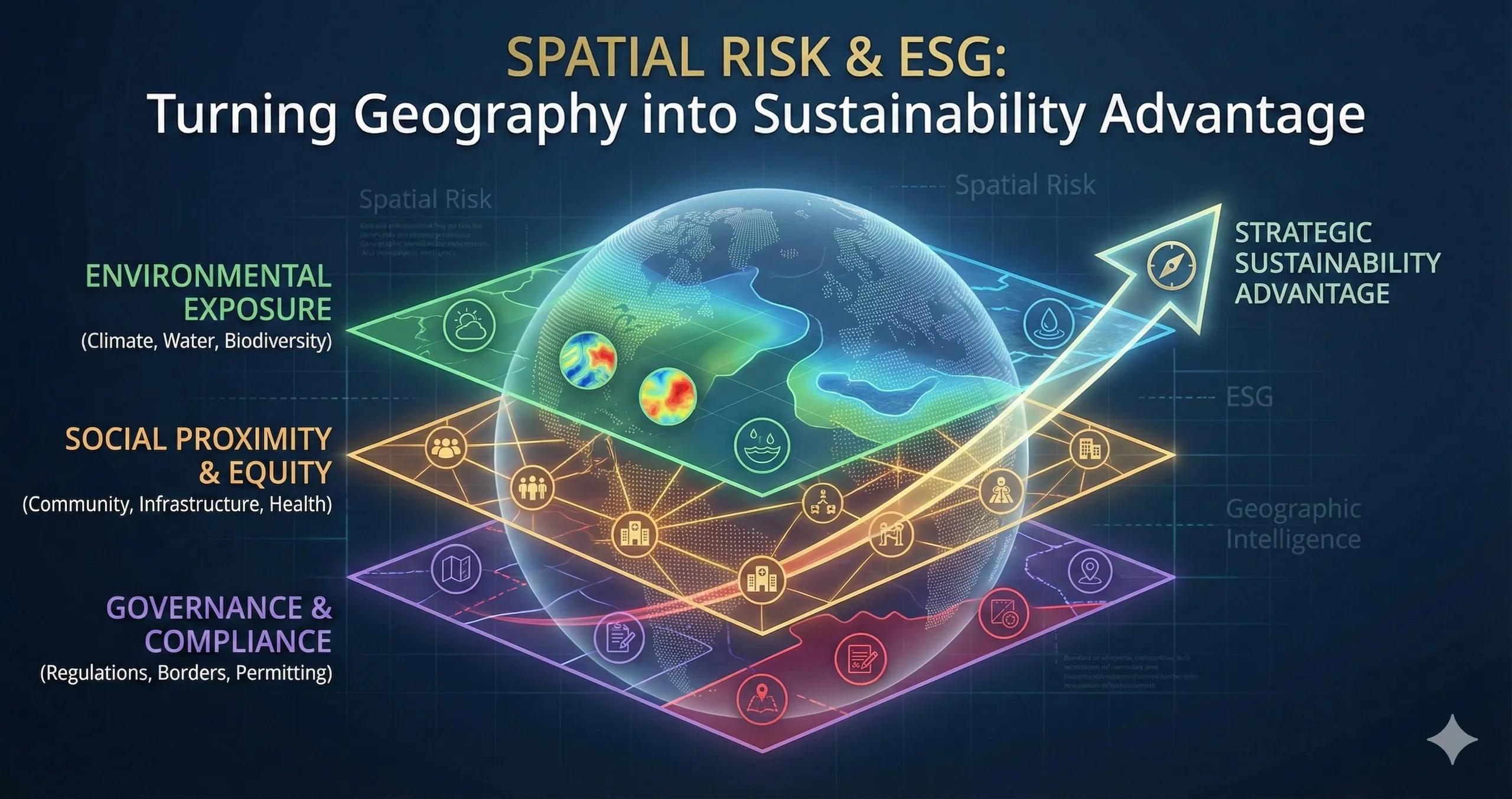
ESG is geographic
Environmental, Social, and Governance (ESG) reporting is often discussed in abstract metrics.
Carbon intensity.
Water usage.
Diversity ratios.
Compliance disclosures.
But ESG performance is not abstract.
It is geographic.
Emissions occur somewhere.
Water stress affects specific basins.
Communities experience infrastructure inequity locally.
Climate risk varies by region.
If ESG is measured without geography, it remains incomplete.
Why spatial risk matters in ESG
Most ESG disclosures answer:
How much are we emitting?
How compliant are we?
What policies do we have?
Fewer answer:
Where are our emissions concentrated?
Which communities face cumulative environmental burden?
Where is our infrastructure exposed to climate stress?
Which assets sit in water-scarce regions?
ESG without spatial context measures totals.
Spatial ESG measures exposure.
The three geographic pillars of ESG
A structured spatial ESG framework aligns with three dimensions:
🌍 Environmental Exposure
Climate vulnerability mapping
Flood, heat, drought risk overlays
Biodiversity impact zones
Carbon footprint clustering
Boards care because environmental exposure affects asset life and impairment risk.
🏙 Social Proximity & Equity
Service accessibility gaps
Community vulnerability indices
Infrastructure inequity mapping
Health and demographic overlays
Regulators and investors care because social risk is geographically uneven.
🏛 Governance & Compliance Geography
Regulatory zone clustering
Permitting risk concentrations
Cross-border exposure
Infrastructure interdependency mapping
Governance is not just policy, it is geographic compliance alignment.
A practical scenario
Consider a renewable energy developer expanding operations.
Without spatial ESG integration:
Projects optimized for cost and grid proximity
With spatial ESG evaluation:
Water stress layers considered
Community proximity assessed
Biodiversity buffers mapped
Climate volatility integrated
The result:
Lower long-term regulatory friction
Stronger stakeholder trust
Reduced litigation exposure
Enhanced investor confidence
Same project.
Different geographic intelligence.
Why investors are paying attention
Institutional investors increasingly evaluate:
Climate-adjusted asset exposure
Regional environmental concentration
Community impact risk
Long-term geographic resilience
ESG ratings without spatial depth are becoming insufficient.
Geographic transparency strengthens credibility.
The risk of ignoring spatial ESG
When geography is excluded:
Climate risk appears uniform
Social impact becomes narrative
Compliance risk remains reactive
Portfolio exposure is underestimated
This creates a disconnect between sustainability messaging and structural resilience.
Investors notice that gap.
From compliance to competitive advantage
Enterprises that integrate spatial risk into ESG strategy can:
Reallocate capital away from high-risk geographies
Design resilient infrastructure corridors
Strengthen regulatory defensibility
Demonstrate quantifiable exposure reduction
ESG shifts from reporting obligation to strategic positioning.
The monetization bridge
As ESG scrutiny intensifies, organizations increasingly seek structured spatial risk frameworks and scalable geospatial platforms that quantify environmental, social, and governance exposure in measurable, board-ready terms aligned with capital allocation and long-term resilience planning.
The shift is from narrative ESG to spatially quantified ESG.
Looking ahead
Climate volatility.
Urban densification.
Resource scarcity.
Regulatory tightening.
All are geographically uneven.
In the next decade, ESG leadership will belong to organizations that understand not just what they emit or report, but where their exposure accumulates.
Closing insight
Sustainability is not evenly distributed.
Risk is not evenly distributed.
Opportunity is not evenly distributed.
Geography determines which is which.
When ESG becomes spatially informed, sustainability becomes strategic.