Strategy Has a Location
Every strategic decision has a geographic dimension.
Market expansion happens in specific regions.
Infrastructure investments are placed in physical locations.
Supply chains move through defined corridors.
Climate risks affect particular geographies.
Yet, in many organizations, leadership discussions remain largely non-spatial .
Decisions are framed in financial, operational, or strategic terms, but rarely in geographic terms.
This creates a gap:
Strategy is discussed abstractly, while risk and opportunity are spatially distributed.
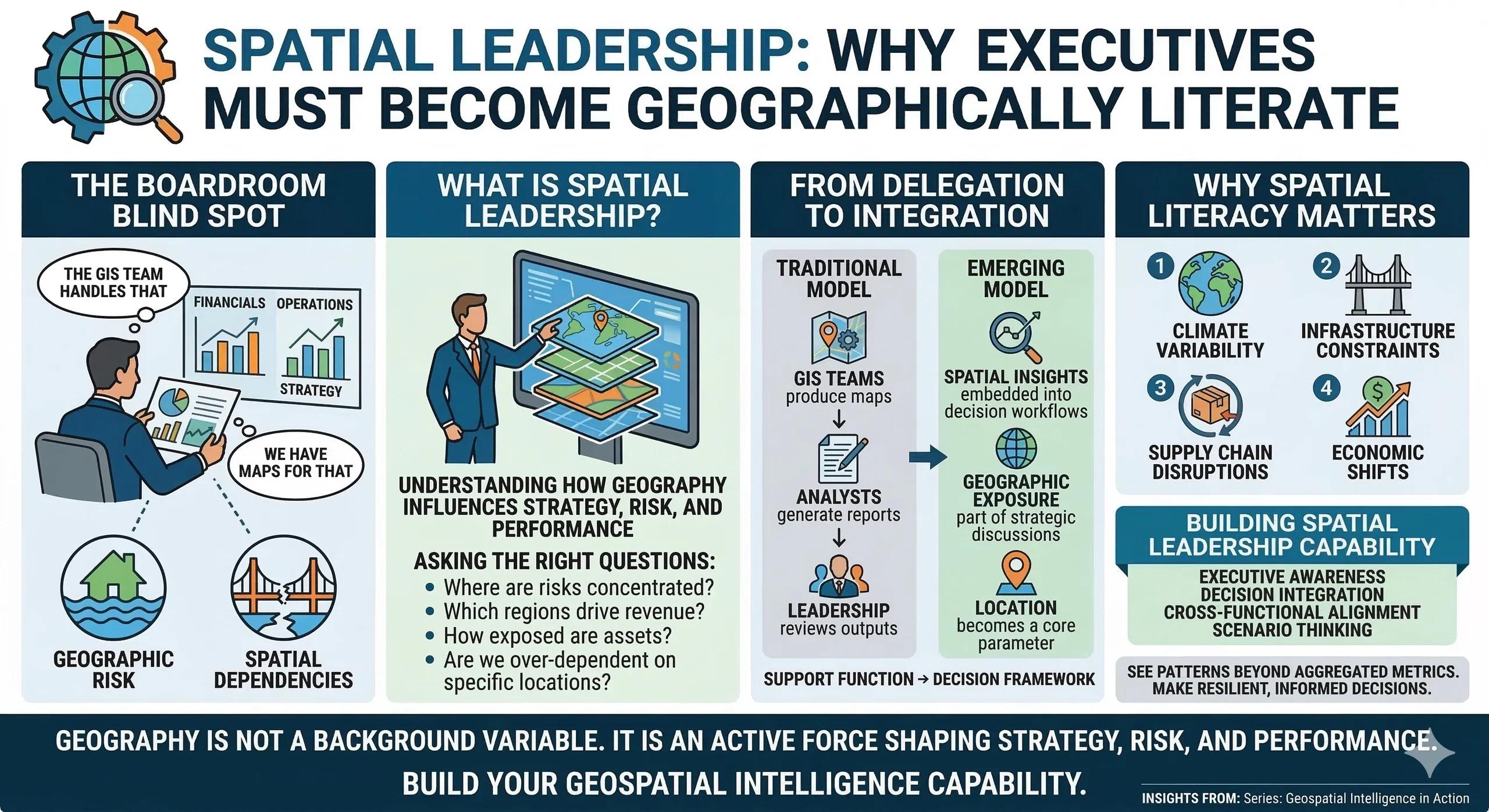
The Boardroom Blind Spot
In many organizations, geography is delegated.
Phrases like:
“The GIS team handles that.”
“We have maps for that.”
“Let the analysts evaluate the location.”
are common.
This delegation creates a blind spot.
Leadership may review reports and dashboards, but often lacks the ability to:
question spatial assumptions
interpret geographic risk
connect location with strategic outcomes
As a result, critical decisions may overlook geographic exposure and spatial dependencies .
What Is Spatial Leadership?
Spatial leadership is the ability of decision-makers to understand how geography influences strategy, risk, and performance.
It does not require executives to become technical GIS experts.
Instead, it requires them to ask the right questions:
Where are our risks geographically concentrated?
Which regions drive our revenue and growth?
How exposed are our assets to climate or infrastructure disruption?
Are we over-dependent on specific locations or corridors?
Spatial leadership shifts geography from a technical layer to a strategic lens .
Why Spatial Literacy Matters
Organizations increasingly operate in environments shaped by:
climate variability
infrastructure constraints
supply chain disruptions
regional economic shifts
These factors are inherently geographic.
Leaders who lack spatial awareness may:
underestimate risk concentration
misjudge expansion opportunities
overlook infrastructure dependencies
fail to anticipate regional disruptions
Spatial literacy allows leadership to see patterns that aggregated metrics cannot reveal .
From Delegation to Integration
Traditional model:
GIS teams produce maps
analysts generate reports
leadership reviews outputs
Emerging model:
spatial insights are embedded into decision workflows
geographic exposure is part of strategic discussions
location becomes a core parameter in planning
This shift transforms spatial intelligence from a support function into a decision framework .
A Practical Example
Consider a company planning regional expansion.
A traditional approach may evaluate:
market demand
regulatory conditions
cost structures
A spatially aware leadership team would also evaluate:
infrastructure connectivity
climate exposure
proximity to supply chains
regional risk concentration
This results in more resilient and informed decisions.
Building Spatial Leadership Capability
Organizations can strengthen spatial leadership through:
Executive awareness
Introducing geographic risk and spatial analytics into leadership discussions.
Decision integration
Embedding spatial metrics into strategic planning and governance processes.
Cross-functional alignment
Ensuring that spatial insights connect with finance, operations, and risk functions.
Scenario-based thinking
Using geospatial analysis and digital twins to evaluate future conditions.
Spatial leadership is not about tools.
It is about how decisions are framed .
The Monetization Bridge
As organizations recognize the strategic value of geographic insight, there is increasing demand for geospatial platforms, digital twin environments, and advisory services that help leadership teams integrate spatial intelligence into decision-making processes. This includes building executive dashboards, scenario simulation systems, and governance frameworks that connect location data with strategic outcomes.
Looking Ahead
In the coming years, spatial literacy will become a critical leadership capability.
Executives will increasingly need to:
understand geographic exposure
evaluate location-based risk
interpret spatial analytics
integrate geography into strategic planning
Organizations that build this capability will make more resilient and informed decisions.
Closing Insight
Geography is not a background variable.
It is an active force shaping strategy, risk, and performance.
Leaders who understand this will have a clearer view of both opportunity and vulnerability.