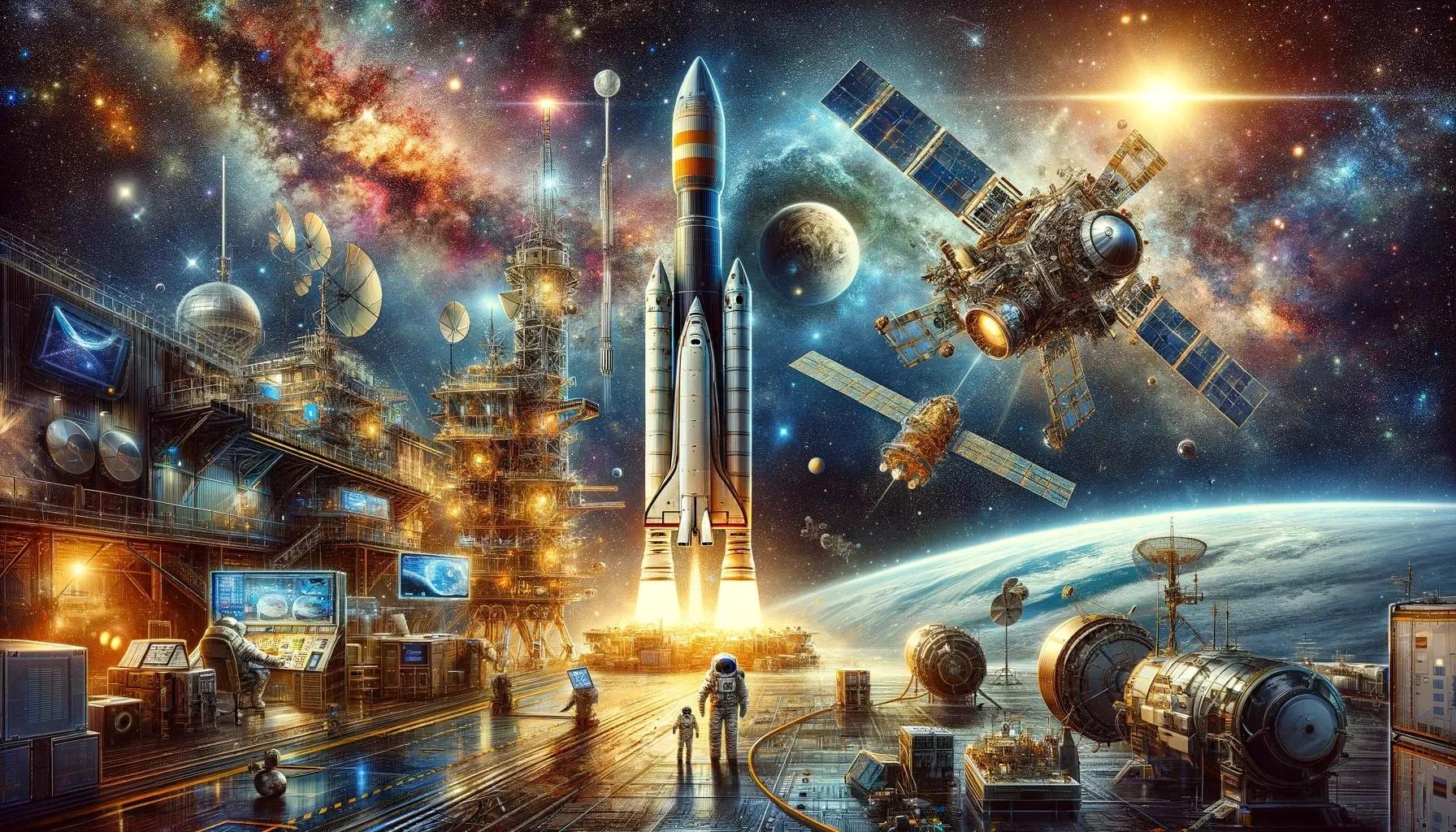
Space technology represents a frontier of human ingenuity and innovation, comprising an array of tools and systems specifically designed for the challenging environment of outer space. This field is not just about exploring the unknown, but also about developing technologies that push the limits of what is possible, blending science and engineering to create solutions for navigating and utilizing space.
Space Vehicles:
The cornerstone of space technology is the space vehicle, encompassing various types of crafts and structures designed for space operations:
Spacecraft: These are complex machines engineered to travel beyond Earth's atmosphere, serving diverse purposes such as scientific exploration, communication relay, and even space tourism. Each spacecraft is a marvel of engineering, equipped to withstand the vacuum of space and function in zero-gravity environments.
Satellites: Often regarded as artificial moon, satellites orbit the Earth and play a pivotal role in data collection and service provision. Their applications are widespread, from meteorology and GPS navigation to satellite television, significantly impacting daily life on Earth.
Space Stations: These are habitable artificial structures in space, primarily used as research laboratories where astronauts conduct experiments in microgravity conditions. They serve as temporary abodes for spacefarers, contributing significantly to our understanding of living in space.
Orbital Launch Vehicles: These powerful rockets are the workhorses of space missions, responsible for delivering payloads like spacecraft, satellites, and crew into space. They are feats of engineering, capable of overcoming Earth's gravity to reach outer space.
Deep-Space Communication:
Communication Satellites: These specialized satellites facilitate communication between Earth and distant space vehicles, playing a crucial role in deep-space missions.
Deep-Space Networks: These are sophisticated ground-based antenna arrays, capable of communicating with spacecraft millions of kilometers away, vital for deep-space exploration and data transmission.
In-Space Propulsion:
Rocket Engines: These are the primary propulsion systems for launching spacecraft, providing the necessary thrust for lift-off and maneuvering in space.
Ion Engines: Representing a more advanced and efficient form of propulsion, ion engines utilize electric fields to propel spacecraft, ideal for long-duration space missions.
Other Technologies:
Robotics: Robots are indispensable in space exploration, undertaking tasks that are too perilous or intricate for humans. They range from rovers exploring planetary surfaces to robotic arms used for repairs and construction in space.
Life Support Systems: These systems are critical for human survival in space, providing essential elements like air, water, and food.
Remote Sensing: Utilizing satellites, remote sensing technology collects data about Earth’s surface, aiding in understanding weather patterns, climate change, and managing natural disasters.
Benefits of Space Technology:
The impacts of space technology are far-reaching, enhancing various aspects of life on Earth:
Communication: Satellites form the backbone of global communication networks, facilitating real-time connectivity across the globe.
Navigation: GPS technology, a direct outcome of space technology, is integral to modern transportation, logistics, and emergency services.
Weather Forecasting: Satellite data is pivotal in weather prediction, aiding in the timely anticipation and response to natural calamities.
Climate Change Monitoring: Satellites play a crucial role in monitoring environmental changes, offering valuable insights for combating climate change.
Medical Research: Space research has led to medical advancements like MRI technology and the development of prosthetic limbs.
Materials Science: The unique conditions of space have led to the creation of new materials with specialized applications on Earth.
The Future of Space Technology:
Looking ahead, the potential advancements in space technology are bound to transform our approach to space and its utilization:
Space Exploration: Ambitious missions to Mars and other celestial bodies are on the horizon, aiming to expand our understanding of the cosmos and the possibility of extraterrestrial life.
Space Tourism: Private enterprises are at the forefront of making space travel more accessible, turning what was once science fiction into reality.
Asteroid Mining: This concept involves extracting resources from asteroids, potentially providing Earth with rare materials.
Space-Based Solar Power: Harnessing solar energy in space and transmitting it to Earth could offer a sustainable and abundant energy source.
In conclusion, as we delve deeper into the mysteries of space, the evolution of space technology continues to be pivotal. It not only furthers our quest to explore the universe but also brings about transformative changes that enhance life on Earth. The journey of innovation and exploration in space technology is an ongoing saga of human achievement and ambition.
Citations
https://en.wikipedia.org/wiki/Spacecraft
https://www.pixalytics.com/how-many-satellites/
https://en.wikipedia.org/wiki/Tiangong_space_station
https://en.wikipedia.org/wiki/List_of_orbital_launch_systems
https://www.esa.int/Applications/Navigation/Communication_satellites_telling_us_where_they_are
https://www.jpl.nasa.gov/missions/dsn
https://en.wikipedia.org/wiki/Rocket_engine
https://en.wikipedia.org/wiki/Ion_thruster
https://www.azorobotics.com/Article.aspx?ArticleID=132
https://en.wikipedia.org/wiki/Life-support_system
https://gisgeography.com/remote-sensing-earth-observation-guide/