Production issues don’t start on the shop floor.
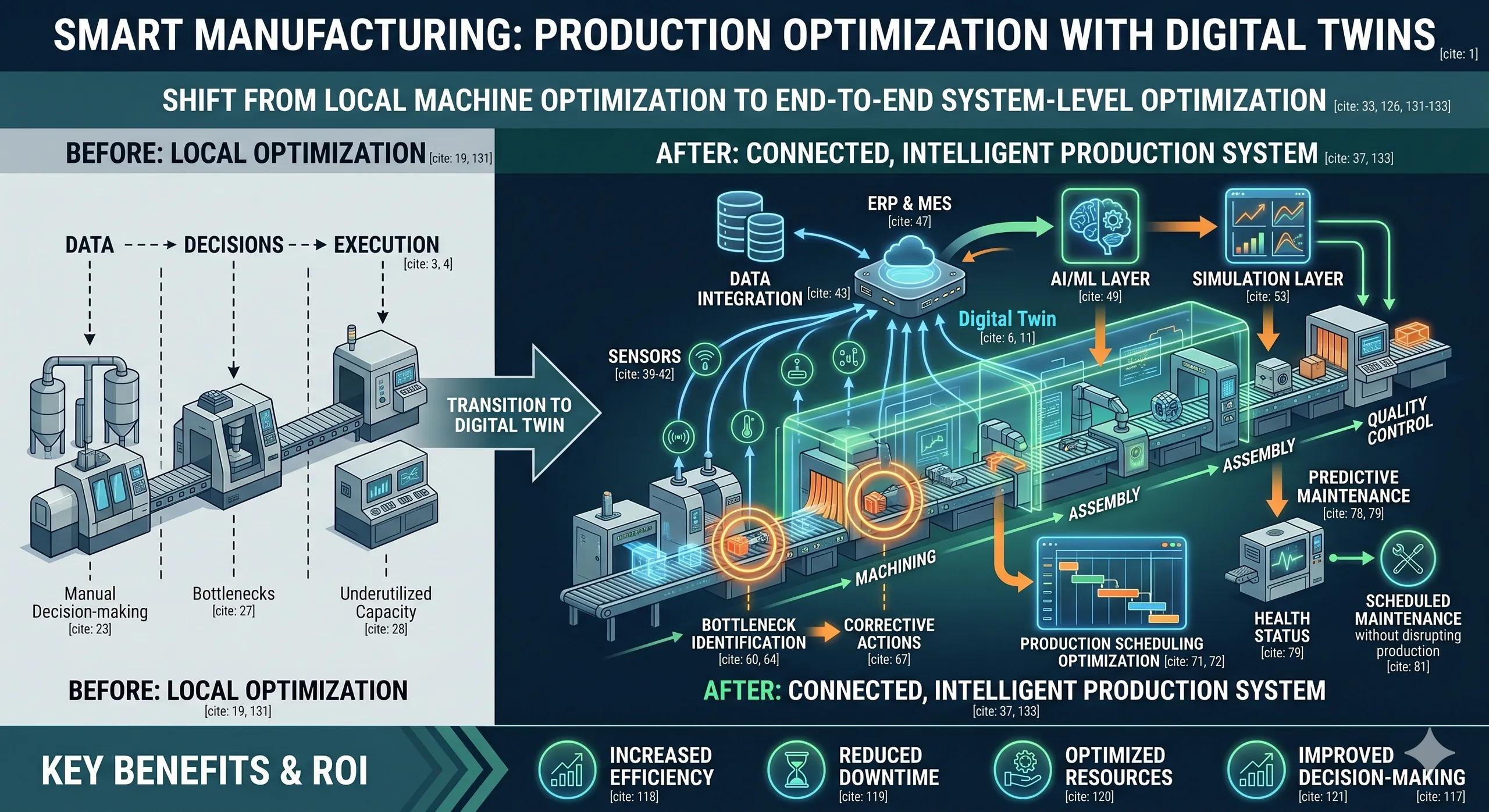
They start in the gap between data, decisions, and execution.
Introduction
In the previous articles, we explored how Digital Twins enable:
predictive maintenance in highways
integrated operations in smart cities
real-time coordination in airports
safety-driven intelligence in railways
Now we move into industrial environments :
👉 Smart Manufacturing
Manufacturing is where Digital Twins deliver some of the most measurable ROI—because:
operations are continuous
processes are repeatable
inefficiencies directly impact cost
In Phase 3, the focus remains:
👉 how Digital Twins enable optimization, not just monitoring
The Core Problem: Local Optimization, Global Inefficiency
Most manufacturing systems today:
optimize individual machines
monitor production metrics
rely on manual decision-making
But:
👉 the system as a whole is not optimized
This leads to:
bottlenecks between processes
underutilized capacity
production delays
higher operational cost
Where Digital Twins Change the Approach
A Manufacturing Digital Twin enables:
👉 end-to-end visibility and optimization across the production line
Instead of:
optimizing isolated machines
It creates:
a connected, intelligent production system
Key Components of a Manufacturing Digital Twin
1. Sensor Layer
machine performance data
temperature, vibration, load
production output
2. Data Integration
connects: machines production systems ERP and MES
👉 creates a unified production view
3. AI/ML Layer
identifies bottlenecks
predicts machine failure
optimizes production scheduling
4. Simulation Layer
tests production scenarios
evaluates process changes
predicts outcomes before execution
5. Visualization Layer
real-time dashboards
3D production line models
Use Case 1: Bottleneck Identification
Traditional Approach
analyze production reports
identify issues after delays
Digital Twin Approach
monitor flow across machines
detect real-time bottlenecks
suggest corrective actions
👉 Outcome:
smoother production flow
reduced downtime
Use Case 2: Production Scheduling Optimization
simulate different production plans
adjust schedules dynamically
align resources with demand
👉 Outcome:
improved throughput
reduced idle time
Use Case 3: Predictive Maintenance Integration
integrate machine health data with production planning
👉 Outcome:
maintenance scheduled without disrupting production
Practical Example
Scenario: Production Delay
machine performance drops in one stage
AI identifies:
👉 bottleneck forming
System triggers:
schedule adjustment
load redistribution
maintenance check
👉 Outcome:
delay avoided
production stabilized
Where Most Implementations Fail
1. Focus on Machines, Not Systems
optimizing individual assets 👉 ignoring system-level flow
2. Data Without Decision Integration
insights exist 👉 no operational action
3. No Simulation Capability
decisions made without testing scenarios
4. Lack of Feedback Loop
outcomes not fed back into system
Ask Yourself
Is your manufacturing system:
👉 optimized locally
Or
👉 optimized end-to-end?
Indian Context
India’s manufacturing sector is rapidly evolving with:
Industry 4.0 adoption
increasing automation
global supply chain integration
Digital Twins can help:
👉 improve productivity
👉 reduce operational cost
👉 enhance competitiveness
Benefits & ROI
increased production efficiency
reduced downtime
optimized resource utilization
improved decision-making
faster response to disruptions
Conclusion
Manufacturing optimization is not about improving one machine.
It is about:
👉 understanding the entire system
👉 predicting outcomes
👉 coordinating decisions
Digital Twins enable this shift.
From:
👉 isolated optimization
to
👉 connected, intelligent production systems