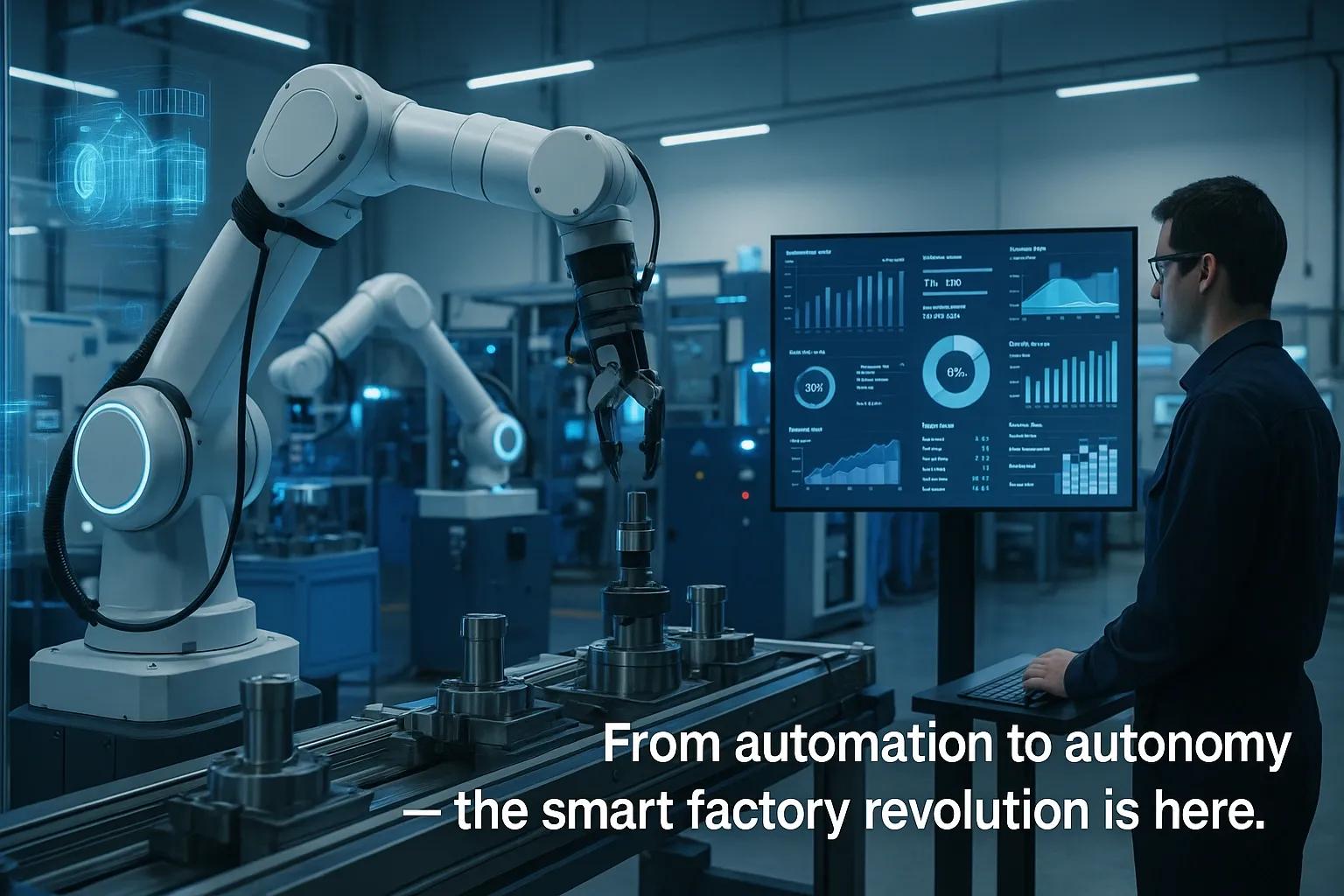
The shift toward smart factories marks one of the most transformative industrial trends of the 21st century. Across the world, manufacturers are reimagining traditional production systems by embedding intelligence, connectivity, and automation at every layer of operations. According to a 2024 Capgemini Research Institute report, over 76% of global manufacturers have already launched smart factory initiatives, with projected annual gains of $2.2 trillion in productivity and efficiency. What began as an abstract Industry 4.0 vision has now become a measurable business reality.
1. The Evolution: From Automation to Autonomy
Traditional factories were built on fixed automation, machines designed for repetitive precision, but rigid and isolated from one another. Smart factories, by contrast, operate as adaptive ecosystems , where cyber-physical systems, AI analytics, and digital twins collaborate to make decisions in real time.
Transformation from X → to Y:
From reactive production → to predictive operations .
From linear workflows → to data-driven, dynamic networks .
From manual optimization → to autonomous self-correction .
For example, Siemens’ Amberg Electronics Plant in Germany illustrates this evolution vividly. The plant operates with 99.998% production quality by integrating IoT sensors, digital twins, and AI-driven analytics to synchronize machines, materials, and workforce inputs in real time. Similarly, Bosch’s Industry 4.0 plants in India have achieved up to 25% improvement in overall equipment effectiveness (OEE) through predictive maintenance and AI-based visual inspection systems.
The smart factory is no longer just about connected devices; it’s about connected intelligence , systems that learn, adapt, and optimize without waiting for human intervention.
2. The Building Blocks of Implementation
Implementing a smart factory requires a structured integration of several core technologies and processes. Each plays a distinct role in transforming operations from data collection to decision automation.
a) IoT and Sensor Networks
Industrial IoT (IIoT) provides the sensory foundation. Machines, tools, and workstations are embedded with sensors that capture parameters like vibration, temperature, energy usage, and cycle time. This data is transmitted via industrial communication standards like OPC UA and MQTT into a central system for processing.
Example: Foxconn , a leading electronics manufacturer, uses IIoT networks to track thousands of machine nodes across its production facilities. The result, a 15% reduction in downtime and faster detection of anomalies across production lines.
b) Digital Twins and Simulation
A digital twin acts as a virtual replica of physical assets and processes , allowing manufacturers to test “what-if” scenarios before implementation. This reduces waste, improves scheduling, and enhances overall throughput.
For instance, BMW Group’s digital twin factory in Regensburg uses NVIDIA’s Omniverse platform to simulate entire production lines in real time. Before deploying a single robot or conveyor belt, engineers can predict efficiency outcomes and safety risks, shortening setup times by nearly 30% .
c) Artificial Intelligence and Analytics
AI transforms raw machine data into actionable intelligence. Predictive analytics can forecast equipment failures, optimize supply chains, and adjust production based on demand variability.
Example: Unilever’s smart factory in Valinhos, Brazil , uses Microsoft’s Azure AI to analyze production data. This system autonomously adjusts equipment settings to maintain product consistency, cutting quality-related losses by 25% .
d) Robotics and Automation Systems
Collaborative robots (cobots) are now integral to smart factories. Unlike traditional robots confined to cages, cobots work safely alongside humans, learning tasks and optimizing movements through AI algorithms.
Example: Fanuc’s AI-powered robots use deep reinforcement learning to improve performance autonomously, minimizing errors and accelerating process calibration.
e) Cloud and Edge Computing
Real-time responsiveness is critical. Edge computing processes data near the source, enabling instant insights and decisions. Cloud platforms, meanwhile, provide centralized control, scalability, and integration across multiple sites.
3. Challenges and the Path to Scalable Adoption
Despite the clear benefits, full-scale smart factory adoption remains complex. Key challenges include:
Legacy Infrastructure Integration: Many factories operate on outdated systems not designed for interoperability. Transitioning from isolated SCADA setups to open IIoT platforms demands careful architectural planning.
Data Management and Security: As connectivity increases, so does exposure to cyber threats. Manufacturing now accounts for nearly 23% of all cyberattacks globally, underscoring the need for secure communication and data governance.
Talent and Skill Gaps: Smart factories require hybrid skills, engineers fluent in data science, IT specialists versed in operations, and operators comfortable with analytics dashboards.
To navigate these challenges, successful companies adopt incremental transformation models :
Begin with pilot projects, typically a single production cell or process.
Establish cross-functional teams to link IT, OT, and management.
Build scalable data pipelines before AI deployment.
Adopt open standards and interoperability frameworks for vendor-neutral growth.
One effective framework is the “Discover → Pilot → Scale” approach used by General Electric’s Brilliant Factory program , which combines Lean principles with digital analytics. GE achieved 10–20% productivity gains across multiple sites by focusing first on transparency, then on automation.
4. Implications and Outlook
The implications of smart factory transformation reach far beyond individual plants. When implemented at scale, they redefine entire supply chains and business models.
Resilient Manufacturing: The COVID-19 pandemic exposed vulnerabilities in global supply chains. Smart factories enable localized, demand-driven production , improving agility and reducing dependency on single-source suppliers.
Sustainability and Energy Optimization: By monitoring energy usage at machine level, smart factories can cut consumption by up to 40% , contributing directly to corporate net-zero goals.
Hyper-Personalized Production: With digital twins and flexible automation, batch sizes of one are now economically viable, enabling true mass customization.
Globally, the smart factory market is projected to grow from $121 billion in 2024 to over $310 billion by 2030 , with Asia-Pacific leading due to massive digitization drives in China, India, and South Korea.
5. From Vision to Value: The Next Decade
The next phase of industrial evolution lies in convergence , uniting smart factory intelligence with enterprise-wide systems like ERP, PLM, and supply chain management. AI-driven manufacturing ecosystems will not only optimize individual operations but also orchestrate end-to-end business outcomes, from design to delivery.
Manufacturers that delay transformation risk falling behind competitors who already leverage predictive insights, autonomous systems, and closed-loop optimization. However, the transition need not be abrupt. A clear roadmap, data strategy, and cultural alignment can help organizations move from digital intent to digital impact .
Smart factory transformation is not about replacing humans, it’s about amplifying human capability through intelligent systems. The winners of this decade will be those who combine operational excellence with adaptive intelligence.