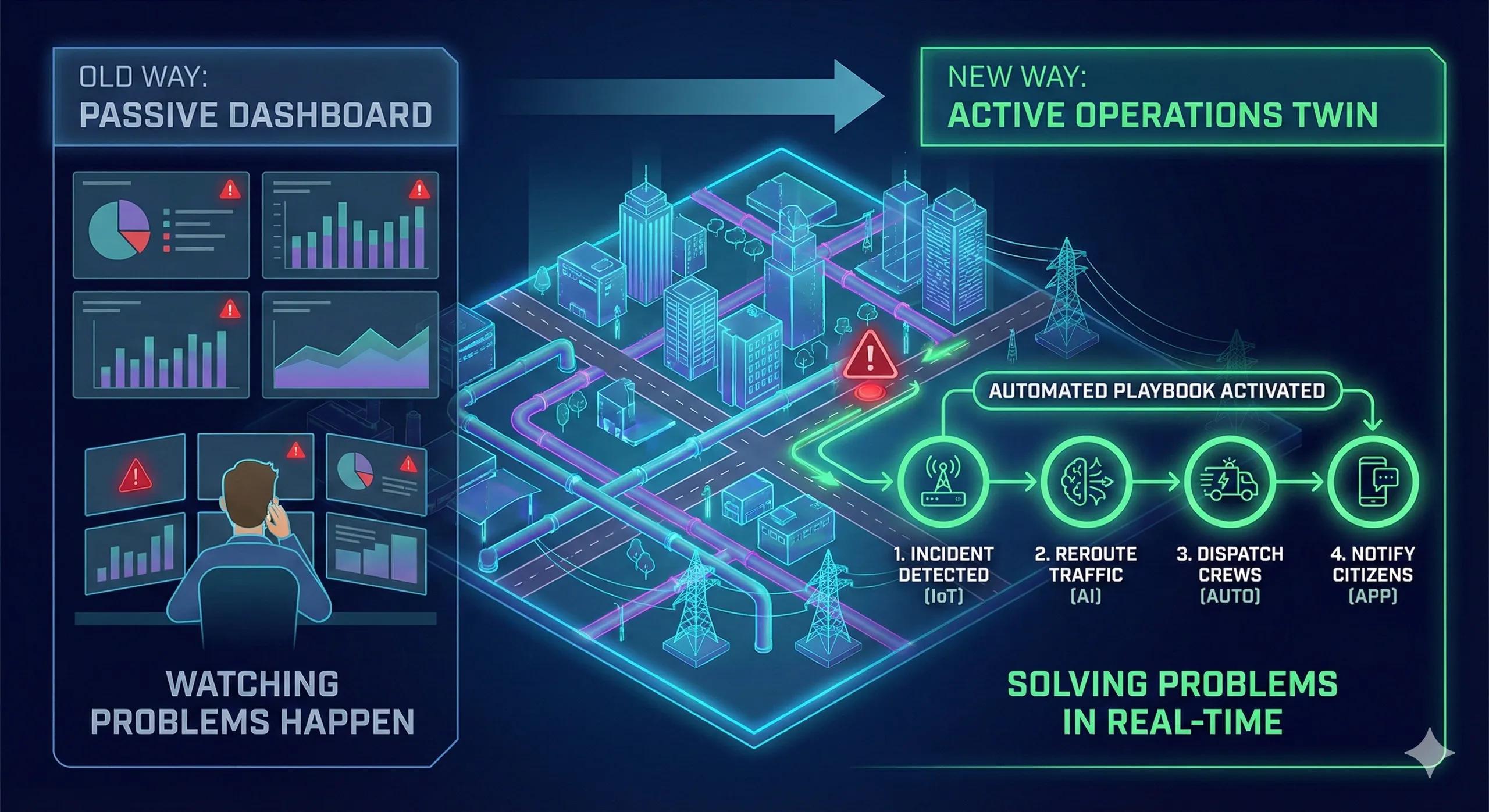
What if a city could monitor itself, diagnose itself, and improve itself, all in real time?
Smart cities are often mistaken for dashboards, IoT sensors, or surveillance cameras.
But true smart-city operations depend on digital twins , living, data-driven replicas of city systems that help administrators monitor, predict, and optimize how a city functions.
A Smart City Operations Twin is not a visualization tool.
It is a real-time governance engine with rules, playbooks, KPIs, and automated workflows.
It tells the city not just what is happening , but what should happen next .
1️⃣ What Is a Smart City Operations Twin?
A Smart City Operations Twin integrates:
live sensor data (traffic, AQI, water, energy, waste)
GIS layers (roads, land use, utility networks)
city KPIs (SLAs, service-level delivery)
workflows (alerts → actions → resolution)
citizen grievances
emergency response systems
digital public infrastructure (DPI)
municipal ERP layers
It converts the entire city into a set of operational loops .
The goal: faster decisions, fewer failures, better service delivery.
2️⃣ The Five Operational Loops of a City Twin
A city runs like a complex machine. Operations twins monitor and optimize these five loops:
A. Mobility Loop
Inputs: traffic sensors, transit feeds, road closures
Outputs: congestion alerts, diversion routes, priority movement for emergency vehicles
KPIs:
average travel time
incident clearance time
bus punctuality
pedestrian/EV safety zones
B. Utilities Loop
Inputs: SCADA, IoT water meters, energy usage, leak detection
Outputs: water pressure balancing, demand–supply matching, outage routing
KPIs:
NRW (non-revenue water)
energy loss index
service uptime (%)
mean time to repair (MTTR)
C. Environment Loop
Inputs: AQI, noise sensors, waste bins, weather, drainage flows
Outputs: air-quality triggers, waste routing optimization, stormwater alerts
KPIs:
AQI hours in "good" category
solid waste collection efficacy
stormwater clearance time
heat stress index
D. Public Safety Loop
Inputs: emergency calls, CCTV analytics, disaster alerts
Outputs: response dispatch, safety advisories, hazard zoning updates
KPIs:
response time (ambulance, fire, police)
incident recurrence
night-time safety score
early-warning lead time
E. Citizen Services Loop
Inputs: grievance systems, mobile apps, field team assignments
Outputs: ticket routing, on-ground verification, SLA tracking
KPIs:
SLA closure (%)
grievance backlog
field team productivity
citizen satisfaction index
3️⃣ City Playbooks, The Real “Brain” of Operations
A Smart City Ops Twin is only as effective as its playbooks , sets of predefined actions that tell the city what to do when a condition occurs.
Examples:
Mobility Playbook
If congestion > threshold → reroute signals → deploy traffic police → update VMS boards → notify commuters.
Water Supply Playbook
If pressure drops in zone → check pump status → inspect valves → predict leakage zones → dispatch repair team.
Flood Playbook
If IMD issues heavy-rain alert → activate pumps → pre-clear drains → block low-lying roads → update flood dashboard.
Air Quality Playbook
If AQI > 200 → restrict construction → deploy sprinklers → alert schools → notify health departments.
Playbooks convert monitoring into automatic action .
4️⃣ KPIs: How a Digital Twin Measures City Performance
KPIs become the city's “vitals.”
A Smart City Ops Twin calculates these in real time:
Governance KPIs
service uptime
complaint resolution SLA
disaster readiness index
operational cost savings
Infrastructure KPIs
water leakage %
electricity loss
road quality index
drainage network health
Mobility KPIs
travel time reliability
public transport occupancy
last-mile connectivity index
Climate KPIs
AQI compliance hours
heat island severity
flood-risk exposure
Citizen KPIs
grievance turnaround
service coverage
digital service penetration
KPIs create accountability, transparency, and planning intelligence .
5️⃣ GeoAI for Smart City Ops
GeoAI enhances twins with predictive capabilities:
LSTM models → traffic + energy + water demand forecasting
Graph Neural Networks → road network resilience
CNNs → pothole detection from imagery
Anomaly detection → sudden drops in water pressure or energy use
Agent-based simulation → evacuation and crowd movement
Heatmap clustering → seasonal complaint hotspots
This shifts city management from reactive → predictive → prescriptive.
6️⃣ India: Smart City Ops Twins Are Becoming Mandatory
India’s urban governance moment is here:
Smart City Mission 2.0
DPI for cities (ULB ERP + spatial layers)
24x7 water & energy reliability goals
Urban Digital Twins proposed by MoHUA
Integrated Command & Control Centers (ICCCs)
City twins unify these diverse systems into a single operational layer .
Tier-2 and Tier-3 cities will benefit the most.
7️⃣ The Future: Fully Autonomous City Operations
A mature Smart City Digital Twin will:
predict failures before they occur
re-route utilities automatically
optimize mobility in real time
balance energy loads during heatwaves
detect illegal dumping
raise early disaster alerts
evaluate policy impacts via simulation
This is not futuristic, it is already happening.
Conclusion
Smart City Operations Twins are the operating system for modern governance.
They combine GIS, IoT, SCADA, mobility data, climate intelligence, and citizen feedback into one decision layer .
Cities don’t just need more sensors.
They need smarter systems that can interpret, respond, and improve continuously.
A city that understands itself becomes a city that serves better.