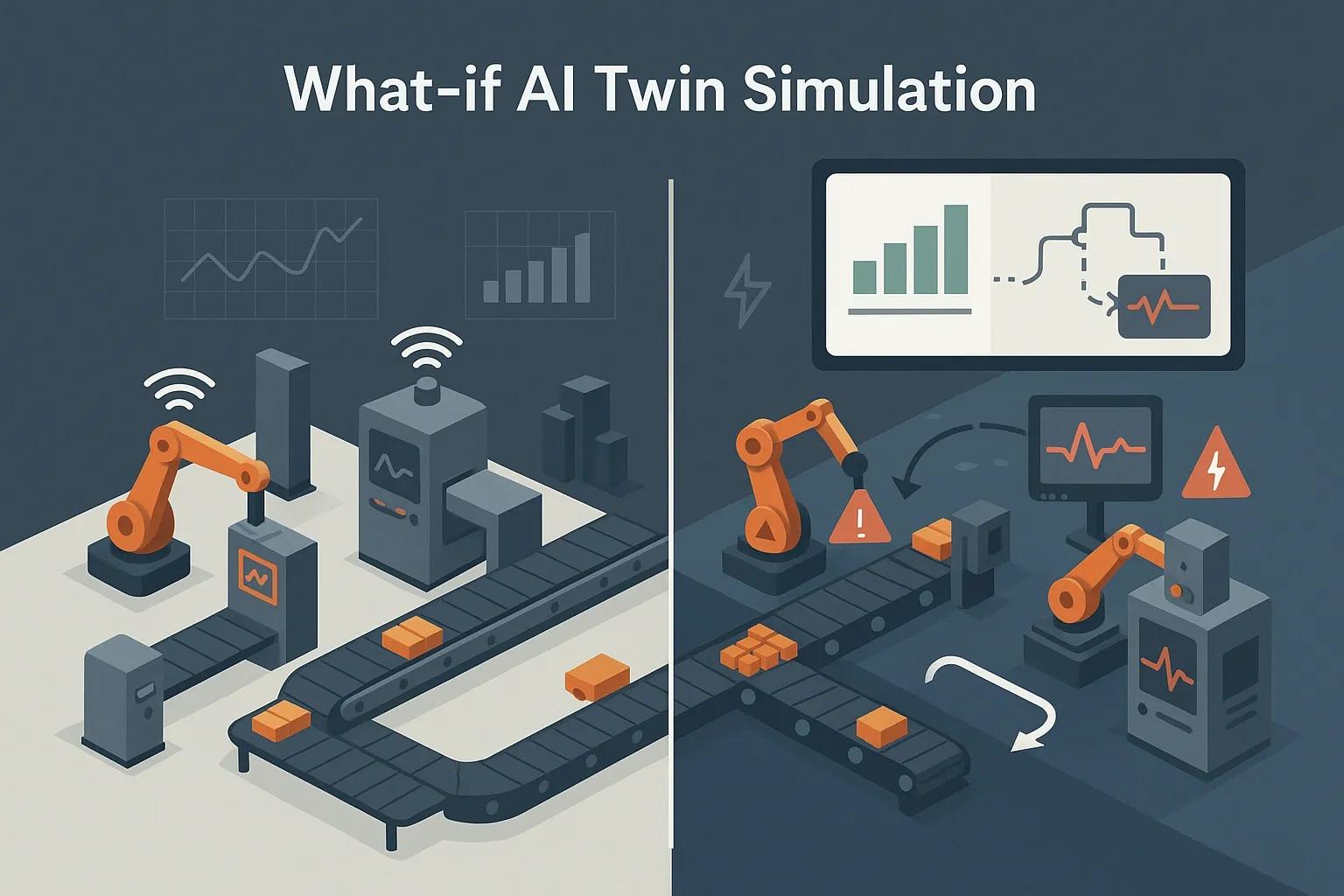
In modern manufacturing environments, downtime, whether scheduled or unexpected, can be costly. Disruptions due to machine failures, supply chain bottlenecks, or operator errors can reduce throughput, increase operational costs, and compromise delivery timelines. Traditional predictive maintenance and monitoring tools offer partial visibility but often fall short when it comes to simulating and preparing for complex failure scenarios. This is where AI-driven digital twins, or AI twins, play a transformative role.
This article explores how AI twins are enabling manufacturers to simulate factory downtime scenarios, perform “what-if” analysis, and plan better for asset failures and operational disruptions.
Understanding AI Twins in the Factory Context
A digital twin is a virtual model of a physical asset, process, or system. When combined with artificial intelligence (AI), the model doesn't just replicate real-world operations, it learns from them. AI twins are advanced digital twins enhanced by machine learning, computer vision, and real-time data analytics. They can continuously ingest data from sensors, control systems, and enterprise applications, allowing them to simulate behavior, optimize performance, and adapt to changing conditions.
In factory settings, AI twins can replicate entire production lines, simulate machine behavior under stress, and model the cascading effects of component failures. The core capability here is predictive simulation, projecting what might happen under specific disruption scenarios.
Simulating Downtime: From Static to Dynamic Modeling
Traditional downtime analysis often relies on static tools like failure mode and effects analysis (FMEA), mean time between failure (MTBF) calculations, or historical downtime reports. While useful, these methods are reactive and do not capture the dynamic interdependencies within a factory.
In contrast, AI twins dynamically simulate the entire factory environment, allowing real-time interaction between different subsystems, such as machinery, operators, raw material inputs, and environmental conditions. This provides a far more realistic and nuanced understanding of how a single point of failure can propagate through the system.
For instance:
If a packaging machine breaks down, how will upstream operations like filling or labeling be affected?
If a robotic arm fails mid-cycle, what’s the best re-routing logic to minimize idle time?
If raw material delivery is delayed, how long before downstream operations halt?
AI twins allow such scenarios to be simulated, visualized, and stress-tested under various assumptions.
Components of a Downtime Simulation Model Using AI Twins
To accurately simulate downtime scenarios, AI twins integrate multiple data sources and models:
Real-Time Sensor Data : Temperature, vibration, pressure, and energy usage data help predict failures.
Maintenance Logs : Past records feed into failure prediction algorithms using supervised learning.
Control System Data : Programmable Logic Controller (PLC) data helps model how machines respond during failures.
Human-Machine Interaction Data : Operator behavior patterns help simulate response times and error rates.
Production Schedules and ERP Data : Enables understanding of supply and demand impact during downtime.
These components are merged into a unified AI model trained to predict, simulate, and recommend actions for various disruption scenarios.
Use Cases: What-if Analysis with AI Twins
1. Machine Failure Simulation
AI twins can simulate the breakdown of critical equipment, such as a CNC machine, and predict the impact on work-in-progress, tool changeover times, and downstream stations. It can suggest whether to switch to backup machines or reschedule production.
2. Line Bottlenecks
Suppose a conveyor belt slows down due to wear and tear. The AI twin simulates queuing behavior upstream and idle time downstream. It then suggests optimal speed adjustments, temporary labor reassignments, or alternate routing.
3. Utility Outages
AI twins can simulate power or compressed air outages and their effect on machine clusters. Using past data, they calculate recovery time and estimate the cost of per-minute outage for each asset group.
4. Labor Shortages or Human Error
If a shift is understaffed or if operators make repeated errors on a quality check, AI twins simulate the effect on throughput, rework rates, and scrap costs. It can trigger pre-emptive training alerts or suggest shifting workloads to other lines.
5. Supply Chain Delays
When raw materials don’t arrive on time, the AI twin calculates how long current buffer stock will last, which orders will be delayed, and what alternative workflows can be adopted to keep utilization high.
Benefits of AI Twin-Based Downtime Simulation
Proactive Planning : Simulations help preemptively identify weak points in production lines.
Decision Support : Managers can evaluate alternative responses to disruptions, such as outsourcing or re-prioritizing orders.
Reduced Downtime : By identifying the shortest path to recovery, AI twins reduce Mean Time to Repair (MTTR).
Cost Optimization : Simulations quantify cost implications for each scenario, aiding in investment planning.
Enhanced Resilience : Organizations can build more robust production systems by repeatedly testing edge-case failures.
Integration with Existing Factory Systems
To implement AI twins for downtime simulations, factories typically need to integrate the following:
IoT Platform : For capturing and streaming sensor data
Manufacturing Execution System (MES) : For operational context
Enterprise Resource Planning (ERP) : For material and scheduling data
AI Modeling Engine : For creating and updating simulation models
Visualization Layer : 3D factory layouts or dashboards to test scenarios
Open standards like OPC-UA and MQTT can be used to ensure interoperability across legacy and new systems.
Challenges and Considerations
Data Quality : AI twins require high-quality historical and real-time data. Missing or inaccurate data can lead to faulty simulations.
Model Complexity : Detailed simulation models can become computationally expensive and need to be balanced for performance.
Change Management : Operators and engineers must trust AI-generated recommendations and simulations.
Cybersecurity : Increased connectivity and data sharing pose security risks that must be mitigated with strong IT-OT security policies.
Future Outlook
As AI models become more advanced and edge computing becomes mainstream, AI twins will be increasingly used for autonomous decision-making in factories. The ability to run thousands of downtime simulations across multiple assets and lines will help manufacturers shift from reactive to anticipatory maintenance, from rigid to adaptive scheduling, and from static to resilient operations.
AI twin platforms are also expected to evolve toward cross-factory learning, where insights from one plant are used to simulate and improve operations in others. Combined with federated learning and cloud-based collaboration, the manufacturing ecosystem is moving toward a collective intelligence model, one that constantly learns, adapts, and prepares for any disruption.
Conclusion
Simulating factory downtime scenarios with AI twins is no longer a futuristic concept, it’s a strategic imperative. With growing complexity in supply chains and increasing demand for operational resilience, manufacturers that adopt AI twin-driven what-if analysis stand to gain a decisive edge. These simulations not only improve uptime and efficiency but also foster a culture of proactive, data-informed decision-making. As factories become smarter, AI twins will become the nerve center for anticipating disruptions and ensuring business continuity.