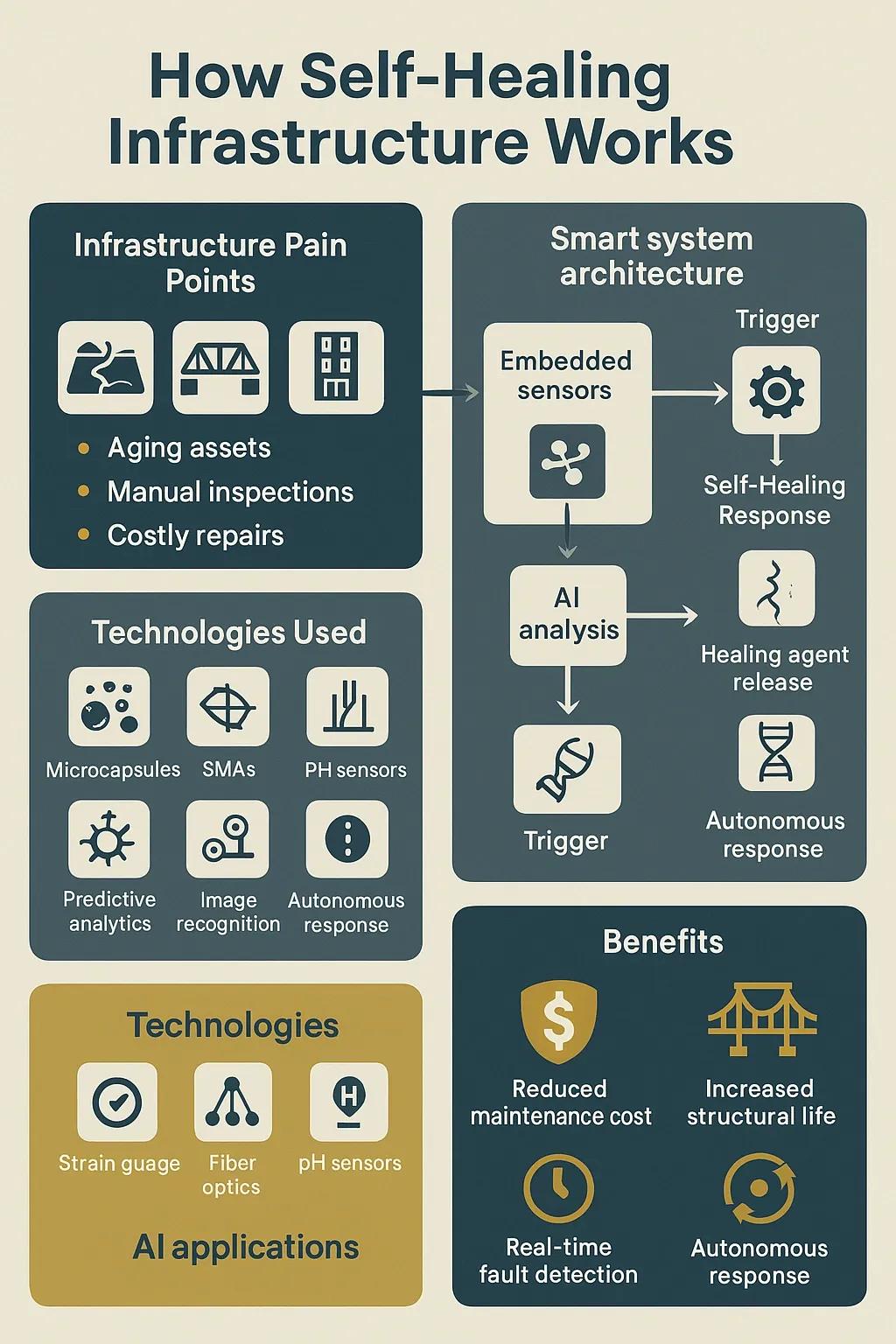
As global infrastructure ages, the need for proactive maintenance and resilience has become urgent. Traditional infrastructure systems, roads, bridges, tunnels, and buildings, often degrade silently, with cracks and weaknesses appearing long before failure is visible. Repair costs escalate due to reactive maintenance strategies. In this context, self-healing infrastructure, powered by smart materials, artificial intelligence (AI), and sensor networks, is emerging as a transformative approach to maintain structural integrity autonomously.
This article explores the architecture and working of self-healing systems, with a focus on how embedded sensors and AI models detect damage, trigger healing mechanisms, and optimize lifecycle management for civil infrastructure assets.
1. What Is Self-Healing Infrastructure?
Self-healing infrastructure refers to structures that can detect, diagnose, and repair damages without human intervention. It integrates:
Smart Materials that respond to stress or cracks by activating healing agents.
Sensors that collect data in real-time about structural strain, temperature, humidity, or chemical changes.
AI algorithms that analyze sensor data to predict failures and trigger autonomous responses.
Together, these technologies enable a new class of intelligent infrastructure that prevents catastrophic failure, extends service life, and lowers maintenance costs.
2. Key Components
a) Smart Materials
These are engineered substances capable of self-repair under defined conditions. Key types include:
Microencapsulated Healing Agents : Capsules containing polymers or adhesives are embedded in materials. When cracks occur, these capsules rupture and release the agent, which hardens and seals the crack.
Shape Memory Alloys (SMAs) : Metals that return to their original shape when heated. Used in bridges and tunnels, they can counteract deformation under stress.
Bacterial Concrete : Incorporates Bacillus bacteria and calcium lactate. When water seeps into cracks, bacteria produce limestone, sealing the crack naturally.
b) Sensor Networks (IoT for Infrastructure)
Sensors embedded within or on structures measure parameters like:
Crack propagation
Moisture content
pH level and corrosion indicators
Vibration and stress distribution
These sensors form an IoT ecosystem for infrastructure health monitoring (IHM), feeding data continuously to centralized systems or edge AI processors.
c) AI and Predictive Analytics
Machine learning models, especially time-series forecasting, anomaly detection, and computer vision, process historical and real-time data from sensors. They perform:
Crack detection and classification using image analysis (e.g., convolutional neural networks)
Predictive maintenance modeling to assess failure probabilities
Decision-making to trigger self-healing processes or alert engineers
3. Applications in Civil Infrastructure
a) Roads and Pavements
Cracks and potholes are early signs of road failure. Smart asphalt, embedded with microcapsules of rejuvenators or conductive fibers, can sense damage and activate healing with heat or pressure. AI models forecast stress points based on traffic and environmental data, enabling preventive activation of healing agents.
b) Bridges
Bridges are vulnerable to corrosion, fatigue, and seismic stress. Integrated fiber optic sensors monitor strain and load distribution. Coupled with neural networks, these systems assess structural behavior in real-time. Self-healing concrete in critical joints, paired with SMAs, helps automatically close microcracks caused by thermal and mechanical loads.
c) Buildings
Modern buildings embed distributed sensor arrays to monitor fire, vibration, structural shifts, and material aging. In earthquake-prone areas, smart columns with viscoelastic dampers and self-centering SMAs restore position post-shock. AI algorithms model building response patterns, enabling early warning and autonomous healing responses in structural components.
4. How the System Works: A Process Flow
Sensing Phase Sensors detect anomalies in strain, cracks, or environmental factors.
Data Transmission Sensor data is transmitted to cloud-based or edge computing platforms.
AI-Based Analysis AI models process the data to: Detect micro-failures Assess severity Predict propagation risk
Triggering Healing Response If the threat is actionable, the system activates the appropriate healing mechanism (e.g., releasing healing agents or heating SMAs).
Validation Post-healing, the system verifies if the crack or issue has been resolved using feedback loops.
Reporting and Logging The event is logged for future analytics and lifecycle management.
5. Technical Challenges
Despite significant promises, several challenges hinder full-scale adoption:
Material Compatibility : Ensuring smart materials retain performance over time in diverse environmental conditions.
Energy Supply : Maintaining power for embedded sensors and processors, especially in remote areas.
Sensor Longevity : Ensuring calibration and durability of sensors over the infrastructure's lifecycle.
Integration Costs : High initial investment in material science R&D, AI modeling, and sensor deployment.
Data Overload and Accuracy : Managing massive sensor data volumes and avoiding false positives in predictive alerts.
6. Industry Use Cases and Pilots
Europe’s HEALCON Project tested bacterial concrete in tunnels and showed crack closure up to 0.8 mm, extending structural life by 30%.
The Netherlands' Smart Highway Project explored self-healing asphalt using induction heating and steel fibers.
Japan’s Akashi Kaikyō Bridge uses fiber optic sensors and AI for corrosion detection, feeding real-time data into maintenance scheduling systems.
7. Future Outlook
The convergence of 5G, AI at the edge, digital twins, and advanced materials is accelerating the feasibility of large-scale self-healing infrastructure. Governments and smart city projects globally are investing in digital infrastructure strategies where automated resilience is key to safety and cost-efficiency.
We expect future infrastructure to be:
Predictive by design: With integrated AI/ML models that simulate long-term stress patterns.
Cyber-physical: With real-world sensors mirrored in digital twins for scenario testing.
Autonomously resilient: With distributed healing mechanisms activated without human involvement.
Conclusion
Self-healing infrastructure is no longer a futuristic idea, it is a practical, data-driven response to aging assets, climate resilience, and rising maintenance costs. By combining AI, sensors, and smart materials, civil infrastructure can transition from passive to proactive systems capable of autonomous damage control.
For cities and organizations embracing digital transformation, investing in self-healing infrastructure offers not just lower repair costs, but longer asset life, enhanced public safety, and sustainable resilience in the face of increasing urban and environmental stress.