Direct-to-cell (D2C) satellite links moved from promise to pilots in 2025. KDDI’s au Starlink Direct went live for SMS in Japan and expanded to broader users, with data support announced in late August. These milestones signal how 2026 can be the first operational year for Indian utilities, highways, and mining to add a satellite “safety net” to existing mobility and IoT stacks.
Why this matters now
Market signal: Starlink’s Direct-to-Cell started text in 2024, data/IoT through 2025, with voice “coming soon.” KDDI’s trials and pricing show real commercial traction and user-friendly entry points.
India traction: Vodafone Idea (Vi) announced a partnership with AST SpaceMobile to bring smartphone satcom across India, aligning with DoT progress on satcom rules and GMPCS licensing for Starlink, Jio-SES, and Eutelsat OneWeb. Commercial satcom rollouts are expected around late-2025, paving the way for D2C integrations in 2026.
Compliance backdrop: The Telecommunications Act, 2023, and subsequent DoT security directives (domestic gateways, monitoring zones) shape how D2C services must be integrated into Indian networks and operations. Plan for lawful intercept, data localization, and routing via Indian gateways.
What D2C is (and isn’t)
What it is: Smartphone connectivity to satellites that emulate a standard LTE/4G cell tower in space, no special handset, antennas, or apps in most cases. Useful for text, basic data, and emergency services when terrestrial coverage disappears.
What it isn’t (yet): A replacement for fiber/4G/5G in high-throughput scenarios. Expect constrained bandwidth, higher latency, and scheduled windows in early phases. Right-size expectations and pick the right use cases.
Field use cases for India’s Utilities, Highways, Mining
Utilities (Power, Water, Oil & Gas)
Crew safety: SOS, location pings, geotagged incident notes in outage zones.
O&M coordination: Text-first ticket updates when mobile sites go dark.
IoT fallback: Low-rate telemetry for critical sites, alarms, and switch states.
Highways & Transport
Patrol continuity: Crash reports, diversion notices, and work-zone alerts across remote stretches of NH44, NH27, and the Golden Quadrilateral.
ECE/ERS integration: D2C as a backstop to roadside units during fiber cuts or monsoon-driven failures.
Mining & Quarries
Lone-worker protection: Panic button + location to command center.
Asset dispatch: Basic job assignments when pit coverage is unreliable.
Vendor landscape snapshot (late-2025 → 2026)
Starlink D2C: Text (2024), data/IoT (2025); global roaming model; KDDI shows real-world onboarding and consumer pricing reference.
AST SpaceMobile: Targeting broadband-class direct-to-device with global MNOs; Vi in India is a key partner; incremental service from late-2025 into 2026-onward.
Lynk Global: SMS-first, numerous MNO agreements; useful for message-centric use cases.
Tip: Engage through Indian MNOs and licensed GMPCS entities to simplify regulatory alignment.
Architecture notes (what to plan for)
Core pattern: Phone ↔ Satellite (LTE eNodeB in space) ↔ Ground gateway ↔ MNO core ↔ Enterprise apps. Ensure your MNO can whitelist your APNs and enterprise identities.
Security & compliance: Route via Indian gateways; enable lawful intercept; treat D2C traffic as “public network” with enterprise security overlays (VPN, MDM, ZTNA).
Devices & apps: Standard LTE smartphones; prioritize lightweight apps that degrade gracefully to text + small payloads.
90-Day Pilot Plan (Ready-to-run)
Use this fast cycle to prove value on one highway corridor + one industrial cluster.
Phases & outputs
Days 0–10: Scope, device list, SIM profiles, escalation matrix.
Days 5–20: Regulatory/MNO onboarding, APN & gateway checks.
Days 10–25: Lab tests, message latency, delivery success, offline workflows.
Days 25–65: Field trials, NH corridor + mining/utility zone; safety drills.
Days 30–70: Crew training, playbooks, incident taxonomy.
Days 50–75: Joint drills with public safety partners.
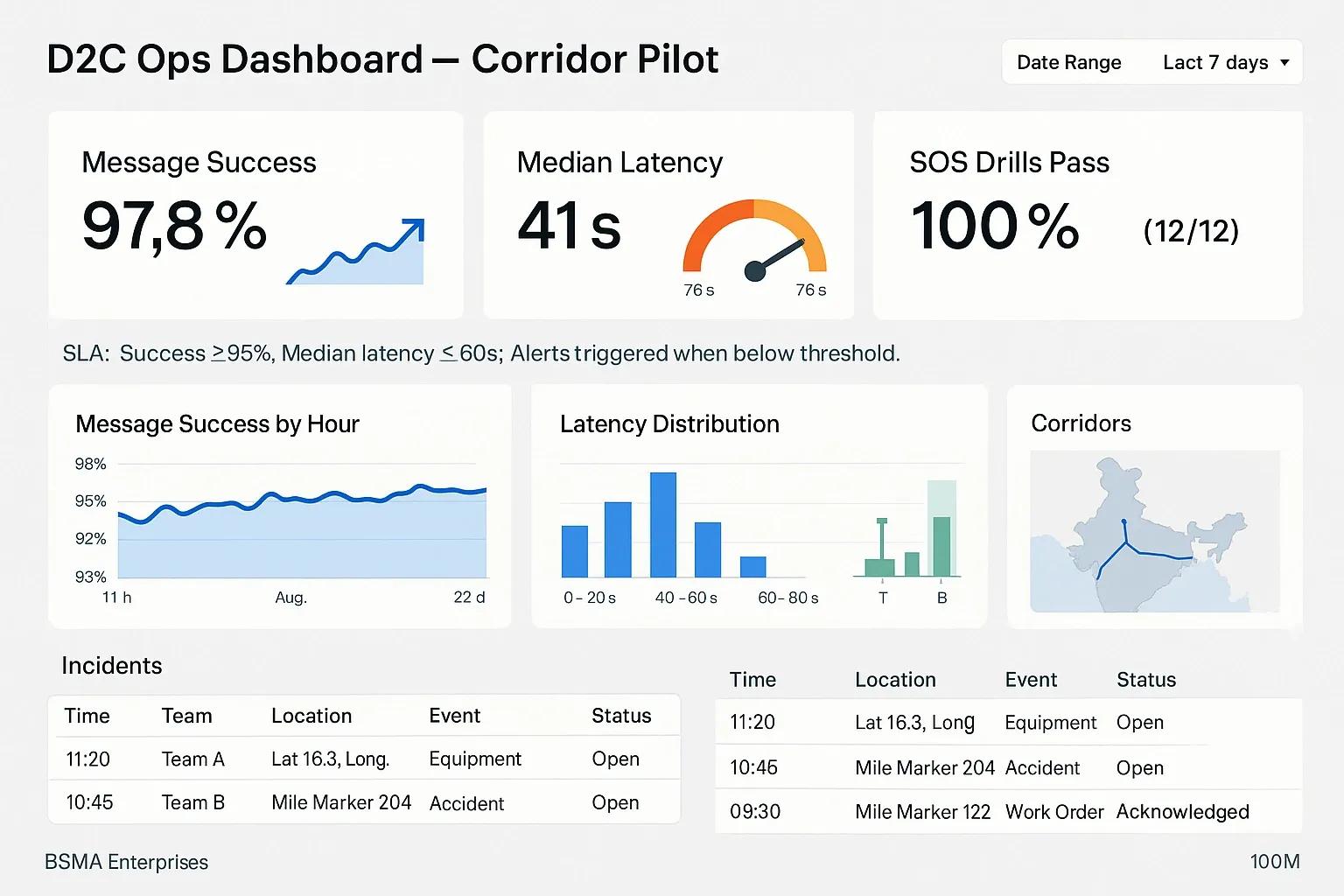
Days 70–88: KPI read-out (delivery success %, median latency, incident comms. coverage minutes), ROI model.
Days 88–90: Go/No-Go + scale plan.
Coverage strategy: start with corridors
Prioritize routes where terrestrial gaps are frequent and consequences are high.
NH44 (North–South), NH27 (East–West), Golden Quadrilateral edges
Coal & minerals belt (Jharkhand–Odisha)
Northeast rail/highway spine
WDFC segments and coastal corridors
(Note: Schematic planning aid, not a GIS base map.)
KPIs & acceptance criteria
Message delivery success: ≥95% for SMS/alerts within pilot windows
Median message latency: Target ≤30–60s for text; note windows/lat passes
Crew safety drills: 100% receipt of SOS + location within defined SLA
Ops continuity: % of outage minutes where D2C kept tickets/updates flowing
TCO model: Per-line satcom fee vs. avoided truck-rolls & downtime
Risks and how to manage them
Regulatory lead time: Align early with licensed providers; confirm data routing and lawful intercept before fielding.
Throughput expectations: Start with text + light data; keep media sync and video off the D2C path in phase-1.
Device variability: Validate a representative handset set; enforce MDM profiles.
Weather & link budgets: Treat D2C as a resilience layer, not the primary pipe.
Budget pointers (order-of-magnitude)
Per-line satcom add-on: Use KDDI’s public pricing only as an international reference; Indian tariffs will vary by partner and policy.
Integration: Allow for APN setup, app adjustments, drills, and training.
Scale curve: As corridors expand, unit economics improve via pooled licenses and shared gateways with your MNO.
2026 rollout roadmap
Q1: Complete two-corridor pilots, freeze playbooks, negotiate enterprise plans.
Q2: Expand to 4–6 corridors; add incident command templates with state disaster management.
Q3–Q4: Extend to priority substations, depots, and pits; connect low-rate IoT alarms; integrate with SOC/NOC dashboards.
Conclusion
Satellite-to-phone is no longer a moonshot; it’s a pragmatic resilience layer for field operations. The 2025 pilots show that text-first D2C works with standard smartphones and can ride existing MNO cores. For India’s utilities, highways, and mining, the near-term value is simple and high-leverage: keep safety alerts, incident locations, and work-order updates flowing when towers go dark.
Execution is the differentiator. Treat D2C as an operations capability, not a gadget. Start with corridors where gaps hurt most, run a 90-day pilot with clear KPIs (≥95% delivery, ≤60s median latency, 100% SOS drill pass), and enforce device/MDM baselines. Build compliance in from day one, Indian gateways, lawful intercept, audit trails, and integrate results into existing SOC/NOC dashboards and playbooks.
By phasing from text to light data and IoT alarms, organizations can harden outage response without overhauling networks or handsets. The payoff is measured in avoided downtime, faster incident clearance, and demonstrably safer crews. Early movers that lock in partnerships, governance, and corridor coverage in 2026 will set the benchmark: routine drills that pass, weekly KPI reviews that hold, and a scale plan tied to real asset risk. In short, D2C becomes part of standard operating procedure, quiet, reliable, and there when it matters.
References (recent signals)
KDDI Japan’s first D2C service (SMS), and data support announcement (Aug 28, 2025).
Starlink Direct-to-Cell product timeline (text 2024, data/IoT 2025).
Vi–AST SpaceMobile partnership for India; EU expansion momentum.
India regulatory context, Telecom Act 2023, forthcoming satcom spectrum procedures, security directives.