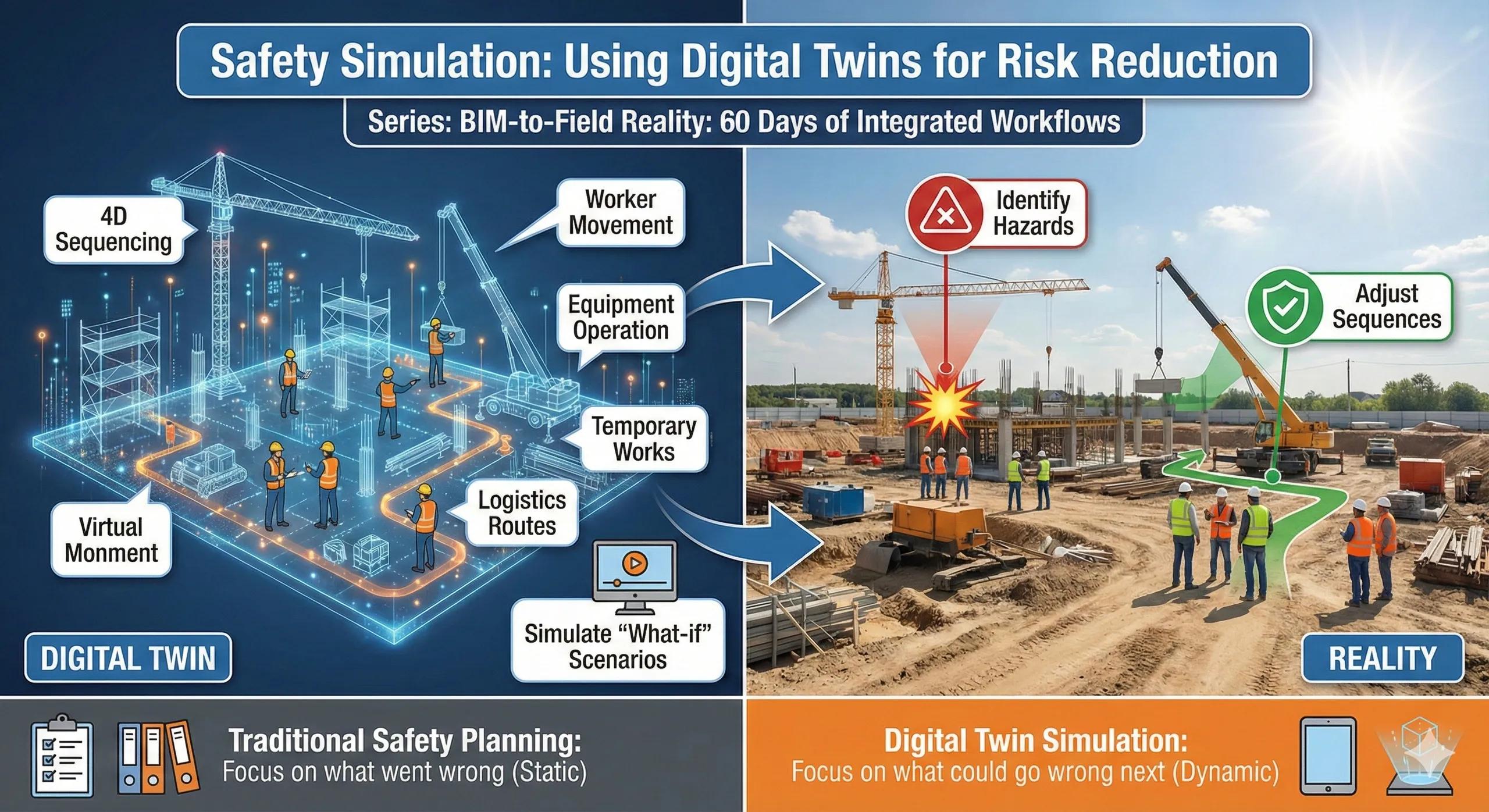
Most safety programs focus on what went wrong .
Digital twins focus on what could go wrong next .
Safety incidents rarely come from a single mistake. They emerge from interactions , between people, equipment, space, time, and changing site conditions. Digital twins make these interactions visible before they turn into incidents.
That shift, from reporting to prediction, is the real value of safety simulation.
1. Why Traditional Safety Planning Falls Short
Conventional safety methods rely on:
Checklists and permits
Toolbox talks
Static method statements
These are important, but static.
Construction sites are dynamic:
Access routes change
Trades overlap
Temporary works move
Weather alters risk daily
Static safety plans cannot keep pace with moving hazards.
2. What Safety Simulation Actually Means
Safety simulation uses a digital twin to:
Combine BIM geometry , 4D sequencing , and spatial context
Simulate worker movement and equipment operation
Identify where hazards emerge over time
Test “what-if” scenarios safely
It’s not about predicting accidents.
It’s about revealing risk patterns early .
3. Common Safety Risks That Benefit from Simulation
Safety simulation is especially effective for:
Trade stacking and congestion
Crane and lifting operations
Working at height
Confined space access
Vehicle–pedestrian interaction
Emergency evacuation routes
These risks are spatial and temporal by nature, perfect candidates for simulation.
4. From Hazard Registers to Risk Scenarios
Traditional safety planning asks:
What are the hazards?
Safety simulation asks:
When do hazards appear?
Who is exposed?
How does sequence amplify risk?
This moves safety from documentation to decision intelligence .
5. Linking Safety to 4D and Logistics
Many safety risks arise because:
Sequences are compressed
Access is compromised
Logistics routes conflict with work fronts
When safety is simulated alongside 4D sequencing and logistics:
Unsafe overlaps surface early
Recovery plans can be tested safely
Risk trade-offs become explicit
6. Temporary Works: The Hidden Risk Layer
Scaffolding, ramps, barricades, and temporary platforms:
Control daily movement
Change frequently
Are often poorly documented
Digital twins that include temporary works provide:
More realistic safety scenarios
Better access validation
Fewer “surprises” during execution
7. India Context: Why Safety Simulation Matters
In Indian construction:
High density and parallel work are common
Mixed traffic and informal movement paths exist
Weather impacts are significant
Skill levels vary widely
Safety simulation helps:
Communicate risk visually
Reduce dependency on text-heavy instructions
Support proactive supervision
8. Simulation Is Not About Eliminating Risk
Construction will always carry risk.
The goal of safety simulation is to:
Make risk visible
Make trade-offs explicit
Reduce exposure where possible
Better decisions, not zero risk.
9. When Safety Simulation Fails
It fails when:
Models are outdated
Sequences are unrealistic
Simulation is treated as a presentation
Insights are not acted upon
Simulation only adds value when it changes behavior .
10. A Simple Safety Rule
If a risk only becomes visible after someone is exposed to it, planning came too late.
Conclusion
Safety is not just about compliance.
It is about foresight .
Digital twin–based safety simulation allows teams to:
Anticipate hazardous interactions
Adjust sequences before execution
Improve access and logistics decisions
Reduce incidents through design and planning
When safety is simulated, not assumed, risk reduces, systematically.