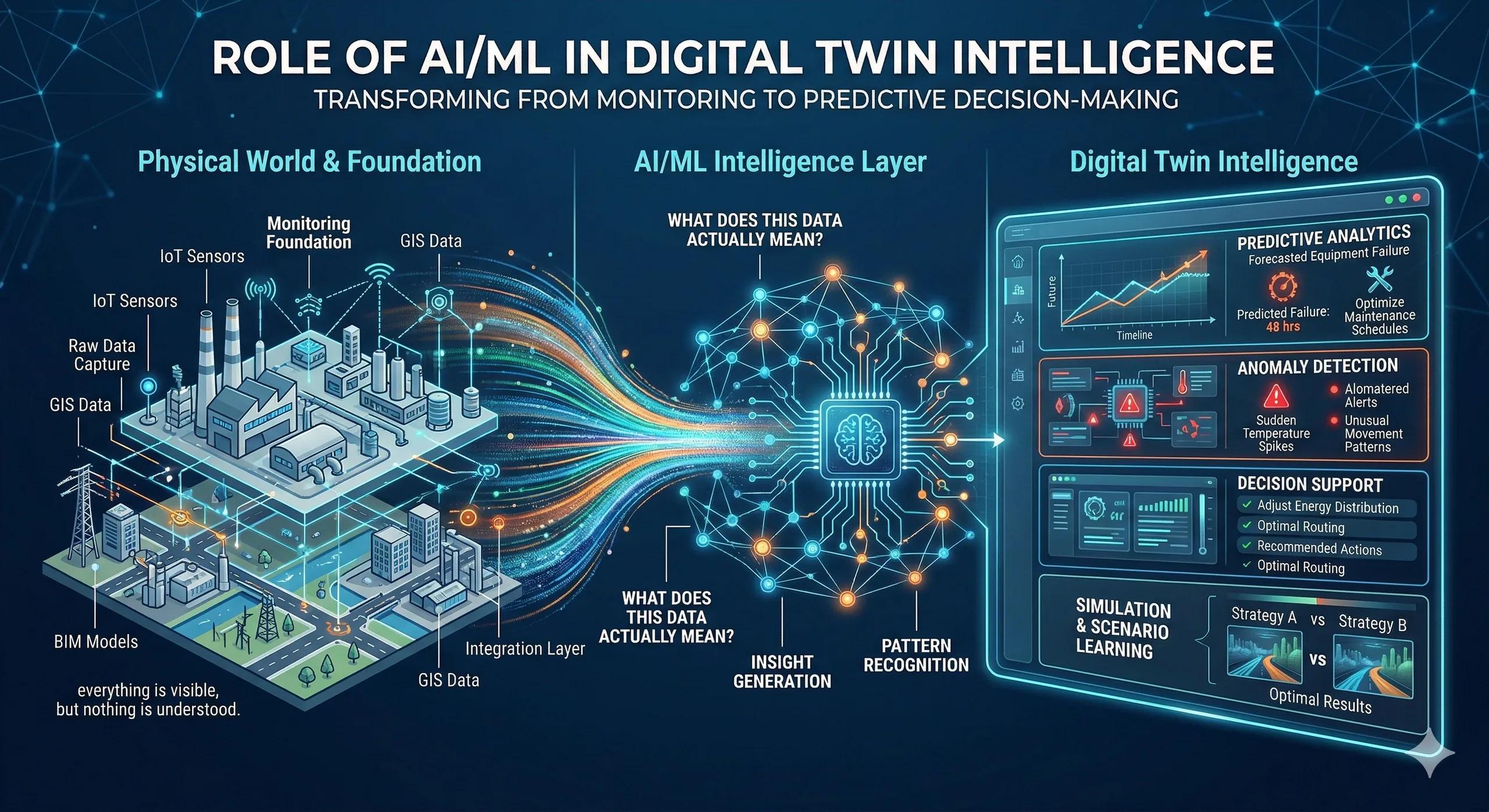
A Digital Twin without AI is like a control room full of screens, everything is visible, but nothing is understood.
Introduction
As Digital Twin architectures mature, organizations are moving beyond data integration toward intelligence. BIM, GIS, and IoT help build the foundation, but AI/ML is what turns that foundation into a system that can interpret, predict, and recommend actions .
The shift is clear:
👉 from monitoring systems
👉 to decision-support systems
Where AI/ML Fits in the Digital Twin Stack
In a typical Digital Twin architecture:
Sensors (IoT, UAVs, LiDAR) → capture raw data
Integration layer (APIs, pipelines) → move data
Storage & processing (cloud/edge) → manage data
Visualization (dashboards, 3D models) → display data
But AI/ML sits above all this as the intelligence layer :
👉 It answers: What does this data actually mean?
Key Roles of AI/ML in Digital Twins
1. Pattern Recognition
AI identifies patterns that are not visible to human operators.
Example:
Detecting abnormal vibration trends in machinery
Identifying recurring congestion zones in urban traffic
👉 This moves systems from data observation → insight generation
2. Predictive Analytics
AI/ML enables forecasting based on historical and real-time data.
Use cases:
Predicting equipment failure before it occurs
Forecasting energy demand in smart grids
Anticipating flood risks using spatial and climate data
👉 This shifts operations from reactive → predictive
3. Anomaly Detection
AI continuously monitors for deviations from expected behavior.
Example:
Sudden temperature spikes in industrial assets
Unusual movement patterns in logistics networks
👉 Critical for risk mitigation and early intervention
4. Decision Support & Recommendations
AI doesn’t just detect, it suggests actions.
Example:
Recommend maintenance schedules
Suggest optimal routing in supply chains
Adjust energy distribution dynamically
👉 This is where Digital Twins start influencing real decisions
5. Simulation & Scenario Learning
AI enhances simulation capabilities by learning from outcomes.
Example:
Testing multiple operational strategies
Learning which scenarios lead to optimal results
👉 Moves from static simulation to adaptive simulation
Ask Yourself
Are we using AI to generate insights or just to enhance dashboards?
Do our models learn from outcomes over time?
Can our Digital Twin recommend actions, or only display information?
Real-World Example
In a manufacturing plant:
IoT sensors capture machine performance
The Digital Twin visualizes operations
AI models analyze vibration, temperature, and load patterns
Outcome:
Predicts failure 48 hours in advance
Recommends maintenance windows
Reduces unplanned downtime significantly
Common Challenges
1. Poor Data Quality
AI is only as good as the data it receives.
Incomplete or inconsistent data leads to unreliable outputs.
2. Lack of Context
AI models without spatial or operational context produce limited insights.
👉 Example: predicting failure without understanding location-based conditions
3. Black-Box Decisions
Many AI systems lack explainability, reducing trust among operators.
4. Disconnected Feedback Loops
AI generates insights, but:
actions are not tracked
learning does not improve future decisions
Benefits & ROI
Organizations implementing AI-driven Digital Twins see:
Reduced downtime through predictive maintenance
Improved operational efficiency
Better risk management
Faster decision-making cycles
Continuous system learning and optimization
Conclusion
AI/ML is not an add-on to Digital Twins, it is what transforms them.
Without AI:
👉 Digital Twins show what is happening
With AI:
👉 Digital Twins explain why it is happening
👉 and suggest what should happen next
The future lies in systems that don’t just mirror reality, but learn from it and improve it continuously .