Digital transformation is no longer optional. It’s a critical lever for operational efficiency, market relevance, and long-term growth. For decision-makers navigating this shift, the main questions are often: Where should we start? What technologies matter? What kind of ROI can we expect?
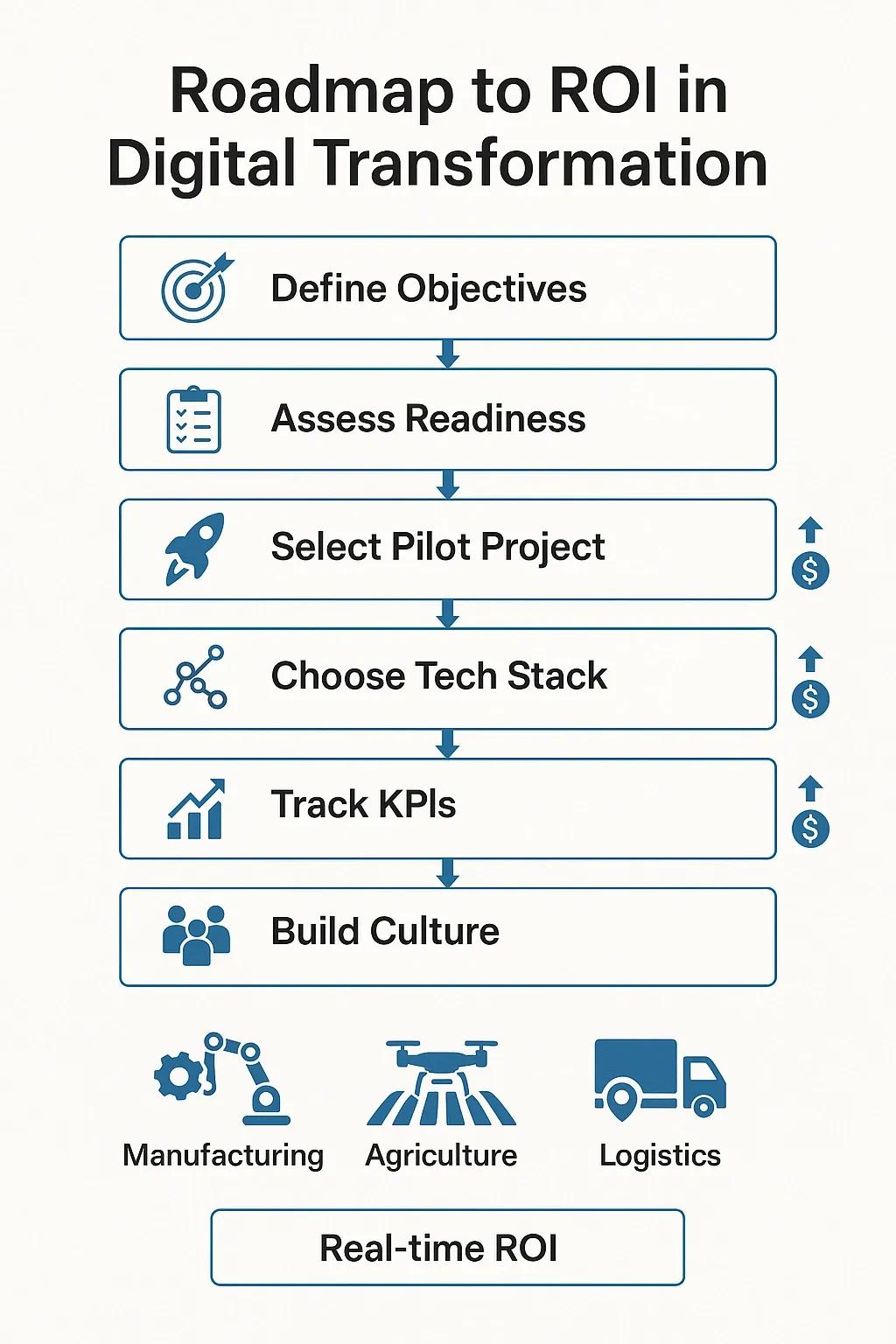
This article provides a roadmap to help organizations make informed choices about initiating digital transformation and outlines what returns they can realistically anticipate, financially, operationally, and strategically.
Why ROI Matters in Digital Transformation
Digital transformation can involve significant investment in technology, people, and processes. The key is to align investments with measurable business outcomes, reducing costs, improving speed, enhancing customer experience, and generating new revenue streams.
According to a 2024 McKinsey study, companies that pursued structured digital transformation initiatives saw a 20-30% improvement in operational efficiency and 15-20% revenue growth within three years.
Step 1: Start with Business Objectives, Not Technology
Avoid the trap of starting with tools. Instead, begin by identifying the business problem or growth opportunity that needs to be addressed. Common drivers include:
Reducing downtime in manufacturing
Improving visibility in supply chains
Enhancing customer service in logistics
Optimizing land and resource use in agriculture
Increasing construction site safety
Clear objectives allow you to define what “return” means, whether it’s cost savings, time savings, higher output, or better decision-making.
Step 2: Conduct a Digital Readiness Assessment
Before choosing a tech stack, assess your current state:
Data readiness : Is your data structured, centralized, and accessible?
Workforce readiness : Do your teams have digital skills or need training?
Infrastructure : Can your current IT systems support cloud, IoT, or AI integration?
Processes : Are workflows rigid or already somewhat digitized?
A readiness assessment helps identify quick wins and gaps that require investment or external support.
Step 3: Choose the Right Starting Point
Start small but with strategic value. Common entry points include:
Asset digitization : Use drones, 3D scanning, or BIM to digitize assets for construction, agriculture, or manufacturing environments.
IoT deployment : Install sensors to collect real-time data from machines, vehicles, or fields.
Process automation : Use low-code platforms or RPA (Robotic Process Automation) to streamline repetitive tasks.
Data visualization dashboards : Build live dashboards using GIS, SCADA, or ERP data for real-time decision-making.
Remote assistance with AR/VR : Offer virtual training and remote diagnostics for field service or maintenance teams.
Choose a pilot that is low risk but has a measurable impact.
Step 4: Build the Right Tech Stack
The tech stack should align with the industry and use case. Here’s a simplified guide by sector focus:
Industry - Key Technologies - Purpose
Construction & AECO - BIM, GIS, AI-based safety analytics, AR/VR; Design optimization, site safety, facility management
Manufacturing - Industrial IoT, predictive analytics, digital twins; Real-time monitoring, preventive maintenance
Agriculture - Drones, AI crop models, geospatial intelligence; Yield prediction, land optimization
Supply Chain & Logistics - RFID, blockchain, digital twins, GIS; Asset tracking, route optimization, demand forecasting
Automotive - Digital thread, edge computing, AR training; Product lifecycle visibility, skill transfer
These technologies should be modular and interoperable. Cloud-native solutions and APIs help ensure long-term scalability.
Step 5: Set Up Metrics and Feedback Loops
Digital transformation is iterative. Without tracking, ROI remains a guess. Key performance indicators (KPIs) include:
Efficiency Gains : Reduced downtime, faster processing times
Cost Savings : Fewer errors, lower operational costs
Revenue Impact : New services, increased throughput
Customer Experience : Faster delivery, improved satisfaction
Compliance and Risk Reduction : Fewer violations, improved traceability
Use a digital dashboard to continuously monitor these metrics. Feedback loops enable course correction and incremental scaling.
Step 6: Build Internal Capabilities and Culture
Technology only works if the people operating it adapt. Success depends on:
Change Management : Communicate purpose, offer training, and build champions.
Cross-functional Teams : Involve operations, IT, and business units from the beginning.
Continuous Learning : Adopt agile practices to iterate based on outcomes.
Organizations that invest in upskilling and ownership see higher ROI and faster adoption rates.
What to Expect in Terms of ROI
1. Short-Term ROI (0-12 Months)
Pilot success with clear cost/time savings
Increased transparency across departments
Basic automation of repetitive processes
Better data-driven decision-making
Example : A manufacturing firm reduced unplanned downtime by 22% within six months after implementing predictive maintenance using IoT sensors.
2. Mid-Term ROI (12-24 Months)
Improved productivity across supply chains
Reduction in operational costs by 10-15%
Enhanced customer satisfaction due to service improvements
Emergence of new digital revenue streams
Example : An agri-tech initiative using drone imagery and AI achieved 18% higher crop yield with optimized inputs in the second year.
3. Long-Term ROI (24-36+ Months)
Fully integrated digital workflows
Digital twin-based simulations for optimization
Continuous innovation pipeline supported by data
Stronger competitive positioning and resilience
Example : A logistics provider implemented a full supply chain digital twin, reducing delivery delays by 30% and improving route efficiency by 25% over three years.
Common Pitfalls to Avoid
Boiling the ocean : Trying to digitize everything at once leads to delays and confusion.
Ignoring the field team : Solutions must work on the ground, not just on paper.
Choosing isolated tools : Siloed systems defeat the purpose of integration.
Underestimating change management : Resistance from staff can block adoption.
Conclusion: Digital Transformation as a Strategic Investment
Digital transformation should be seen not as a cost center, but as a value creation engine. When aligned with business goals and implemented through a well-sequenced roadmap, the returns go beyond cost savings, they translate into agility, innovation, and long-term competitiveness.
Decision-makers must focus on practical pilots, measurable impact, and scalable architecture. With the right mindset, tools, and partners, digital transformation becomes a continuous journey of improvement, not a one-time project.