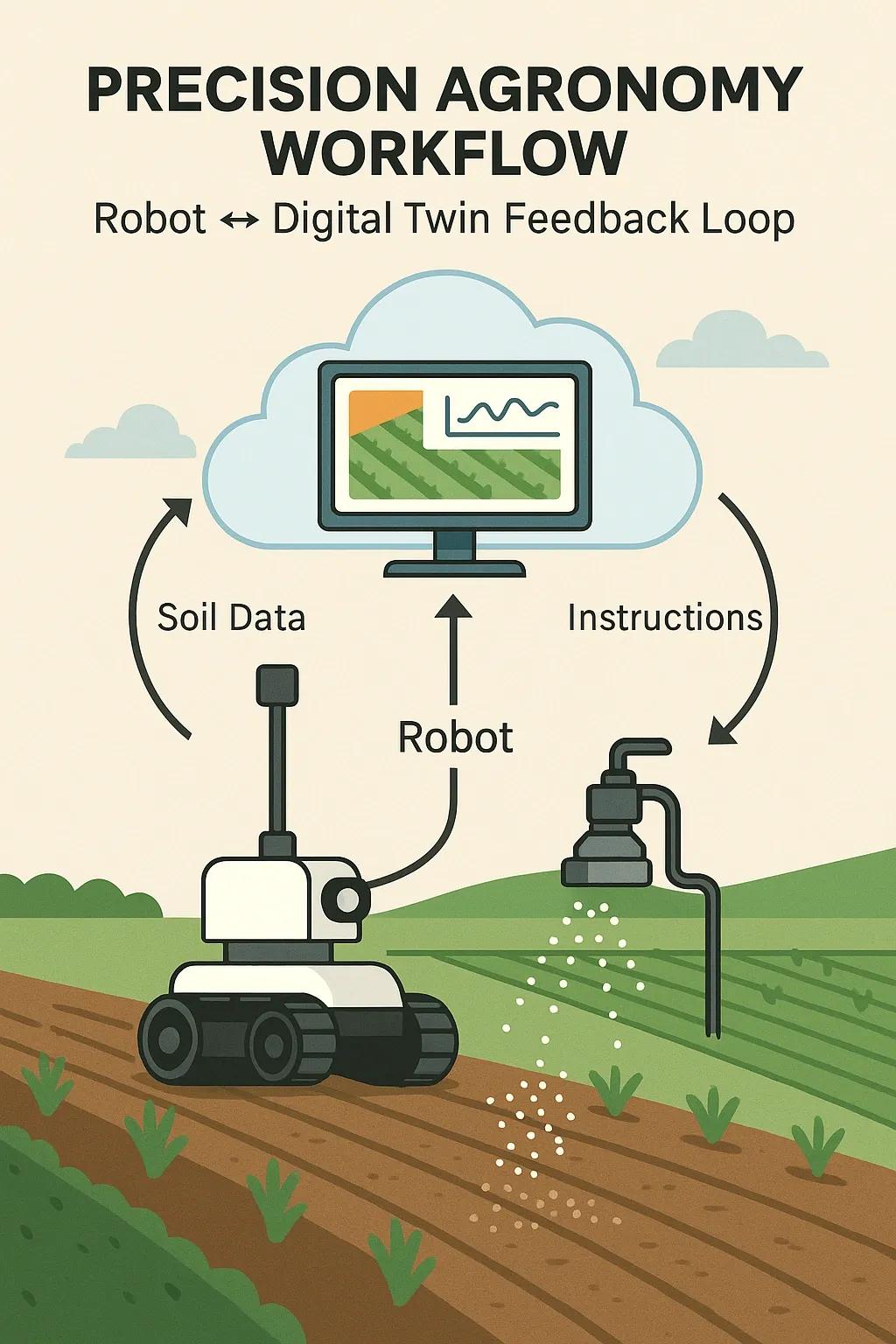
Precision agronomy is reshaping modern agriculture by utilizing data-driven technologies to enhance crop productivity, resource efficiency, and sustainability. Among its most transformative developments is the integration of robotics with digital twins, enabling real-time soil monitoring and action. Field robots, acting as mobile agents, not only collect data but also execute precise agronomic interventions based on dynamic digital models of agricultural systems. This article explores how robotic systems are advancing precision agronomy and how digital twins amplify their effectiveness through continuous simulation, prediction, and decision support.
Precision Agronomy and the Need for Robotics
Precision agronomy refers to the site-specific management of crops, soil, and inputs by leveraging real-time data and spatial variability. Traditional agronomic practices treat fields uniformly, often leading to inefficient resource use and environmental stress. However, variables such as soil moisture, nutrient distribution, crop stress, and pest prevalence vary significantly across and within fields.
To address this complexity, precision agronomy requires frequent, high-resolution, and site-specific data, which can no longer be gathered manually at scale. This is where robotics enters the picture.
Field Robots: Capabilities and Design
Field robots are autonomous or semi-autonomous ground-based platforms equipped with sensors, actuators, and AI-based decision engines. These robots perform various tasks including:
Soil sampling and analysis
Plant health monitoring
Targeted pesticide or fertilizer application
Weeding and pest control
Micro-irrigation delivery
Real-time phenotyping
Key components of field robots include:
Sensors : Multispectral cameras, LiDAR, soil moisture probes, pH and EC meters.
Localization and Navigation : GPS, RTK-GNSS, and SLAM (Simultaneous Localization and Mapping) for autonomous movement.
Manipulators/Actuators : Robotic arms and spraying nozzles for action.
Edge AI and Onboard Computing : For real-time data processing and autonomous decisions.
These robots reduce dependency on manual labor, allow 24/7 operations, and operate with centimeter-level precision.
Role of Digital Twins in Agronomy
A digital twin is a virtual replica of a physical system that synchronizes in real time using IoT and data streams. In precision agronomy, a digital twin integrates field data, agronomic models, weather inputs, and crop simulation algorithms to continuously represent the actual conditions of a field.
Components of an Agronomic Digital Twin:
Soil models : Representing moisture, compaction, nutrient status.
Crop models : Simulating growth stages, stress levels, and yield.
Environmental inputs : Real-time weather and microclimatic data.
Farm management layers : Historical interventions, machinery movement, input logs.
By integrating with robotic data streams, digital twins become dynamic and predictive, guiding next-step actions rather than just observing conditions.
Robotics + Digital Twins: Real-Time Soil Actions
The convergence of field robotics and digital twins enables closed-loop agronomic decision-making, where sensing, modeling, and acting occur continuously.
Workflow Example:
Sensing : A field robot traverses the plot, collecting soil data (e.g., moisture, nitrogen level).
Digital Twin Update : The real-time data syncs with the digital twin, updating soil and crop growth models.
Analysis and Prediction : The twin forecasts stress zones or predicts nutrient deficiencies based on growth simulations.
Task Scheduling : The system triggers precise interventions (e.g., micro-dosing fertilizer).
Action : The robot returns to the flagged location and executes the prescribed treatment.
Feedback : The action and its effect are monitored, completing the loop.
This process happens on-demand or cyclically, allowing farmers to transition from reactive to proactive farming.
Use Cases in Indian and Global Context
1. Variable Rate Application (VRA) Robots
Robots equipped with soil sensors and digital twin access can perform zone-specific fertilizer application, reducing input costs by 30-40%. Indian startups are piloting such systems in Punjab and Maharashtra.
2. Autonomous Weeding
AI-enabled robots use real-time soil and weed distribution maps from the twin to selectively remove weeds using mechanical arms or directed lasers, minimizing herbicide use.
3. Disease Detection and Targeted Spraying
A robot, guided by hyperspectral imaging and crop health models in the twin, identifies early-stage leaf spot diseases and applies bio-pesticides locally, reducing blanket spraying.
4. In-Situ Soil Remediation
In regions with degraded soil patches, robots can inject soil microbes or correct pH imbalances under the guidance of the digital twin’s soil chemistry profile.
Benefits of Integrated Robotic-Digital Twin Systems
Benefit - Description
Precision - Actionable decisions down to meter or sub-meter scale
Timeliness - Immediate interventions before stress becomes visible
Sustainability - Reduces chemical overuse, soil degradation, and water waste
Labor Reduction - Robots automate repetitive and hazardous tasks
Cost Savings - Optimization of inputs, minimized wastage, and increased yield
Traceability - Digital twin provides a digital log for compliance and certification
Technical Challenges and Considerations
Despite the potential, several challenges need to be addressed for widespread adoption:
Sensor Calibration and Accuracy : Soil data must be accurate and consistent under varying field conditions.
Energy Management : Battery life and solar charging must support long field operations.
Connectivity : Real-time updates need reliable connectivity, especially in remote rural areas.
Interoperability : Standardization of data formats between robots and digital twins is critical.
Economic Viability : High initial costs must be offset by long-term value, especially for smallholders.
Skill Gaps : Farmers need training to manage robotic systems and interpret digital twin outputs.
Future Outlook
The next generation of agricultural robotics will likely feature swarm intelligence, where fleets of small robots coordinate through a shared digital twin to manage large fields efficiently. Advances in edge AI, 5G connectivity, and satellite-based positioning will further reduce latency and improve coordination.
Governments and agritech firms in countries like India, Israel, and the Netherlands are investing in such systems to promote climate-smart and resource-efficient farming. With digital twins evolving into AI-powered agronomic advisors, the synergy between robotics and simulation models will be at the heart of next-gen farm management.
Conclusion
Robotics integrated with digital twins is pushing the boundaries of precision agronomy, shifting agriculture from static and reactive practices to dynamic, data-driven, and responsive systems. Field robots serve as both the eyes and hands of the farm, while digital twins function as its brain, together forming an intelligent ecosystem that can continuously adapt to changing soil and crop conditions in real time. For agriculture to meet the dual challenge of feeding a growing population while preserving ecosystems, such technology integration is not optional, it’s essential.