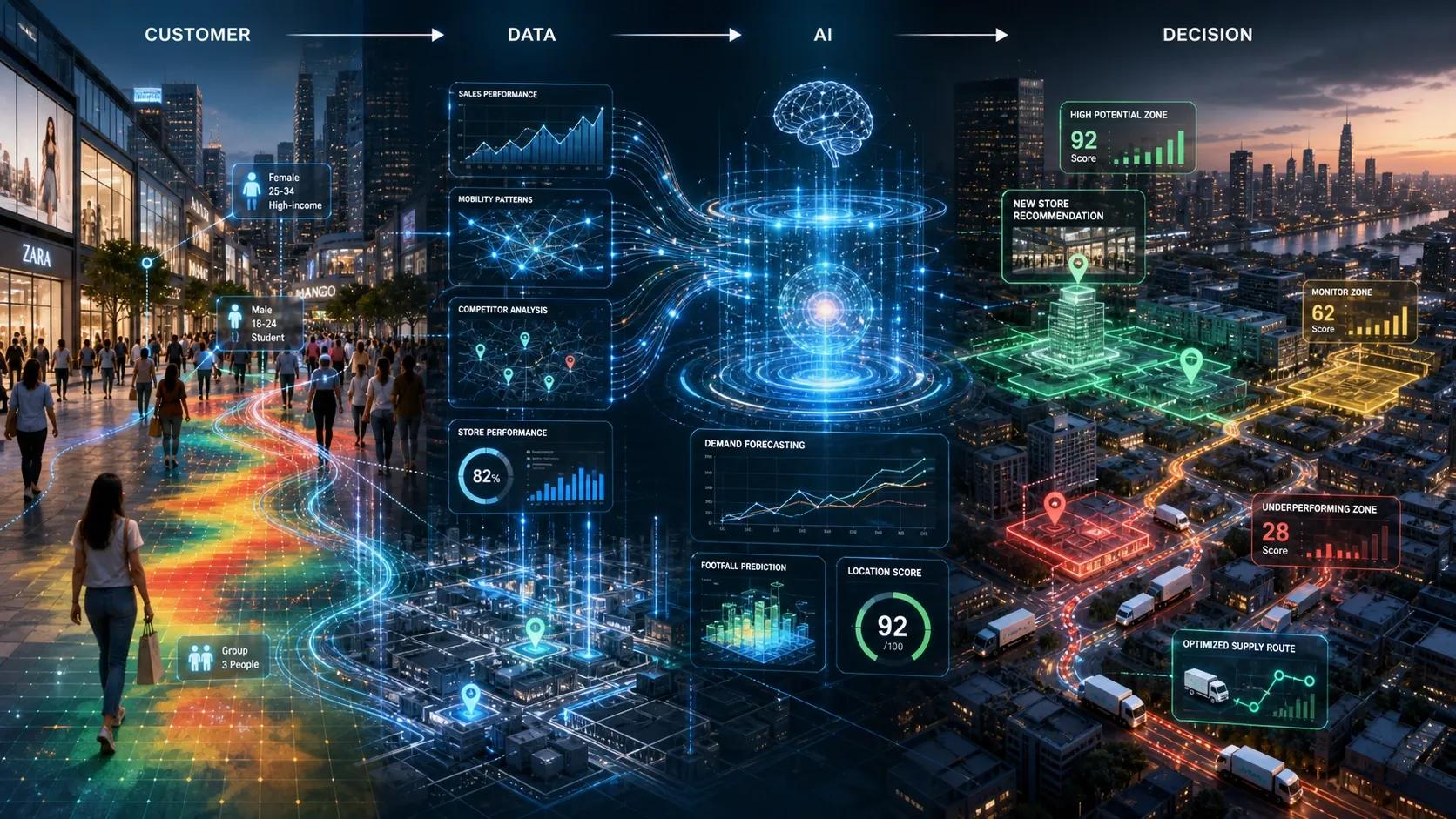
Retail doesn’t fail because of products.
It fails when location, demand, and timing don’t align.
Introduction
In the previous articles, we explored how Digital Twins enable:
infrastructure monitoring
facility optimization
telecom and port coordination
disaster management and resilience
Now we move to a sector where:
👉 location directly drives revenue
👉 Retail & Location Intelligence
Retail systems involve:
store locations
customer movement
demand patterns
supply and inventory
In Phase 3, the focus remains:
👉 how Digital Twins enable demand prediction, site selection, and real-time operational decisions
The Core Problem: Decisions Without Spatial Context
Most retail planning today:
relies on historical sales data
selects locations based on limited analysis
reacts to demand shifts
But:
👉 customer behavior is dynamic and location-driven
This leads to:
poor site selection
underperforming stores
inventory mismatch
lost revenue opportunities
Where Digital Twins Change the Approach
A Retail Digital Twin enables:
👉 real-time, location-aware decision-making
Instead of:
static planning
It creates:
a dynamic model of demand, movement, and performance
Key Components of a Retail Digital Twin
1. Data Layer
customer demographics
footfall data
mobility patterns
sales data
competitor locations
2. Integration Layer
combines: spatial data customer behavior store performance
👉 creates a unified retail view
3. AI/ML Layer
predicts demand
identifies high-potential locations
optimizes inventory
4. Simulation Layer
models new store locations
evaluates demand scenarios
5. Visualization Layer
GIS-based maps
footfall heatmaps
performance dashboards
Use Case 1: Site Selection
Traditional Approach
manual analysis
limited data
👉 high risk
Digital Twin Approach
analyze: population density mobility competitor presence
👉 Outcome:
optimized store placement
Use Case 2: Demand Forecasting
predict customer demand by location
👉 Outcome:
better inventory planning
Use Case 3: Footfall Optimization
analyze customer movement patterns
👉 Outcome:
improved store layout and positioning
Use Case 4: Performance Monitoring
track store performance in real time
👉 Outcome:
faster decision-making
Practical Example
Scenario: New Store Planning
analysis shows high footfall but low retail presence
Digital Twin identifies:
👉 high-potential zone
System recommends:
store location
product mix
👉 Outcome:
improved revenue
Where Most Implementations Fail
1. Data Without Location Context
decisions based only on sales data
2. Static Planning
inability to adapt to changing demand
3. Siloed Data
customer and spatial data not integrated
4. Delayed Decision-Making
actions taken after performance drops
Ask Yourself
Are your retail decisions:
👉 data-driven
Or
👉 location-aware and predictive?
Indian Context
India’s retail sector is expanding rapidly.
Challenges include:
location selection
demand variability
competition
Digital Twins can help:
👉 optimize store locations
👉 improve demand forecasting
👉 enhance customer experience
Benefits & ROI
improved site selection
increased revenue
better inventory management
enhanced customer experience
optimized operations
Conclusion
Retail success is not just about products.
It is about:
👉 location
👉 demand
👉 timing
Digital Twins enable:
understanding customer behavior
predicting demand
optimizing decisions
This transforms retail from:
👉 reactive operations
To
👉 intelligent, location-driven systems