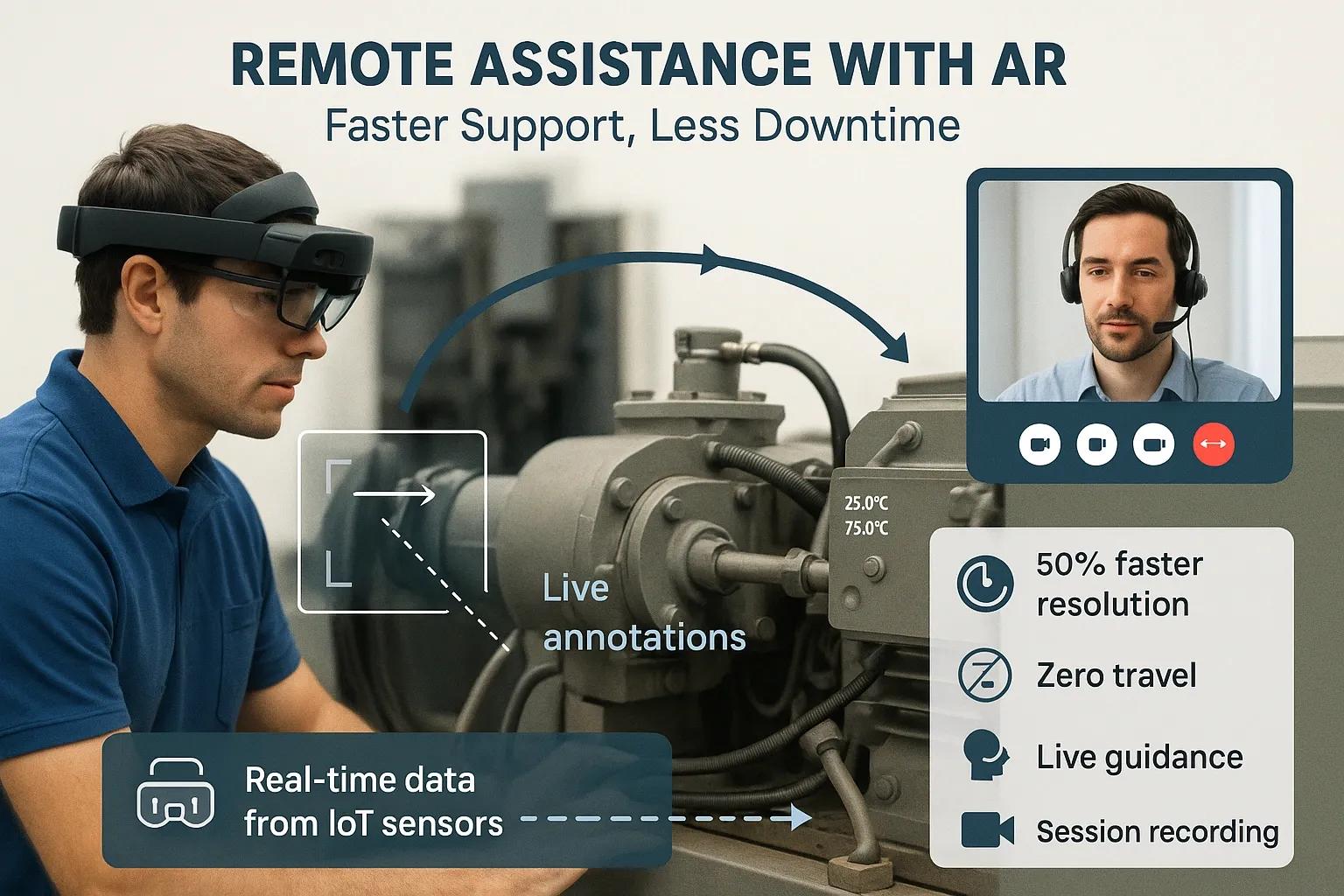
Augmented Reality (AR) is evolving beyond gaming and marketing into a critical tool for remote support in industrial and field operations. One of the most impactful applications is remote assistance using AR headsets, where field technicians can connect with remote experts for real-time guidance. This approach reduces equipment downtime, accelerates issue resolution, and minimizes travel costs, transforming support models in sectors like manufacturing, automotive, utilities, and telecom.
This article breaks down how AR-powered remote assistance works, where it adds value, and how it aligns with current technology trends driving the Fourth Industrial Revolution.
What is AR-Based Remote Assistance?
AR-based remote assistance is the use of wearable devices, typically AR glasses or head-mounted displays (HMDs), to connect technicians on-site with remote experts. Through these devices, remote support personnel can see exactly what the technician sees and provide step-by-step instructions, annotations, and visual cues overlaid on the physical environment.
This method goes far beyond video calls or chat-based support. It enables hands-free, real-time collaboration that integrates digital information directly into the technician’s field of view, improving precision and speed of service.
Technology Stack and Hardware
At the core of remote AR assistance are three main components:
AR Hardware : Devices such as Microsoft HoloLens 2, RealWear Navigator, Vuzix, and Magic Leap provide wearable displays with embedded cameras, microphones, and sensors to capture the user’s environment.
AR Software Platform : Solutions like TeamViewer Frontline, PTC Vuforia Chalk, Scope AR, or Help Lightning manage the remote interaction, offering real-time video streaming, 3D annotations, object recognition, and session recordings.
Cloud and Connectivity Infrastructure : Low-latency, high-bandwidth communication (preferably via 5G or Wi-Fi 6) is essential for streaming high-quality visuals and maintaining synchronized interaction.
Together, these technologies allow the field technician to receive interactive, context-aware support without pausing their work or interpreting complex manuals.
How It Works in Practice
A typical remote assistance workflow using AR involves:
Initiation : A technician faces a complex issue on-site and initiates a support session via voice command or app.
Connection : The AR device connects to a remote expert through the AR software platform. The expert sees what the technician sees in real time.
Collaboration : The expert provides visual guidance by overlaying arrows, highlights, or diagrams directly in the technician’s view. They may also share documents, schematics, or instructional videos.
Resolution and Documentation : Once the issue is resolved, the session can be saved for compliance, training, or future reference.
This real-time, interactive model drastically reduces back-and-forth communication and the need for expert travel to remote sites.
Applications Across Industries
1. Manufacturing Remote AR assistance reduces production halts by enabling technicians to fix equipment without waiting for specialist intervention. It also accelerates machine installation, calibration, and maintenance.
2. Utilities and Energy Field engineers working in hazardous or remote areas (e.g., oil rigs, substations, wind turbines) can be guided safely from afar, reducing exposure and improving turnaround time.
3. Automotive In dealerships and workshops, mechanics use AR to consult OEM specialists for complex diagnostics or repair procedures. This is especially relevant as EV and hybrid systems grow more intricate.
4. Construction and Infrastructure On large-scale projects, AR support can help align teams, troubleshoot equipment on-site, and verify installations in real time without waiting for engineers to visit physically.
5. Telecom and Smart Cities Field agents setting up or repairing towers, fiber lines, or sensors can quickly resolve issues with central NOC teams through AR, boosting uptime and customer satisfaction.
Key Benefits
1. Reduced Downtime AR remote assistance can cut Mean Time to Repair (MTTR) by up to 50% by enabling faster diagnosis and resolution, especially when experts are not readily available on-site.
2. Expert Resource Optimization One expert can assist multiple locations from a central hub, eliminating unnecessary travel and maximizing their availability for critical tasks.
3. Lower Operational Costs Fewer site visits translate to savings in logistics, travel, and accommodation. Over time, this lowers the Total Cost of Ownership (TCO) of support operations.
4. Safety and Compliance Remote supervision helps ensure technicians follow standard operating procedures, especially in regulated environments. Sessions can be recorded for audits and training.
5. Knowledge Transfer and Training Junior technicians can be guided in real time, shortening the learning curve and retaining institutional knowledge through recorded sessions and annotated instructions.
Challenges and Considerations
While AR remote assistance offers many benefits, it also comes with a few challenges:
Connectivity : In remote or industrial locations, poor network quality can degrade AR performance. Investments in 5G and private LTE networks are critical.
Hardware Comfort and Battery Life : Long sessions can be tiring with headsets. Devices must be ergonomically optimized for extended use.
Security and Data Privacy : Visual streams may expose sensitive equipment or customer data. Secure transmission, access control, and anonymization are essential.
Change Management : Workforce adoption depends on ease of use and clear value demonstration. Training and buy-in from both field teams and support staff are crucial.
Alignment with Global Tech Trends
According to the 2025 "Circular Transformation of Industries" report and broader Industry 4.0 trends, AR in remote support contributes to:
Resilient Operations : Systems are designed to continue functioning despite disruptions, AR supports this by decoupling expertise from location.
Workforce Augmentation : Rather than replacing workers, AR empowers them with better tools, improving productivity and decision-making.
Sustainable Practices : Reducing travel and minimizing downtime align with energy efficiency and emission reduction goals.
Decentralized Expertise Models : Businesses can operate with distributed teams while maintaining high standards of support.
Future Outlook
AR-based remote assistance is expected to become a default standard in industrial operations, especially as hardware becomes lighter, more affordable, and more integrated with AI for intelligent recommendations. We also anticipate tighter integration with IoT and digital twins, where sensor data can trigger AR-guided maintenance automatically.
In India, where technician-to-expert ratios are often skewed, this technology can drastically uplift service quality across Tier 2 and Tier 3 locations. Government programs like Digital India and Production Linked Incentives (PLI) schemes for electronics and telecom sectors further support the adoption of such technologies.
Conclusion
Remote assistance with AR is a practical and scalable way to improve field service efficiency, reduce costs, and ensure knowledge retention across industries. As businesses continue to adapt to hybrid work models and seek resilience, this technology provides a robust bridge between human expertise and digital enablement.