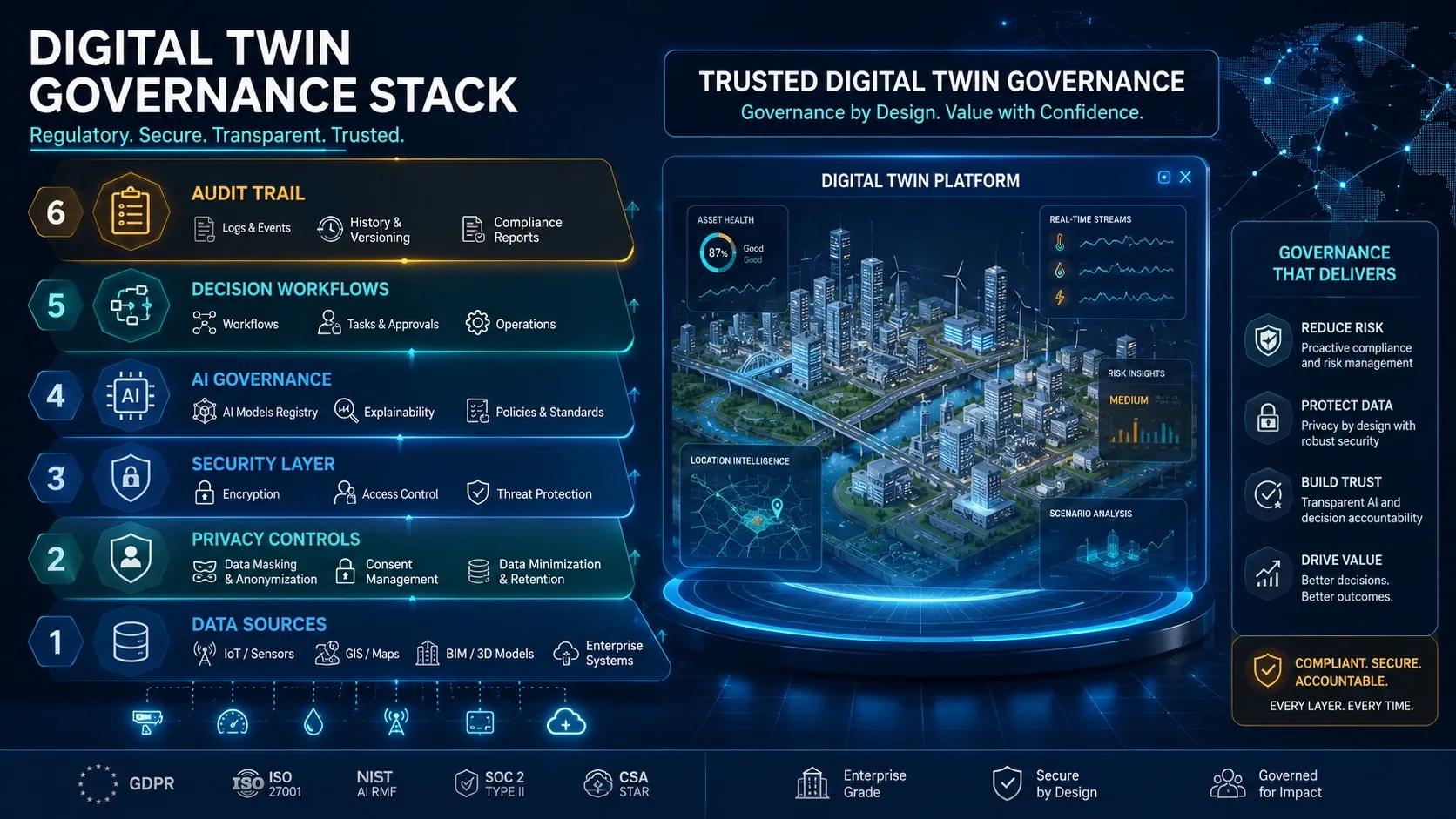
A Digital Twin becomes powerful when it connects real-world data.
But the moment it starts using personal, operational, geospatial, infrastructure, or sensor data, it also becomes a governance responsibility.
Introduction: Why Regulation Matters Now
In the earlier articles of this series, we discussed AI-driven Digital Twins, GeoAI-powered Twins, Edge AI, XR, and market trends.
Now comes one of the most important but often under-discussed topics:
Regulatory and Data Privacy Considerations
As Digital Twins mature from visualization models into decision-support and operational intelligence systems, they begin to handle sensitive data such as:
asset locations
employee movement
citizen mobility
camera feeds
IoT sensor data
utility consumption
infrastructure vulnerability
healthcare accessibility
land and property information
environmental risk layers
This means Digital Twins cannot be treated only as technical systems.
They must be treated as regulated data ecosystems .
In India, this discussion becomes even more relevant because the Digital Personal Data Protection Act, 2023 establishes a legal framework for processing digital personal data while balancing individual privacy rights with lawful data use.
The Core Shift: From Data Collection to Data Responsibility
Many organizations start Digital Twin projects by asking:
👉 What data can we collect?
But the more mature question is:
👉 What data should we collect, why do we need it, who controls it, and how will it be protected?
This shift is critical.
A Digital Twin that collects more data than required may look advanced, but it can also increase privacy, security, compliance, and trust risks.
Global privacy principles such as purpose limitation, data minimization, accuracy, storage limitation, integrity, confidentiality, and accountability are central to frameworks such as the GDPR. These principles are highly relevant for Digital Twin design, even outside Europe, because they provide a practical foundation for responsible data systems.
Why Digital Twins Create Privacy Complexity
Digital Twins are different from traditional databases.
They combine data from multiple sources and continuously update the operational model.
For example, a city Digital Twin may integrate:
CCTV feeds
traffic sensors
property layers
mobility data
flood risk maps
utility networks
emergency response systems
A factory Digital Twin may integrate:
machine data
worker location
production quality
safety zones
energy consumption
ERP and maintenance records
A healthcare planning Twin may integrate:
population distribution
accessibility data
facility locations
demographic indicators
disease risk patterns
Individually, each dataset may appear harmless.
But when combined, they may create sensitive insights.
This is why privacy risk is not only about one data layer.
It is about data fusion .
Key Regulatory and Privacy Questions for Digital Twins
Before implementing a Digital Twin, organizations should ask a few practical questions.
1. Is Personal Data Being Processed?
A Digital Twin may not always appear to use personal data.
But personal data can enter the system through:
worker tracking
visitor movement
vehicle number plates
camera feeds
mobile app data
location history
biometric or safety wearable data
customer behavior patterns
Under the DPDP Act, personal data is connected to an individual who is identifiable by or in relation to that data. That definition matters because location and sensor data can become personal when connected to a person, device, or identity.
So the first step is to classify the data.
Is it:
👉 personal data?
👉 operational data?
👉 sensitive infrastructure data?
👉 aggregated data?
👉 anonymized data?
👉 commercially confidential data?
Without classification, compliance becomes difficult.
2. What Is the Lawful Purpose?
A Digital Twin should not collect data only because it is technically possible.
Every data stream must have a clear purpose.
For example:
worker location data may be justified for safety evacuation
vehicle tracking may be justified for logistics efficiency
energy consumption data may be justified for optimization
flood exposure data may be justified for disaster planning
maintenance data may be justified for asset reliability
But each purpose should be documented.
The organization should be able to explain:
👉 why the data is collected
👉 how it is processed
👉 who can access it
👉 how long it is retained
👉 what decision it supports
This is where Digital Twin governance begins.
3. Is Data Minimization Being Followed?
One of the biggest risks in Digital Twin projects is over-collection.
A system may not need exact individual-level data for every use case.
For example:
crowd density may be enough instead of individual movement history
zone-level worker presence may be enough instead of continuous precise tracking
aggregated traffic flow may be enough instead of vehicle-level identity
anonymized heatmaps may be enough instead of user-level location logs
The principle is simple:
Collect the minimum data required to support the decision.
This reduces privacy risk, improves trust, and lowers the burden of compliance.
Data Privacy by Design in Digital Twins
Privacy should not be added after the platform is built.
It should be embedded into the architecture from the beginning.
This is especially important for:
smart cities
airports
campuses
factories
hospitals
ports
utilities
public infrastructure systems
A privacy-by-design Digital Twin should include:
role-based access control
data masking
consent management where required
anonymization and aggregation
audit logs
retention policies
encryption
secure APIs
data lineage
purpose-based access
incident response procedures
NIST describes its Privacy Framework as a voluntary tool to help organizations identify and manage privacy risk while enabling innovation and services. This type of risk-based approach is useful for Digital Twin programs because the technology often crosses business, engineering, operational, and public-interest boundaries.
Geospatial Data and Regulatory Sensitivity
GeoAI-powered Twins add another layer of complexity.
Geospatial data can reveal patterns about people, assets, infrastructure, environment, and strategic locations.
Examples include:
utility networks
defense infrastructure
ports
logistics corridors
high-value industrial zones
land parcels
telecom assets
critical infrastructure
vulnerable communities
India’s National Geospatial Policy 2022 aims to strengthen the geospatial sector and promote innovation, while geospatial data acquisition, production, and access continue to be governed by applicable guidelines issued by the Department of Science and Technology.
So Digital Twin teams must consider not only personal privacy, but also:
👉 geospatial data governance
👉 infrastructure sensitivity
👉 national security considerations
👉 data sharing permissions
👉 source licensing
👉 update responsibility
👉 data accuracy and liability
A Digital Twin built on unreliable or unauthorized geospatial data can create operational and legal risk.
Cybersecurity and Data Protection
Privacy and cybersecurity are closely connected.
A Digital Twin may become a high-value target because it represents the live or near-live state of physical systems.
If compromised, attackers may gain visibility into:
asset weaknesses
operational routines
facility layouts
sensor networks
maintenance schedules
emergency response systems
utility dependencies
For critical infrastructure, the risk is not only data theft.
It may become an operational safety risk.
Therefore, Digital Twin architecture should include:
network segmentation
secure device onboarding
encrypted communication
API security
access monitoring
identity management
zero-trust principles
backup and recovery
vulnerability management
audit trails
The more operational the Digital Twin becomes, the stronger the security architecture must be.
Data Ownership and Custody
One of the most difficult questions in Digital Twin projects is:
👉 Who owns the data?
The answer is often not simple.
Different datasets may come from:
government agencies
asset owners
contractors
sensor vendors
platform providers
consultants
citizens
field teams
third-party APIs
satellite data providers
This creates a custody challenge.
Organizations should clearly define:
data ownership
data stewardship
usage rights
update responsibility
access control
sharing limitations
deletion rights
model ownership
derived insight ownership
This is especially important when Digital Twins are built through partnerships, PPP models, vendor ecosystems, or multi-agency collaboration.
A Digital Twin without clear custody becomes difficult to scale.
AI Governance in Digital Twins
When AI is added to Digital Twins, regulatory responsibility increases.
AI may recommend:
maintenance prioritization
emergency response actions
route diversions
production adjustments
risk scoring
investment planning
compliance alerts
This creates important questions:
👉 Can the AI recommendation be explained?
👉 What data was used?
👉 Was the model tested for bias?
👉 Who approves high-impact decisions?
👉 Can decisions be audited later?
👉 What happens if the model is wrong?
In safety-critical or public-interest systems, AI should not operate as a black box.
It should operate with:
explainability
human oversight
validation rules
escalation protocols
model monitoring
decision logs
accountability mechanisms
A Digital Twin may become intelligent, but it must also remain governable.
Operational Example: Worker Safety Twin
Consider a factory or industrial Digital Twin that tracks workers inside safety zones.
The system may help with:
evacuation monitoring
restricted zone alerts
heat exposure alerts
emergency response
attendance inside hazardous areas
This can create strong safety value.
But it also raises privacy questions:
Is worker location tracked continuously?
Is the data used only for safety or also productivity monitoring?
Who can access individual movement history?
How long is the data stored?
Is there a clear policy?
Are workers informed?
The same technology can be trusted or mistrusted depending on governance.
The difference is not the sensor.
The difference is the rulebook.
Operational Example: Smart City Digital Twin
A city Digital Twin may support traffic management, flood response, public safety, air quality monitoring, and service planning.
But it must avoid becoming an uncontrolled surveillance system.
The city must define:
what data is collected
whether citizen identity is involved
what is aggregated
what is anonymized
who can access raw data
how public dashboards differ from internal systems
how long data is retained
how decisions are reviewed
Public Digital Twins need public trust.
Without trust, adoption becomes difficult.
Indian Context
India has a major opportunity to build responsible Digital Twin ecosystems across:
PM GatiShakti-linked infrastructure planning
smart cities
ports
highways
utilities
industrial corridors
agriculture
disaster management
healthcare accessibility
But India’s Digital Twin growth must be supported by strong data governance.
The important question is not only:
👉 Can we build Digital Twins?
It is also:
👉 Can we build trusted Digital Twins?
For India, the foundation should include:
DPDP Act awareness
geospatial policy alignment
data classification
consent and lawful processing where required
secure data exchange standards
interoperable GIS-BIM-enterprise architecture
privacy-by-design systems
auditability and accountability
clear data ownership across agencies and vendors
This will decide whether Digital Twins remain isolated pilots or become trusted decision infrastructure.
What Organizations Should Do Before Starting
Before building a Digital Twin, organizations should prepare a governance checklist.
They should define:
What data will be collected?
Is any personal data involved?
What is the lawful purpose?
Who owns each dataset?
Who can access the data?
How will consent or notice be handled?
How long will data be retained?
How will data be anonymized or aggregated?
How will AI decisions be audited?
What cybersecurity controls are required?
What happens when data is wrong?
Who is accountable for action taken from the Twin?
These questions should not be postponed.
They should be part of the Digital Twin design stage.
Conclusion
The future of Digital Twins is not only technical.
It is regulatory, ethical, and operational.
As Digital Twins become more intelligent, connected, and autonomous, they will increasingly influence decisions in infrastructure, cities, factories, utilities, healthcare, agriculture, and public systems.
That creates enormous value.
But it also creates responsibility.
A mature Digital Twin should not only be:
👉 accurate
👉 real-time
👉 predictive
👉 interactive
It should also be:
👉 lawful
👉 secure
👉 privacy-aware
👉 explainable
👉 auditable
👉 accountable
Because the next generation of Digital Twins will not be judged only by how much data they collect.
They will be judged by how responsibly they convert data into decisions.