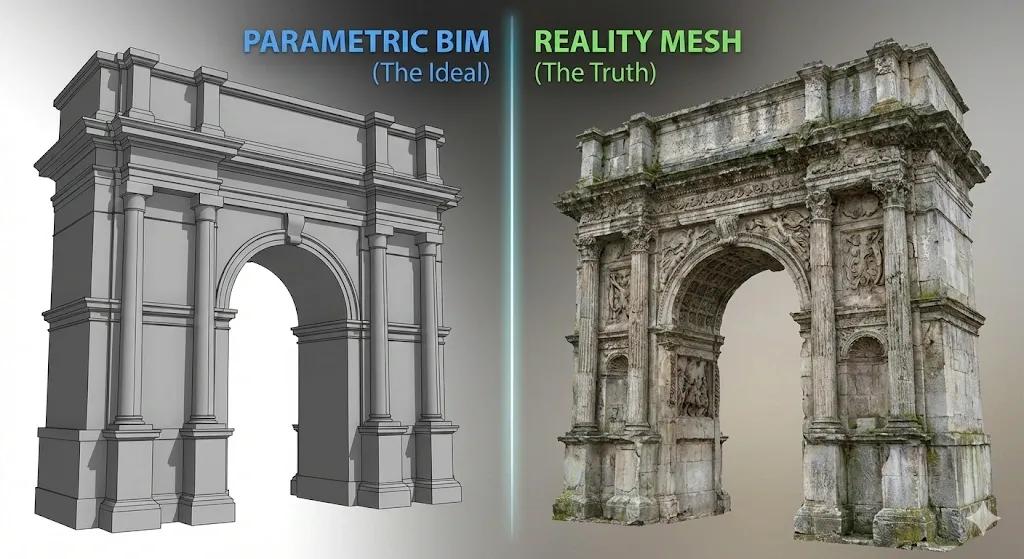
BIM excels at representing intent , what should be built, how systems are designed, and how elements relate logically. But construction sites are rarely clean, complete, or perfectly documented. Temporary works, partial installations, legacy conditions, surface irregularities, and unmodeled assets often exist outside the structured world of BIM.
This is where reality mesh models become critical.
Reality meshes, derived from photogrammetry or LiDAR, capture the site as it actually exists , not as it was designed. They do not replace BIM. They fill the gaps where BIM stops being practical .
This article explains when BIM alone is insufficient, where reality meshes add value, and how they should be used responsibly in BIM-to-field workflows.
1. Why BIM Reaches Its Limits on Real Sites
BIM models are:
Discrete
Parametric
Structured
Intent-driven
Construction sites are:
Continuous
Irregular
Temporary
Often undocumented
Trying to model every temporary, irregular, or short-lived condition in BIM leads to:
Over-modeling
High update overhead
Delayed decisions
Model fatigue
BIM is not designed to represent everything that exists , only what must be managed long-term .
2. What Reality Mesh Models Actually Represent
Reality meshes are:
Dense surface reconstructions
Continuous geometry
Texture-rich
Non-parametric
They capture:
Scaffolding
Temporary supports
Excavation edges
Surface deformation
Legacy assets
Site logistics
They prioritize visual and spatial truth , not semantic structure.
3. When Reality Meshes Outperform BIM
Temporary Works & Construction Logistics
Scaffolding layouts
Formwork geometry
Temporary access routes
Material storage zones
Modeling these in BIM is slow and rarely reused.
Irregular or Legacy Conditions
As-built surfaces
Deformed structures
Existing utilities
Rock faces or excavation walls
BIM idealizes geometry; reality meshes preserve imperfection.
Visual Validation & Stakeholder Communication
Progress visualization
Safety reviews
Remote inspections
Claims and dispute documentation
Meshes communicate reality faster than drawings or models.
4. Where Reality Meshes Fail (And BIM Must Lead)
Reality meshes struggle with:
Quantitative precision at tolerances
Parametric queries
Asset management
Lifecycle tracking
They cannot replace BIM for:
Fabrication
Commissioning
Operations
Digital twins
Meshes show what exists .
BIM explains what it means .
5. BIM + Reality Mesh: A Complementary Model Stack
The most effective workflows use both:
BIM → design intent, logic, rules
Reality Mesh → context, temporary conditions, irregular geometry
Examples:
Mesh for excavation geometry + BIM for foundation design
Mesh for temporary access + BIM for permanent circulation
Mesh for progress visuals + BIM for quantities and approvals
The value comes from overlay , not substitution.
6. Accuracy Expectations for Reality Meshes
Reality meshes are:
Visually accurate
Spatially consistent
Not intended for millimeter tolerance checks
Using meshes for:
Fit-up validation
Fabrication checks
…is a misuse.
Meshes support:
Spatial awareness
Progress verification
Clash anticipation at a macro level
Accuracy must match intent.
7. Managing Reality Mesh Data Responsibly
Uncontrolled meshes can overwhelm teams.
Best practices:
Time-stamp meshes clearly
Archive superseded versions
Limit resolution to purpose
Keep meshes read-only
Avoid mixing mesh and BIM responsibilities
Reality meshes are snapshots , not authoritative records.
8. Reality Meshes in BIM-to-Field Deployment
For field teams:
Meshes provide fast situational awareness
BIM provides installable truth
Common pattern:
Use mesh to understand “what’s there now”
Use BIM to decide “what happens next”
This reduces ambiguity on site.
9. Reality Meshes and Digital Twin Readiness
Reality meshes support digital twins by:
Capturing change
Documenting conditions
Feeding visual context
But without BIM linkage:
Meshes remain static
Twins lack intelligence
Meshes become valuable when anchored to BIM and time .
10. A Practical Decision Rule
Use this rule of thumb:
If the condition is temporary, irregular, or not worth maintaining parametrically, use a reality mesh.
If it is permanent, regulated, or lifecycle-critical, use BIM.
Conclusion
Reality meshes are not a shortcut around BIM.
They are a practical response to construction reality .
When used correctly:
They reduce modeling overhead
Improve spatial understanding
Speed up decisions
Enhance communication
When misused:
They create false confidence
Blur responsibility
Undermine precision
In BIM-to-field workflows, success comes from knowing when BIM isn’t enough, and when it shouldn’t try to be .