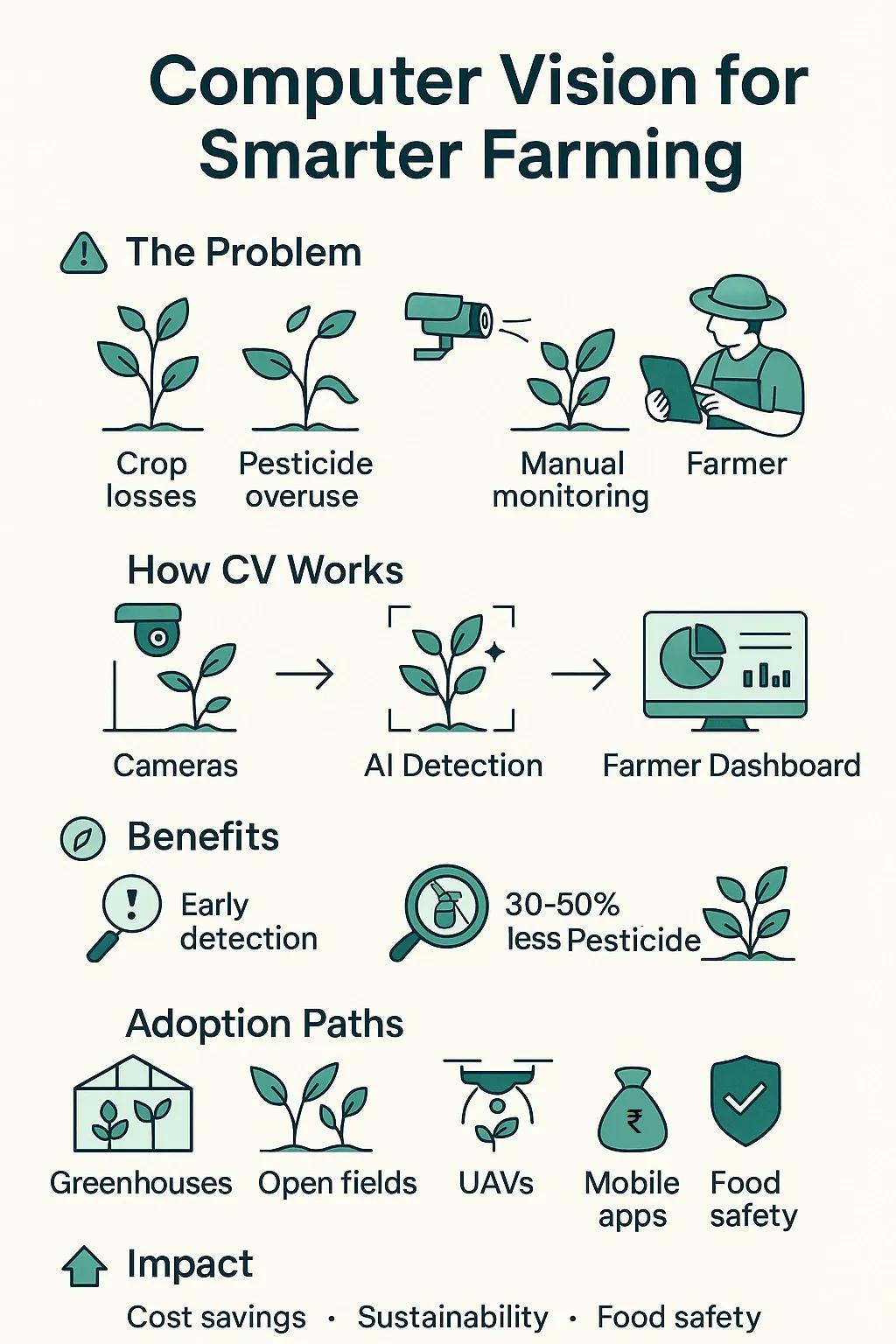
Crop losses due to pests, diseases, and inefficient pesticide usage remain among the biggest challenges in agriculture. The Food and Agriculture Organization (FAO) estimates that pests alone account for 20–40% of global crop yield losses annually. At the same time, pesticide overuse contributes to soil degradation, water contamination, and health risks. The result is a paradox: farmers struggle with declining yields and rising costs, while ecosystems face chemical overload.
This is where computer vision (CV) technologies are beginning to transform farming practices. Companies like Fermata (Israel) are pioneering AI-driven computer vision solutions that help farmers detect crop threats early, precisely monitor field conditions, and optimize pesticide usage. The result is reduced waste, healthier crops, and a more sustainable food system.
The Problem It Solves
Late Detection of Pests and Diseases: Farmers often detect infestations only after visible damage occurs, at which point yield losses are irreversible.
Excessive Use of Pesticides: Without precise detection, many rely on scheduled spraying rather than data-driven application, leading to unnecessary chemical use.
Labor-Intensive Monitoring: Manual scouting is time-consuming and inconsistent. Skilled labor shortages worsen the problem.
Environmental and Economic Burden: Overuse of chemicals leads to resistance in pests, harms biodiversity, and drives up costs for farmers.
Core Technology: Computer Vision in Agriculture
Computer vision applies AI to analyze visual data, images and video streams from cameras, UAVs, or smartphones, to generate actionable insights. Fermata’s solutions rely on three main technology layers:
Image Acquisition: High-resolution cameras and UAVs continuously capture field or greenhouse data.
AI-Powered Models: Machine learning algorithms identify anomalies, such as early signs of fungal infections, insect infestations, or nutrient deficiencies.
Decision Support: Insights are delivered through farmer dashboards or mobile apps, showing severity maps, treatment recommendations, and trend analysis.
Key Features:
Early Detection: Identifies problems before visible symptoms spread.
Automated Scouting: Replaces manual field inspections with 24/7 monitoring.
Precision Pesticide Use: Sprays only when and where required.
Scalability: Works across greenhouses, orchards, and open fields.
Adoption Paths for Farmers
The adoption of computer vision in agriculture follows several practical paths:
Greenhouse Farming: Controlled environments make it easier to deploy cameras and sensors. Computer vision systems help detect subtle changes in crop health, particularly for high-value vegetables and flowers.
Open-Field Crops: UAVs equipped with multispectral and RGB cameras extend coverage to large fields. This is critical for crops like cotton, maize, and rice.
Mobile-Based Solutions: For smallholder farmers, smartphone apps with built-in CV modules allow simple pest detection using camera photos.
Integration with IoT: CV tools are increasingly combined with IoT soil and weather sensors, creating a holistic precision agriculture ecosystem.
Potential Impact
Yield Preservation: By catching diseases at the onset, farmers can protect 10–20% more yield each season.
Reduced Pesticide Use: Precision spraying cuts chemical usage by up to 30–50%, saving costs and improving food safety.
Sustainability Gains: Reduced chemical runoff supports soil health, pollinators, and water quality.
Climate Resilience: CV systems allow data-driven adaptation to changing climate patterns, helping farmers mitigate unpredictable pest outbreaks.
Economic Benefits: Lower input costs combined with higher yields directly improve profitability for farmers, especially smallholders.
Case Example: CV in Tomato Farming
Greenhouse tomato growers are highly vulnerable to fungal infections like powdery mildew. Traditional practice involves preventive spraying. With computer vision:
Cameras continuously monitor leaf surfaces.
AI detects spores before symptoms spread.
Farmers spray only targeted plants, reducing chemical use by up to 40%.
The result: healthier produce, higher profits, and improved worker safety.
Challenges to Adoption
Despite the promise, adoption is not without hurdles:
Upfront Costs: Hardware and AI subscriptions may deter smallholder farmers.
Connectivity Barriers: Rural areas often lack the internet bandwidth needed for real-time CV processing.
Data Localization: Farmers may be hesitant about uploading images of their fields to cloud platforms.
Skill Gaps: Farmers need training to interpret dashboards and recommendations.
Emerging Solutions:
Pay-per-use business models to lower entry costs.
Offline edge AI processing to reduce internet dependency.
Local language interfaces and training programs.
Looking Ahead
The convergence of computer vision, AI, IoT, and UAVs is reshaping farming. As costs decline and edge computing improves, adoption will accelerate. The shift is not just about reducing losses; it represents a new paradigm where farms operate as data-driven systems, constantly monitored and optimized for sustainability.
The big picture is clear: with global food demand set to rise by 60% by 2050, computer vision solutions offer a crucial path to feeding the world while reducing environmental harm.